Chile Stocks Fall 1.5% as Wall Street Slumps | Chile Market Report, Nov 5
Key Facts
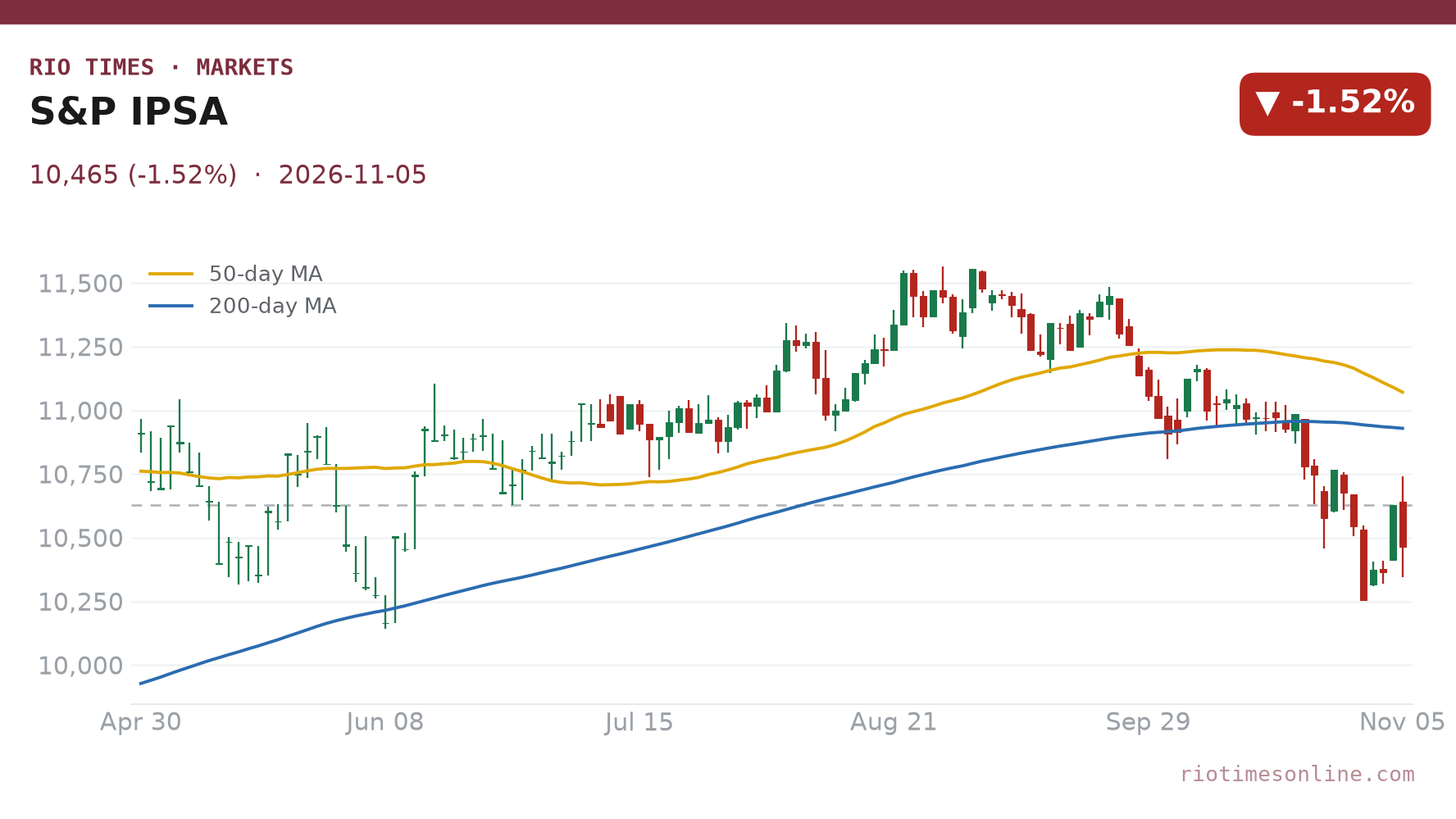
- Chile’s S&P IPSA fell 1.52% to 10,465, leaving the country’s main stock index 10.0% below its 12-month high of 11,628, set on 2026-01-28.
- The peso weakened as USD/CLP rose 1.23% to 978.36, meaning one dollar now buys more pesos, though still 1.7% below the 995.39 peak of 2026-10-23.
- Wall Street’s slump was the main cause: the S&P 500 fell 4.36%, the Nasdaq fell 5.52% and the VIX fear gauge jumped 69.66% to 28.18.
- LATAM Airlines, the region’s largest carrier, rose 5.8% on US$25m traded, the only heavily traded name to gain, while retailer Cencosud fell 4.3% and the banks all slipped.
- History is mildly kind to patient buyers: after 60 earlier falls of this size, the IPSA was higher 20 sessions later in 34 cases, or 57%, though the worst case was a fall of 24.6%.
- Prediction markets: Polymarket, where users bet real money, puts 57.5% on no change at Chile’s central bank in December and 40.5% on a 25-basis-point rise (US$21,867 traded, 7:59 p.m. ET, 5 November).
Today’s Focus
Chile’s main stock index, the S&P IPSA, fell 1.52% to 10,465, and the peso lost ground as USD/CLP — the number of pesos one US dollar buys — rose 1.23% to 978.36.
The shock came from New York, not Santiago: the S&P 500 fell 4.36%, the Nasdaq fell 5.52%, and the VIX, Wall Street’s fear gauge, jumped 69.66% to 28.18.
Chile held up better than the US over the past five sessions, but the IPSA is still 10.0% below its 12-month high and down 4.86% over 20 sessions.
LATAM Airlines was the one big winner, up 5.8%, while supermarket and retail group Cencosud fell 4.3%.
What matters today. Chile was pulled down by a global flight from risk rather than bad news at home, so the next move depends on whether Wall Street’s fear fades.
01 The session in one read
Think of the IPSA as a ship on a swell: Wall Street raised the wave, and Santiago rode down it. The index closed at 10,465, down 1.52%, while the peso slid to 978.36 per dollar, a 1.23% rise for the dollar.
Few heavyweights escaped. LATAM Airlines rose 5.8% on US$25m traded, but Chile’s big banks, lithium miner SQM and retailer Falabella all ended lower.
For a newcomer, the peso’s slide has two faces. Imports and foreign holidays cost Chileans more, while exporters earn more pesos for every dollar they sell abroad.
The evidence points to a shared shock: the S&P 500 fell 4.36%, the VIX leapt 69.66%, the Brazilian real and Mexican peso weakened alongside the Chilean peso, and US 10-year yields fell 4 basis points as money sought safe bonds. The one oddity is a flat dollar index at 101.565, which says the pressure fell on emerging-market currencies rather than on a broad dollar rally — and the variable to watch is whether the VIX settles back from 28.18.
02 The day’s numbers
| Measure | Level | Change | Read |
|---|---|---|---|
| S&P IPSA | 10,465 | −1.52% | Chile’s benchmark index of its largest listed companies; one hard down day |
| Session range | — | — | Intraday high and low not in our scan |
| USD/CLP (pesos per dollar) | 978.36 | +1.23% | A rising number means a weaker peso |
| IPSA 52-week range | 9,323–11,628 | −10.0% | Change shown against the 12-month high; 12.3% above the low |
| USD/CLP 52-week range | 851.67–995.39 | −1.7% | Change shown against the October high; 14.9% above the February low |
| Key IPSA level | 10,000 | — | Round-number support, 4.4% below the close |
The picture is of a market sitting in the lower half of its yearly range. The IPSA is 12.3% above its 12-month low of 9,323 but 10.0% below its high of 11,628, and it has lost 4.86% over 20 sessions.
The peso tells a different story. The dollar is 1.7% below its 995.39 peak of 2026-10-23, so the peso is weak but has not retested its worst level. Rio Times · Live Market Intelligence
Live Market IntelligenceChile — Live Market Board
Chile — Live Market Board
Instrument Last Change YoY Prev. High Low Volume
IPSA
10,465.26
-1.52%
—
10,627.08
10,741
10,346
—
USD/CLP
977.69
+1.16%
+3.63%
966.50
977.69
977.69
—
COPPER
6.26
-2.17%
+26.21%
6.40
6.28
6.20
6,385
SQM-B
55,320
-0.82%
+23.73%
55,775
58,024
54,619
239,232
COPEC
6,340
-2.76%
-6.42%
6,520
6,583
6,303
648,578
BSANTANDER
79.10
-1.43%
+16.63%
80.25
80.62
78.06
96,487,675
FALABELLA
6,499
-0.93%
+9.32%
6,560
6,700
6,334
1,217,457
ENELAM
81.50
-1.74%
-7.93%
82.94
83.73
81.50
30,990,208
CENCOSUD
1,620
-4.32%
-44.56%
1,693
1,708
1,611
2,965,883
CMPC
905.00
+0.11%
-32.21%
904.00
919.96
904.00
2,478,692
BANCO CHILE
189.69
-1.19%
+12.24%
191.98
194.00
187.00
64,780,607
LATAM AIR
22.95
-1.76%
+8.82%
23.36
23.66
22.47
1,057,627,165
SOUTHERN COPPER
165.38
-6.48%
+26.40%
176.84
178.17
162.19
1,591,910
03 Why it moved — Wall Street’s fear reached Santiago
Cause one, with medium-to-high confidence, is a global flight from risk. The S&P 500 fell 4.36% and sits 5.9% below its 52-week high, the Nasdaq fell 5.52%, and the VIX leapt 69.66% to 28.18; US 10-year yields fell 4 basis points (a basis point is one-hundredth of a percentage point) to 4.846%, the classic sign of money running to safe bonds.
Cause two, with medium confidence, is that the Chilean peso behaved like a risk currency: USD/BRL rose 0.81% to 5.5032 and USD/MXN rose 0.73% to 18.7575, so the Brazilian real and Mexican peso weakened too, even though the dollar index was flat at 101.565.
Cause three, with lower confidence, is pressure on domestic-demand stocks. Cencosud and mall owner Parque Arauco each fell 4.3%, a pattern consistent with shoppers’ companies suffering when a weaker peso lifts import costs and markets turn jittery.
The oil check supports the one bright spot. Oil, tracked by the USO fund, is down 11.88% over five sessions even after rising 1.93% to 148.21 on the day, which eases fuel bills for LATAM Airlines; official data from the US Energy Information Administration (eia.gov/petroleum/supply/weekly) show commercial crude stocks at 409.8 million barrels, 0.9 million lower than the week before.
04 The day’s movers
| Driver | Level / Move | Change | Note |
|---|---|---|---|
| LATAM Airlines (LTM) | US$25m traded | +5.8% | Most traded name; the only big gainer |
| SQM-B (lithium) | US$14m traded | −0.8% | Lithium miner; modest fall next to Wall Street |
| Banco de Chile (CHILE) | US$13m traded | −1.2% | Largest bank by turnover today |
| BCI | US$10m traded | −1.1% | Bank; sold with the sector |
| Falabella | US$8m traded | −0.9% | Retailer with a banking arm |
| Banco Santander Chile | US$8m traded | −1.4% | Weakest of the big banks |
| Cencosud | — | −4.3% | Supermarket and retail group; a biggest domestic loser |
| Parque Arauco | — | −4.3% | Shopping-centre owner; a biggest domestic loser |
| Andina-B | — | +2.3% | Biggest domestic gainer; Coca-Cola bottler |
The telling detail is breadth. All the large banks fell by between 0.7% and 1.4% on solid turnover, which looks like broad selling rather than one bad headline.
Three of the biggest losers are investment-fund lines, including trackers of Bitcoin and the Nasdaq, with falls of up to 10.1%. They are listed in Santiago but mirror foreign markets, so they say little about Chilean companies.
For an ordinary investor or expat, the takeaway is that Chile’s drop was an echo, not a verdict. The dollar is still slightly cheaper than a week ago, so the day’s slide reversed only part of the peso’s earlier strength.
05 The regional scoreboard
| Index | Country | Change |
|---|---|---|
| S&P IPSA | Chile | −1.52% |
| Ibovespa | Brazil | −0.82% |
| S&P/BMV IPC | Mexico | +0.30% |
| Merval | Argentina | −4.1% |
| COLCAP | Colombia | −0.88% |
Mexico was the only major index to rise, while Argentina’s Merval, down 4.1%, fell harder than Chile. The live market board above carries the full closes.
The Latin America lens is mostly about currencies. The dollar rose 0.81% against the real and 0.73% against the Mexican peso, while the Colombian peso strengthened as USD/COP fell 0.71% to 3,227; Chile and Peru, two of the world’s leading copper producers, are the markets most exposed to a global growth scare.
06 The technical picture
On the IPSA, the nearest support is the round 10,000, then the 12-month low of 9,323 set on 2025-11-04. Resistance is the 12-month high of 11,628, a long climb of 11.1% from here.
For USD/CLP, resistance is the 995.39 peak of 2026-10-23, then the psychological 1,000 line. Support sits far away at the February low of 851.67.
Our own price history offers a calm sentence. The IPSA fell 4.9% in 20 sessions, and in the 60 earlier cases since 2007 with a move at least that large, it was higher 20 sessions later in 34 of them, or 57%, with a median gain of 1.6% — but the worst case was a fall of 24.6% and the best a gain of 14.5%.
History is not a forecast, and does this stop? It stops when Wall Street’s fear gauge calms; if the VIX stays near 28.18, a test of 10,000 is the honest risk.
What it means for you. If you hold Chilean shares or earn pesos, a weaker peso raises the cost of imports and foreign trips, while exporters gain. The next clues are the VIX and the US jobs report due Friday 6 November.
07 What to watch
- Wall Street fear gauge: Whether the VIX falls back from 28.18 and US payrolls on 6 November (forecast 65, previous 29) steady nerves.
- Chile inflation: Chile’s inflation data on 6 November, with forecasts of 0.6 (previous 0.4) and 4.2 (previous 4.1), will shape expectations for interest rates.
- IPSA support: A close below 10,000 would open the path to the 12-month low of 9,323.
- Peso ceiling: A move in USD/CLP above 995.39 would put the 1,000 line in play.
Background: Chile Stocks Jump 2.52% as Oil Slumps.
Background: Chile Stocks Slip 0.09% as Copper Retreats.
What Prediction Markets Say
Polymarket, a prediction market where users bet real money, shows a 57.5% chance that Chile’s central bank leaves its interest rate unchanged in December and a 40.5% chance of a 25-basis-point rise, with US$21,867 traded. Prices were read at 7:59 p.m. ET on 5 November 2026.
These are bets, not forecasts.
Why we show this: prediction markets turn real-money bets into a live probability that moves within minutes of the news, which is why investors, campaigns and newsrooms in the United States now follow them closely. We show them next to polls and official results, never instead of them.
Frequently Asked Questions
What happened to Chile’s stock market?
The S&P IPSA, Chile’s main stock index, fell 1.52% to 10,465, pulled down by a sharp sell-off on Wall Street.
Why did the Chilean peso weaken?
USD/CLP rose 1.23% to 978.36 as investors sold risk-sensitive currencies, with the Brazilian real and Mexican peso also weaker.
What is the IPSA?
It is the S&P IPSA, the benchmark index of Chile’s largest listed companies, such as SQM, Falabella and the big banks.
Does history suggest a rebound?
In 60 earlier falls of this size since 2007, the index was higher 20 sessions later 57% of the time, but that is not a forecast.
Market data: The Rio Times; exchange figures from Bolsa de Santiago
This article was produced by The Rio Times’ automated newsroom system. How we use AI · Report an error · Editorial responsibility: Matthias Camenzind, Editor-in-Chief
LatAm Markets: Live Signals → — real-time movers, turnover leaders and FX across Latin America.
Get The Rio Times delivered to your inbox — market intelligence, daily briefs, and breaking analysis across Latin America.
Start for US$1