Mexico’s CJNG Cartel Tried to Set Up a Meth Lab in Chile, Antofagasta Prosecutor Says
SECURITY · CHILE
Key Facts
- —The country Chile, whose northern ports in the Antofagasta region ship copper and other cargo to Asia. Prosecutors say that fast Pacific route also draws drug traffickers.
- —What happened On 30 September 2026, Antofagasta regional prosecutor Juan Castro Bekios said investigators detected an “active presence” of Mexico’s CJNG cartel, tied to a meth lab plot in 2024 and 2025.
- —The numbers Police seized 844 kg of methamphetamine at a farm in Lolol on 9 January 2025. Prosecutors seek 35 years in prison for each of two Mexican defendants (Fiscalía, February 2026).
- —What it means for you The plot was stopped before the lab ran at scale. The case points to tighter checks on cargo leaving Chilean ports for Asia.
- —Still open The trial date (Radio Pauta reported early November), the verdict, and whether the cartel has any other operation in Chile.
A senior Chilean prosecutor has confirmed that Mexico’s CJNG cartel, the Jalisco New Generation Cartel, had an active presence in Chile. Juan Castro Bekios, regional prosecutor of Antofagasta, said so on Radio Pauta on Wednesday 30 September.
He was not describing a new cell. He was referring to a 2024–25 plot to build a methamphetamine lab, which police broke up. Its trial is now close.

What the prosecutor said
“We did detect the active presence of the Jalisco New Generation Cartel,” Castro Bekios said. That is according to the prosecution service and Radio Pauta. The group first planned the lab for the industrial zone of Antofagasta, then moved it to Lolol for logistical reasons.
Lolol is a rural district in the O’Higgins region, south of Santiago. The goal, he said, was to crystallise methamphetamine for more lucrative international markets.
How the Lolol case unfolded
In September 2024, a pallet of 36 paint buckets left the Mexican port of Manzanillo for Chile. The drug was dissolved inside, waiting to be extracted, according to a February 2026 statement from the Fiscalía, the public prosecution service.
On 9 January 2025, officers of OS7, the anti-narcotics unit of the Carabineros police, raided the farm. They arrested two Mexican citizens mid-extraction and seized 844 kilograms of methamphetamine.
Prosecutors charged both men with drug trafficking, illegal drug production, possession of chemical precursors and criminal association. They are seeking a total of 35 years in prison for each.
Seizures at record levels
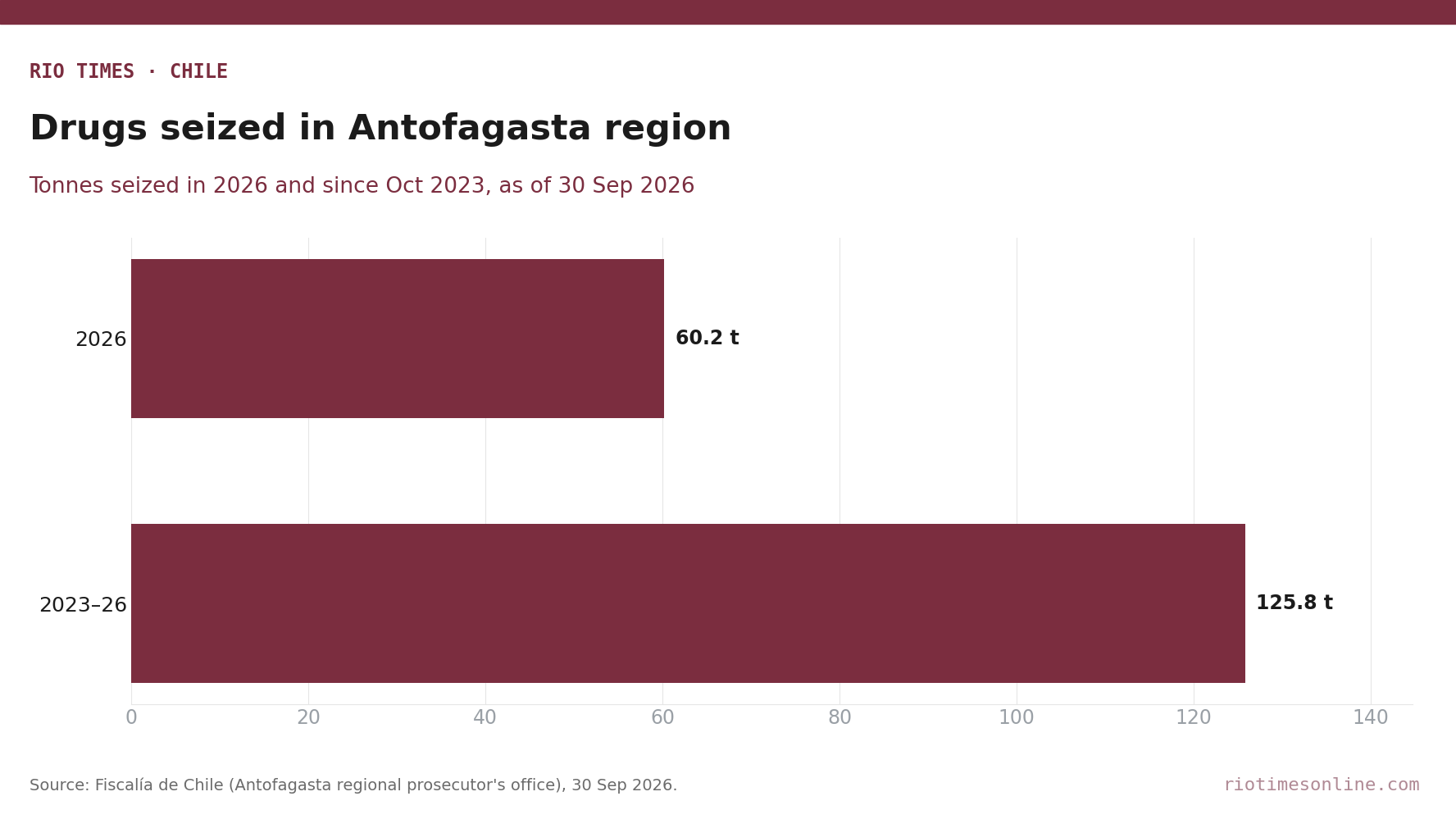
Castro Bekios said the Antofagasta region had seized 60.2 tonnes of drugs so far in 2026. Since October 2023, when his term began, the total is 125.8 tonnes.
He credited special teams that act at once when a drug shipment is spotted. Radio Pauta reported that marijuana makes up more than 80% of regional seizures, while ketamine seizures have risen sharply.
Ports and the Bioceanic Corridor
The prosecutor said shipments leaving Chile had been found carrying drugs at transit or destination ports. “We have to inspect better and know what to inspect,” he said.
He was cautious on Brazil’s PCC, the First Capital Command gang, saying he had no evidence it operates in Chile. He warned it could be drawn by the Bioceanic Corridor road linking Brazil to Chile’s ports.
At a meeting of northern prosecutors in La Serena, he urged one shared strategy for the northern macrozone. He proposed joint teams with neighbouring countries and a port profiling centre.
What Is Not Yet Known
The exact trial date has not been published by the courts. Radio Pauta reported that the oral trial is set for the first days of November.
Prosecutors have not said whether the CJNG cartel has other operations in Chile beyond the Lolol plot. The cartel’s own leadership has also changed, with Mexico confirming a new CJNG leader in September.
Sources: Fiscalía de Chile, 30 Sep 2026; Fiscalía de Chile, Macrozona Norte, 30 Sep 2026; Fiscalía de Chile, 24 Feb 2026; Radio Pauta, 30 Sep 2026.
Read More from The Rio Times