Colombia’s Cartagena Cable Car Secures US$84 Million
Colombia · Infrastructure
Cartagena is getting its first cable car. The US$84 million Kalamari line has cleared its biggest hurdle — financial close — and will string gondolas from the cruise port over the city to the historic center, carrying an estimated one million riders a year.
Key Facts
— The project. Kalamari is Cartagena’s first aerial cable car, a US$84 million tourism-and-mobility line.
— Capacity. It is designed to move about one million users a year.
— Milestone. The mayor confirmed the project reached financial close in July 2026.
— Timeline. Pre-construction was slated for mid-2026, with operations expected in December 2027.
The project
The city of Cartagena has confirmed the financial close of Kalamari, a US$84 million aerial cable car billed as both a tourist attraction and a mobility fix. Reaching financial close—locking in the funding to build—is the step that turns a rendering into a real project, and Mayor Dumek Turbay’s administration says the money is now secured. With the funding puzzle solved, construction can begin in earnest, moving the initiative from concept to concrete. The mayor’s team emphasized that the agreement guarantees full access to the capital needed, eliminating the last financial uncertainty that had shadowed the proposal.
The line is designed for roughly one million passengers a year, easing pressure on Cartagena’s notoriously clogged streets while offering visitors a bird’s-eye view of the Caribbean city. It is meant to run on renewable energy, with solar panels integrated into the system to shrink its carbon footprint and trim long-term operating expenses. This clean-energy commitment dovetails with the city’s broader ambition to modernize public infrastructure without exacerbating local air pollution. By banking on the sun as a power source, the cable car sidesteps fossil-fuel dependency and aligns with global sustainability benchmarks.
The route
Kalamari will connect Cartagena’s cruise-ship terminal with the Nuevo Chambacu sports complex and the walled Historic Center, with intermediate stations near the sprawling Bazurto market and at the foot of La Popa hill. That corridor stitches together the tourist waterfront, a chaotic market district and the UNESCO-listed old city—giving visitors a new vantage over Cartagena while offering residents an alternative to congested streets. Passengers boarding at the cruise port will be whisked above the bumper-to-bumper traffic that often clogs the access roads to the Old City, shaving travel time down to a handful of minutes. At the Historic Center station, they’ll step off into the very core of the colonial district, bypassing the usual search for taxis or the crush of tour buses.
The Bazurto market stop will crack open access to one of the city’s busiest commercial hubs, where thousands of vendors and shoppers converge every morning in a tight warren of stalls. From there, the gondolas will glide toward La Popa, whose hilltop convent and panoramic lookout have long been a pilgrimage site for tourists willing to brave a winding, car-clogged ascent. The new station will cut that journey to a smooth aerial glide, making the landmark truly accessible for the first time to travelers who might have shied away from the road trip. Finally, the Nuevo Chambacu sports complex terminus links the line to a major recreational venue, broadening its usefulness far beyond mere sightseeing.
Who is behind it
The consortium brings together France’s MND, one of the world’s largest manufacturers of cable-transport systems; Almabro as the project’s structurer; and Cal y Mayor, a Mexican firm, as operator. That mix of European hardware and Latin American operating experience mirrors how several of the region’s cable systems have been built. MND arrives with decades of engineering pedigree from alpine ski resorts and urban networks across Europe and Asia, adapting its detachable-gondola technology to tropical latitudes. Their cabins are engineered to slow at platforms, a design detail that makes boarding easier for passengers with luggage, strollers, or limited mobility.
Almabro, the structurer, pieced together the financial architecture that steered the project past the financial-close milestone, coordinating the streams of capital that made the US$84 million price tag viable. Its role was the behind-the-scenes blueprint of guarantees, loans, and equity that transforms a public vision into a bankable venture. Mexican operator Cal y Mayor then steps in with front-line management experience from similar mass-transit systems in the region, overseeing day-to-day operations and maintenance schedules. This regional expertise ensures that the line—once built—runs to safety standards attuned to local conditions and passenger expectations.
Following Medellín and La Paz
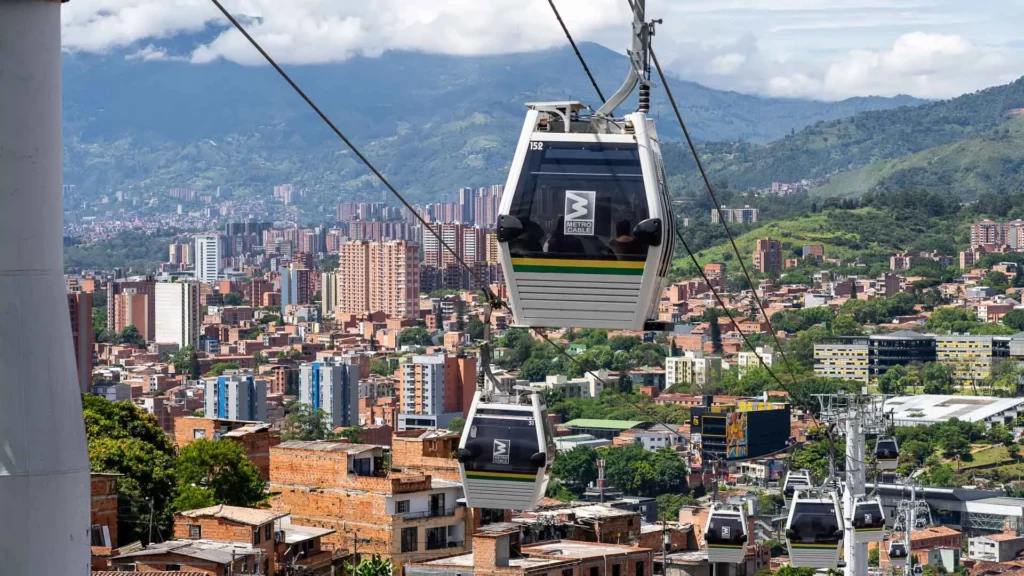
Cartagena is joining a Latin American trend it did not start. Medellín turned aerial cable cars into public transit two decades ago with its Metrocable, connecting hillside neighborhoods to the metro, and La Paz, Bolivia, went on to build the world’s largest urban cable-car network. Medellín’s pioneering lines proved that gondolas could slash commute times in steep, informal settlements while knitting isolated barrios into the economic fabric of the city. Those Metrocable corridors became lifelines, dropping travel times from over an hour to just minutes and sparking social investment in once-marginalized communities.
La Paz’s Mi Teleférico network multiplied that model across high-altitude canyons, growing into a sprawling web of interlinked lines that carries millions of passengers daily. Cartagena’s flat, Caribbean geography differs sharply from both predecessors, yet the core principle endures: an elevated cable escapes ground-level gridlock and links critical nodes that streets cannot smoothly connect. For a city whose narrow colonial lanes and single-carriage arteries often seize up under the weight of buses, taxis, and delivery trucks, the Kalamari line lifts the solution into the air. It bets that a scenic, ten-minute glide can pull thousands of daily car trips off the road, melting tension from the historic core without digging a single tunnel or widening a single street.
More: Colombia news in English, every day from The Rio Times.
Frequently Asked Questions
What is the Kalamari cable car?
Cartagena’s first aerial cable car, a US$84 million tourism-and-mobility line carrying about one million users a year.
When will it open?
Pre-construction was set for mid-2026 and operations for December 2027; financial close was confirmed in July 2026.
Who is building it?
France’s MND, structurer Almabro and Mexican operator Cal y Mayor.
Connected Coverage
JBS’s Pilgrim’s Pride Sees Profit Slump on Chicken Glut
Profarma Q2 Revenue Jumps 32% to US$703 Million
Sources: Mayor Dumek Turbay's administration.
This article was produced by The Rio Times’ automated newsroom system. How we use AI · Report an error
In depth
Read More from The Rio Times