Bolivia: anti-government protests leave several injured
The Bolivian cities of La Paz and Santa Cruz experienced heavy street clashes on Monday during anti-government protests that left several injured, according to the police.
In Santa Cruz, in eastern Bolivia, opposing sides collided in avenues when they tried to unblock roads that had been taken by protesters.
Read also: Check out our coverage on Bolivia
Meanwhile, in a neighborhood of La Paz, hundreds of anti-government coca growers clashed with the police to demand the closure of a parallel market run by a supposedly pro-government union. A farmer was severely injured by the explosion of a dynamite charge that he tried to throw at the police.
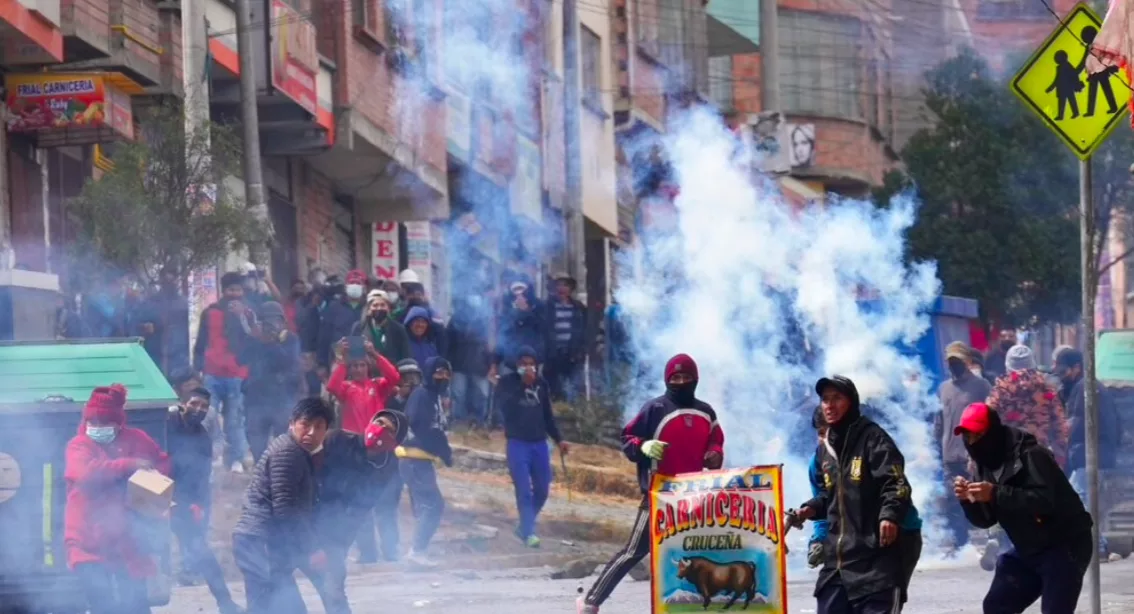
Santa Cruz, the most prosperous province and stronghold of Bolivia’s political opposition, began a strike on Monday against the decision of the government of President Luis Arce to postpone for two years a census that would give that region more state funds and seats in the Legislative.
The city was almost paralyzed and with little transportation due to street blockades while the police and government supporters – led by the Minister of Public Works, Edgar Montaño – removed debris and tires to restore traffic. Classes in the schools of that city of 1.7 million inhabitants were suspended and work activity was reduced, according to images from television stations and local media.
Arce and some of his ministers pointed out that the two-day strike has “political motives” and accused Governor Luis Fernando Camacho, one of the opposition leaders, of encouraging anti-government protests.
On his Twitter account, Camacho called on Monday for the city’s inhabitants to go out “to the streets to show that Santa Cruz is fighting for a timely, fair and transparent census.”
Camacho led the 2019 protests that forced the resignation of then-president Evo Morales after the presidential elections that the Organization of American States (OAS) described as fraudulent, which triggered a social outbreak that left 37 dead. Morales was seeking a fourth consecutive term.
Santa Cruz, the largest province and the country’s agro-industrial engine, is the region with the highest population growth due to internal migration. State resources and legislative representation are distributed according to population. The census was to take place in November this year, but was postponed until 2024.
The coca conflict in La Paz has nothing to do with the protests in Santa Cruz, but it is also activated by anti-government groups and has been going on for several months.
The country is experiencing open polarization after the 2019 political crisis that was accentuated by the trials and sentences of opposition leaders, including former interim president Jeanine Áñez (2019-2020), who was sentenced to 10 years in prison. Opponents accuse the government of manipulating justice to unleash political persecution.
More: Bolivia news in English, every day from The Rio Times.
Editorial responsibility: Matthias Camenzind, Editor-in-Chief · Editorial standards · Report an error