After more than 20 years, Peruvian justice looks at victims of forced sterilizations
By Sebastián Ochoa
The Peruvian justice system is progressing in the case of forced sterilizations carried out by the government of Alberto Fujimori in the 1990s.
Thousands of indigenous and peasant women underwent surgery to eradicate poverty.
During Alberto Fujimori’s government (1990-2000), around 300,000 indigenous and peasant women were sterilized as part of the National Reproductive Health and Family Planning Program.
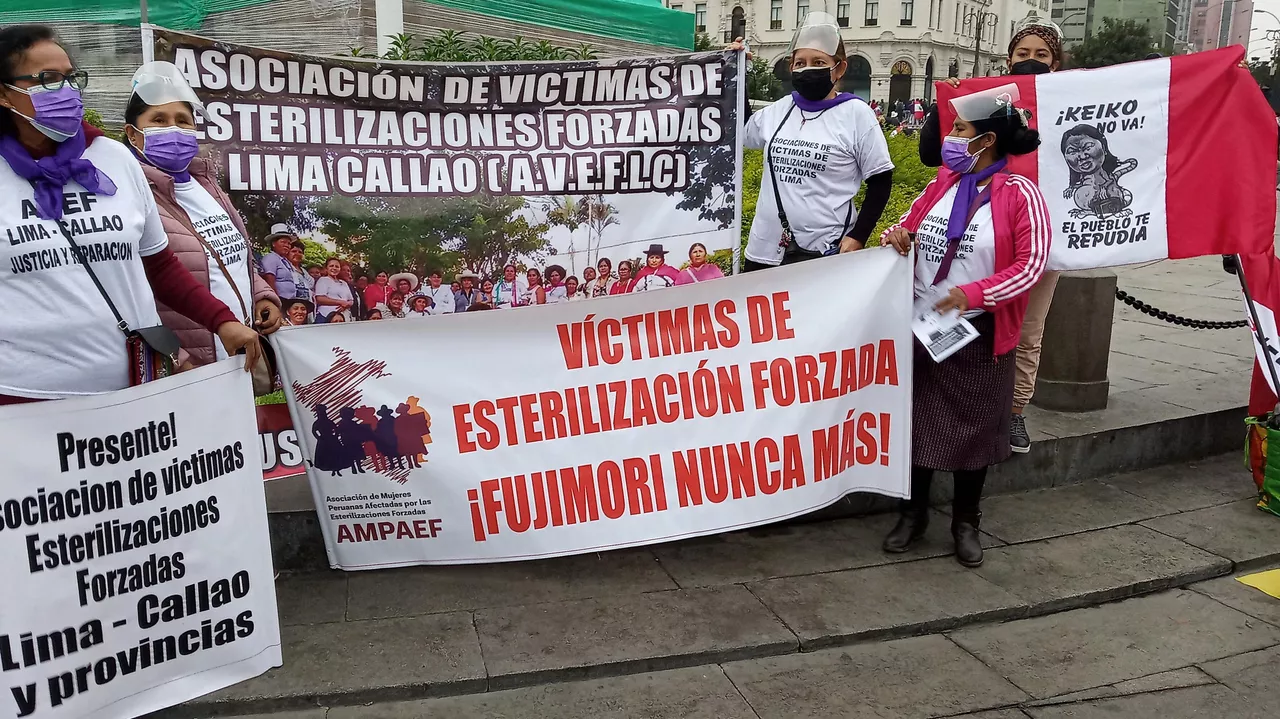
An undetermined number of women were forcibly subjected to tubal ligation operations, according to reports made more than 20 years ago.
Finally, the Peruvian justice system seems determined to compensate the thousands of victims.
But the matter is very complex.
When his mandate – considered by a large part of the population as a dictatorship – ended, Fujimori fled to Japan, where he also had citizenship.
In 2005 he appeared in Chile, where he was captured and extradited to Peru.
To make the extradition process viable, Peru sent the documents of seven trials opened against the former president to the neighboring country.
Five for corruption and two for human rights violations.
Fujimori, 84, testified days ago before the Chilean justice for the case of forced sterilizations.
None of the seven documents sent to Chile dealt with this issue, which is why the permission of the Supreme Court of the neighboring country is necessary to move forward with the case in Peru.
Lawyer Ana María Vidal told Sputnik that “this first judicial process includes more than 1,000 victims, but many more are not included.”
“There is still a long way to go before justice is done, but the first steps have been taken.”
“There is the persistence of the women who continue even though they have everything against them”.
She commented that all the plaintiffs are registered in the Registry of Victims of Forced Sterilization (REVIESFO), but “not all of them have legal assistance, as established by Supreme Decree.”
“Less than half have legal assistance,” said the lawyer representing the association of victims of forced sterilizations in Cusco (south).
Between 1996 and 2000, more than 270,000 women were intervened in the National Reproductive Health and Family Planning Program, which “sought to end poverty by ending the poor, going through women’s bodies so that they would not reproduce,” explained Vidal.
“That was the logic of the program that did not even respect informed consent, something basic for any surgical intervention,” she asserted.
The lawyer recounted that according to testimonies, “many times they were kidnapped, sterilized while pregnant. They were threatened with being put in jail to be deprived of social benefits; they were even captured and tied to stretchers to be sterilized.”
Several of these victims died due to complications during the operations, often carried out without the aseptic conditions.
Human rights organizations count at least 40 deaths of women.
The tubal ligation operation “would have nothing wrong with it if they had chosen it as a method of family planning,” warned Vidal.
And she mentioned several reports from Peruvian state institutions, according to which “women’s sexual and reproductive rights were violated, and some women died because the sanitary conditions in which the operations were performed were often terrible”.
According to the lawyer, many women did not report the forced sterilization because they do not speak Spanish, only Quechua or Aymara, which distances them from Peruvian institutions where there are generally no officials trained in these languages.
LACK OF GOVERNMENT ATTENTION
Fujimori and his former health ministers Eduardo Yong Motta, Marino Costa Bauer, and Alejandro Aguinaga, currently a congressman, are prosecuted for forced sterilizations.
For Vidal, this case “shows that there was a logic according to which doctors decided on women’s reproductive system.”
“It was a policy created from the presidency, but that could be carried out due to a macho, patriarchal, classist mentality of a whole health system.”
“This case shows a systematic and generalized policy against the poorest women, the illiterate, and those who speak a language other than Spanish.”
“They thought that women were never going to claim their rights, but […] they organized themselves and began to seek justice,” said the lawyer.
Vidal noted the lack of state attention to victims.
She mentioned that during the internal armed conflict of the 1990s, a Truth Commission was formed, and a public policy of reparations was applied “just like in Chile or Colombia, where without having to go through judicial processes there is recognition of the damage done by the State.”
But in the case of forced sterilizations, “the State continues to deny this right because cutting off the reproductive apparatus of women does not generate a generalized violation of human rights,” she said.
With information from Sputnik
News Peru, English news Peru, Peruvian society
More: Peru news in English, every day from The Rio Times.
Read More from The Rio Times