Venezuela Censorship Eases as 74 Websites Are Unblocked but 145 Remain Blocked

PRESS FREEDOM · VENEZUELA
Key Facts
- —The country Venezuela, now under acting president Delcy Rodríguez, has blocked news and rights websites for years. The regulator Conatel orders the blocks and internet providers apply them.
- —What happened 74 domains have been unblocked on at least one provider since 16 September, the monitor VE Sin Filtro said in its fifth report on 29 September.
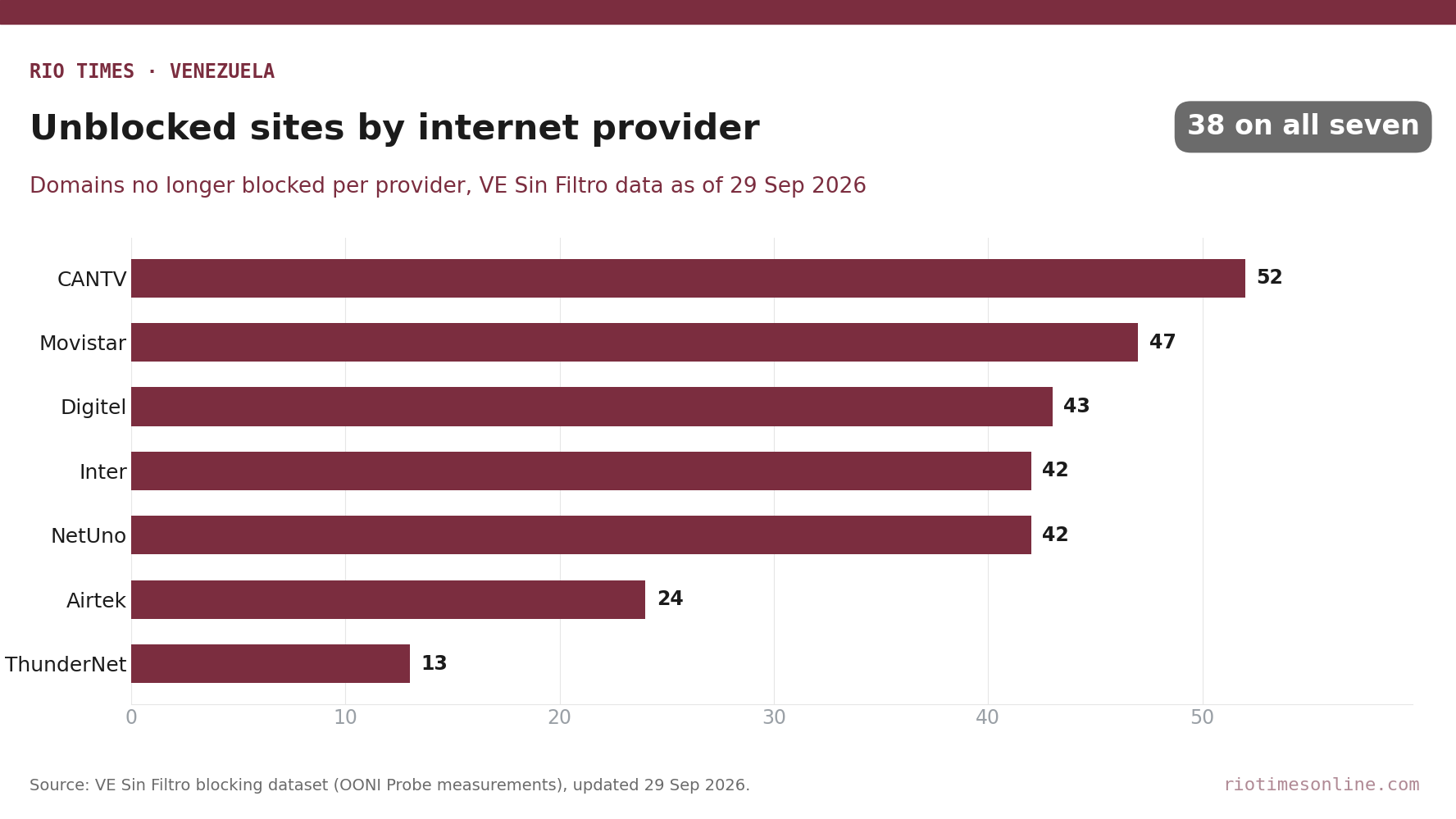
- —The numbers Only 38 domains load on all seven providers tested. 145 sites remain blocked, against more than 188 blocked domains documented before the change (VE Sin Filtro, 29 September).
- —What it means for you Efecto Cocuyo, El Pitazo and Crónica Uno open again on most networks. Infobae, NTN24, La Patilla and Armando.info stay blocked on five of the seven providers tested (data as of 29 September).
- —Still open Conatel has not published the list of domains it ordered unblocked. No rule yet stops new blocks from being imposed by administrative decision.
Venezuela censorship of the internet has eased, but only in part. VE Sin Filtro, a group that tests website access across providers, counts 74 domains unblocked since mid-September.
Its fifth report, published on 29 September and reported by Efecto Cocuyo on Sunday, found 145 sites still blocked. Only 38 domains now load freely on every network it measures.
How the unblocking began
The first move came on the night of 16 September. Vice-Foreign Minister Oliver Blanco published a recommendation from a government peace programme to lift restrictions on media domains.
Hours later Conatel, the National Telecommunications Commission, said it had sent a “technical notification” to operators. Access was to be restored from 17 September, Efecto Cocuyo reported.
A second round followed on 25 September, when the executive ordered measures lifted on 55 more domains. That evening VE Sin Filtro counted 47 domains unblocked on at least one provider.
The monitor said the step formed part of commitments from the second round of the national dialogue. Those talks are covered in Venezuela Opens Transition Talks With Its Leader’s Legal Basis Unclear.
CANTV opens some outlets and keeps others shut
CANTV, the state-owned operator and the main internet provider, restored Efecto Cocuyo, El Pitazo, Crónica Uno and Tal Cual. It kept domain-name and packet-inspection blocks on investigative and foreign outlets, the report said.
Armando.info, El Nacional, Infobae, NTN24 and La Patilla remain blocked on CANTV. The 29 September dataset shows most of them also blocked on Movistar, Digitel, Inter and NetUno.
That includes the outlet whose editor a court has just cleared, as reported in Rory Branker Acquitted in Venezuela Terrorism Case. La Patilla itself is still filtered for most readers inside the country.
Private networks are uneven too
The opening has not been stable on private networks either. VE Sin Filtro recorded blocks returning on Movistar for Radio Fe y Alegría Noticias and The Wall Street Journal.
Its tests run through the OONI Probe tool on seven providers: CANTV, Movistar, Digitel, Inter, NetUno, Airtek and ThunderNet. The smaller networks, Airtek and ThunderNet, show the fewest unblocked domains.
Venezuela censorship was always a state choice
Andrés Azpúrua, VE Sin Filtro’s director, told the rights group Espacio Público the move was “a small step” for freedom of information. He said it “falls very short” because the scale of the violation is immense.
Lifting a fraction of the blocks shows the government “always had in its hands” the end of Venezuela censorship online, he said. Espacio Público also recalled a 13 March protest at Conatel by more than 30 institutions.
Even so, the direction of Venezuela censorship policy is towards more access, not less. VE Sin Filtro called the official commitment positive on 25 September and said the changes it had seen were verifiable.
What Is Not Yet Known
Conatel has not published a full list of domains ordered unblocked, and VE Sin Filtro is asking it to. Without that list, official orders cannot be checked against the technical tests.
It is also unclear whether blocks could return by administrative decision. The monitor wants any future restriction to require approval by an independent judge.
The group’s public dataset was last updated on 29 September. Any changes since then have not yet been measured independently.
Sources: Efecto Cocuyo (4 October 2026); VE Sin Filtro statement (25 September 2026); VE Sin Filtro blocking dataset (updated 29 September 2026).
Editorial responsibility: Matthias Camenzind, Editor-in-Chief · Editorial standards · Report an error
Read More from The Rio Times