U.S. Bolsters Philippine Military with $500 Million Aid Amid South China Sea Tensions
On Tuesday, US Secretary of State Antony Blinken and Defense Secretary Lloyd Austin arrived in Manila. They announced a significant military aid package of $500 million for the Philippines.
This visit underscores the strategic importance of the Philippines to the US, particularly amid rising tensions with China over territorial disputes in the South China Sea.
Blinken and Austin met with Philippine Foreign Affairs Secretary Enrique Manalo and Defense Secretary Gilberto Teodoro at Camp Aguinaldo.
This meeting, part of their annual 2+2 Ministerial Dialogue, covered a range of security issues.
It culminated in the announcement of substantial military funding aimed at modernizing the Philippine military and coastguard.
“We’re now allocating an additional $500 million in foreign military financing to the Philippines,” Blinken said during a joint news conference.
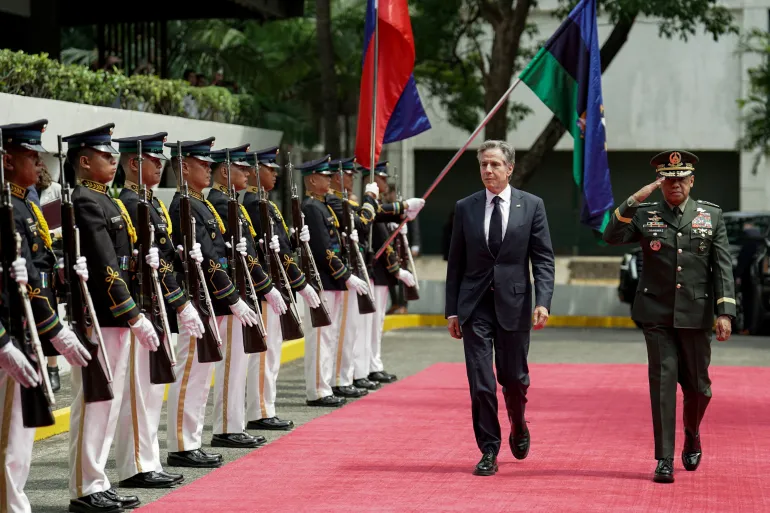
He emphasized the importance of boosting security collaboration with their oldest treaty ally in the region.
Austin highlighted the unprecedented nature of this funding. He underscored the strong support from the Biden-Harris administration, the US Congress, and the American people.
Of the $500 million, approximately $125 million will be directed towards constructing and improving Philippine military bases.
This will enable the stationing of US troops under the Enhanced Defense Cooperation Agreement.
Edmund Tayao, head of the Political Economic Elemental Researchers and Strategists think tank, stated that this visit demonstrates the US’s concrete commitment to Manila. He emphasized its importance as a security partner.
However, Tayao warned that this increased funding could escalate tensions with Beijing, leading to a heightened risk of violence in the South China Sea.
Tensions in the South China Sea
The South China Sea has been a hotspot for conflict. The latest skirmish occurred on June 17, involving the Philippine navy and the Chinese coastguard at the disputed Second Thomas Shoal.
This clash resulted in injuries to several Filipino sailors, marking a turning point in the ongoing territorial dispute.
The Philippines and the US have a longstanding Mutual Defense Treaty (MDT) from 1951. This treaty obligates mutual support in the event of external aggression.
Blinken reiterated this commitment, ensuring it extends to any armed attacks on the Philippine Armed Forces, public vessels, or aircraft, including the coastguard.
This commitment applies anywhere in the Pacific, including the South China Sea. Before the dialogue, Blinken and Austin met with President Ferdinand Marcos Jr. He has taken a more confrontational stance on the South China Sea disputes.
He has also strengthened security ties with the US since taking office two years ago. Blinken hailed this year’s ministerial dialogue as “historic,” emphasizing the comprehensive range of issues addressed and the deepening partnership between the two nations.
Matteo Piasentini, a security analyst from the Italian think tank Geopolitica, noted the broader significance of Blinken and Austin’s visit.
Beyond countering Beijing, the US aims to support the Philippines in bolstering its economy and energy security.
They also discussed an intelligence-sharing agreement at the highest levels. This visit is part of an 11-day tour across Asia, with stops in Japan, Singapore, and Vietnam.
These countries have also strengthened security ties with the Philippines. Analysts suggest the US is orchestrating these security arrangements to counter China’s influence, creating a coalition centered around the Philippines.
Despite some speculation about Washington’s commitment, many agree that US assistance remains crucial for Manila’s immediate defense needs.
This article was produced by The Rio Times’ automated newsroom system. How we use AI · Report an error
Read More from The Rio Times