(Analysis) Recent escalations have transformed the South China Sea into a critical flashpoint of geopolitical tension.
This essential maritime region, through which over 20% of global commerce flows, is not only abundant in oil, natural gas, and fish but also plays a pivotal role in international trade.
Yet, it is increasingly known for heightened tensions among several nations, notably China, the Philippines, Vietnam, Malaysia, and Brunei.
Central to these disputes are China‘s broad territorial claims, underscored by the construction of artificial islands and a significantly enhanced military presence.
These aggressive moves not only undermine the sovereign rights of adjacent countries but also pose serious challenges to established international maritime laws and norms.
Despite Beijing’s professed commitment to keeping these critical sea lanes open for its export-driven economy, its assertive expansion and infrastructure projects reveal a determined intent.
This intent is to assert dominance over this strategic waterway. The complexities of the situation are further deepened by U.S. involvement.
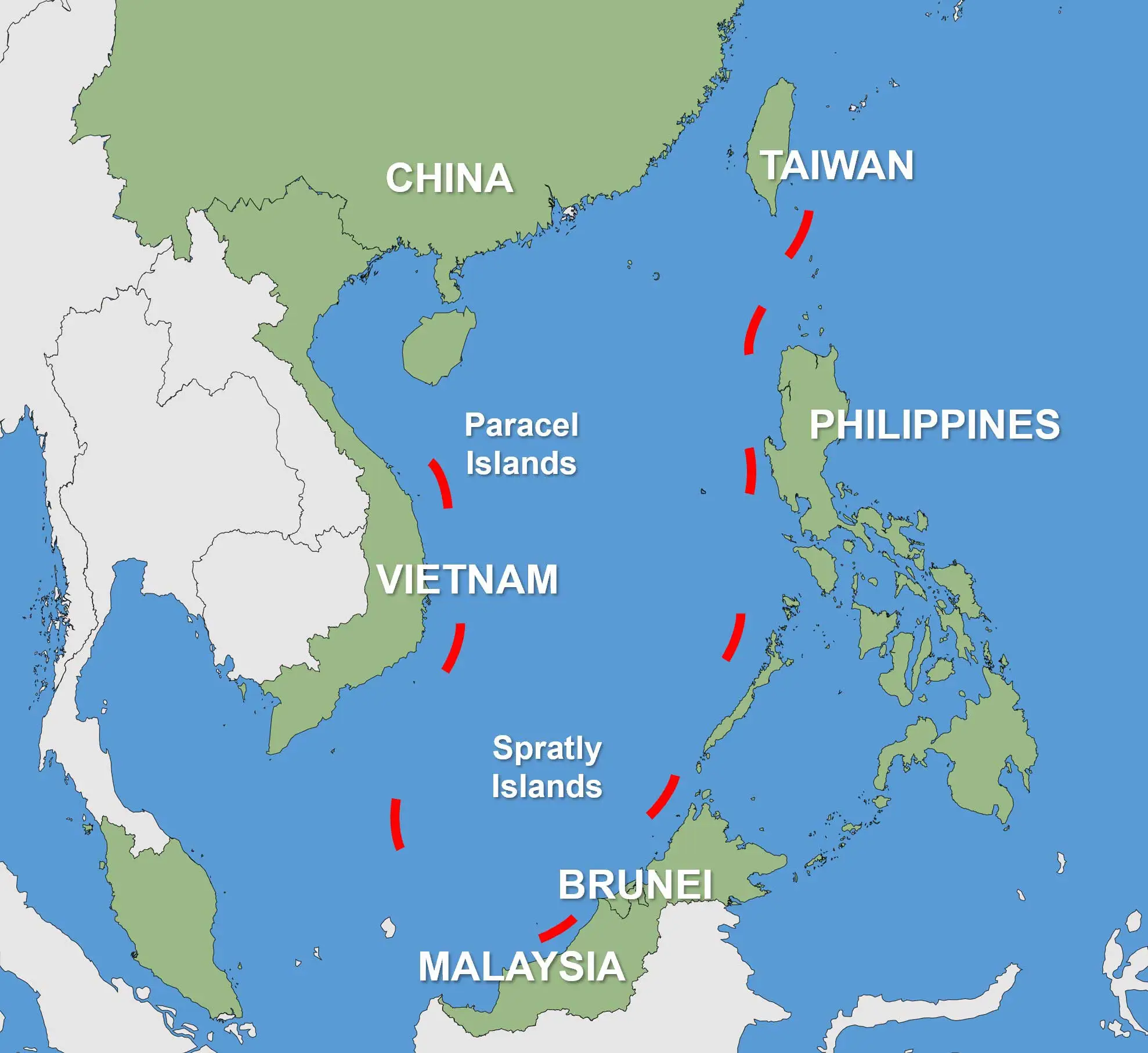
The U.S. champions freedom of navigation and adherence to a rules-based international order, standing in direct opposition to Beijing’s ambitions.
This superpower rivalry broadens the scope of the conflict from regional disputes to global geopolitical dynamics, affecting security and trade across the Asia-Pacific and beyond.
Internationally, the strategic and economic stakes of the South China Sea are widely acknowledged.
This area serves as a vital military and commercial gateway, enhancing China’s strategic military capabilities.
It is especially important as China seeks to project its naval power well beyond its traditional coastal confines.
Key Challenges and Economic Implications
China’s endeavors here are aligned with its broader objectives. These include the controversial issue of Taiwan’s reunification and establishing regional dominance.
Moreover, the South China Sea acts as a crucial channel for Beijing’s blue-water naval ambitions.
It enables deeper maritime engagement and supports China’s transformation into a major global naval force.
These maritime ambitions are part of China’s strategy to counter perceived encirclements by U.S.-led alliances.
This strategy includes controlling the ‘first island chain,’ which stretches from Japan through Taiwan to the Philippines.
These maritime ambitions are part of China’s strategy to counter perceived encirclements by U.S.-led alliances.
This strategy includes controlling the ‘first island chain,’ which stretches from Japan through Taiwan to the Philippines.
These ongoing disputes and military activities underline the delicate balance of power in the region.
They also raise crucial questions about the future of international maritime governance and regional stability.
Understanding the dynamics of the South China Sea is crucial for anyone concerned with global peace and stability.
This region reflects the complexities of modern geopolitical struggles and serves as a bellwether for the changing patterns of global power and influence.
In short, it is a critical area of focus for international observers and policymakers alike.
This article was produced by The Rio Times’ automated newsroom system. How we use AI · Report an error · Editorial responsibility: Matthias Camenzind, Editor-in-Chief