St Vincent Fuel Surcharge Up 45% Since March as Debate Grows Over a Flat Fee

ENERGY · ST VINCENT AND THE GRENADINES
Key Facts
- —The country St Vincent and the Grenadines, an eastern Caribbean island state. Its state-owned utility, VINLEC, generates most of its power from imported diesel.
- —What happened VINLEC’s fuel surcharge on September 2026 bills was 79.67 EC cents per kWh (about US$0.30), up 45% from 54.90 cents in March, its published notices show.
- —The numbers The surcharge peaked at 83.20 cents on July bills. The base rate is 50 cents a unit. Fuel burnt in August cost EC$12.3m (about US$4.6m), per VINLEC.
- —What it means for you On 250 units, the September surcharge alone adds about EC$199 (about US$74) to a household bill, before the base charge. EC$2.70 = US$1 (2 October).
- —Still open The October rate, based on September fuel costs, and whether May’s matching discounts still apply. VAT changes on domestic electricity are expected this month, an iWitness News column says.
The St Vincent fuel surcharge has become the largest line on many household power bills. On September bills it stood at 79.67 Eastern Caribbean cents per kilowatt hour (kWh), about US$0.30, the state utility’s notice shows.
That is 45% above March and well above the 50-cent (about US$0.19) base rate for the electricity itself. A column published by iWitness News on Saturday 3 October argues that replacing the surcharge with a flat fee would not help.
How the St Vincent fuel surcharge is calculated
VINLEC, St Vincent Electricity Services Limited, is state-owned and passes fuel costs to customers monthly. The rate is the fuel cost above a fixed base price, divided by the units sold.
For September bills, fuel burnt in August cost EC$12.29m (about US$4.55m), VINLEC’s notice shows. The base price covered only EC$421,235 (about US$156,000), leaving EC$11.86m (about US$4.39m) for the surcharge.
VINLEC says it makes no profit on the charge. Its notices show the rate rising from 54.90 cents in March to a peak of 83.20 cents in July.
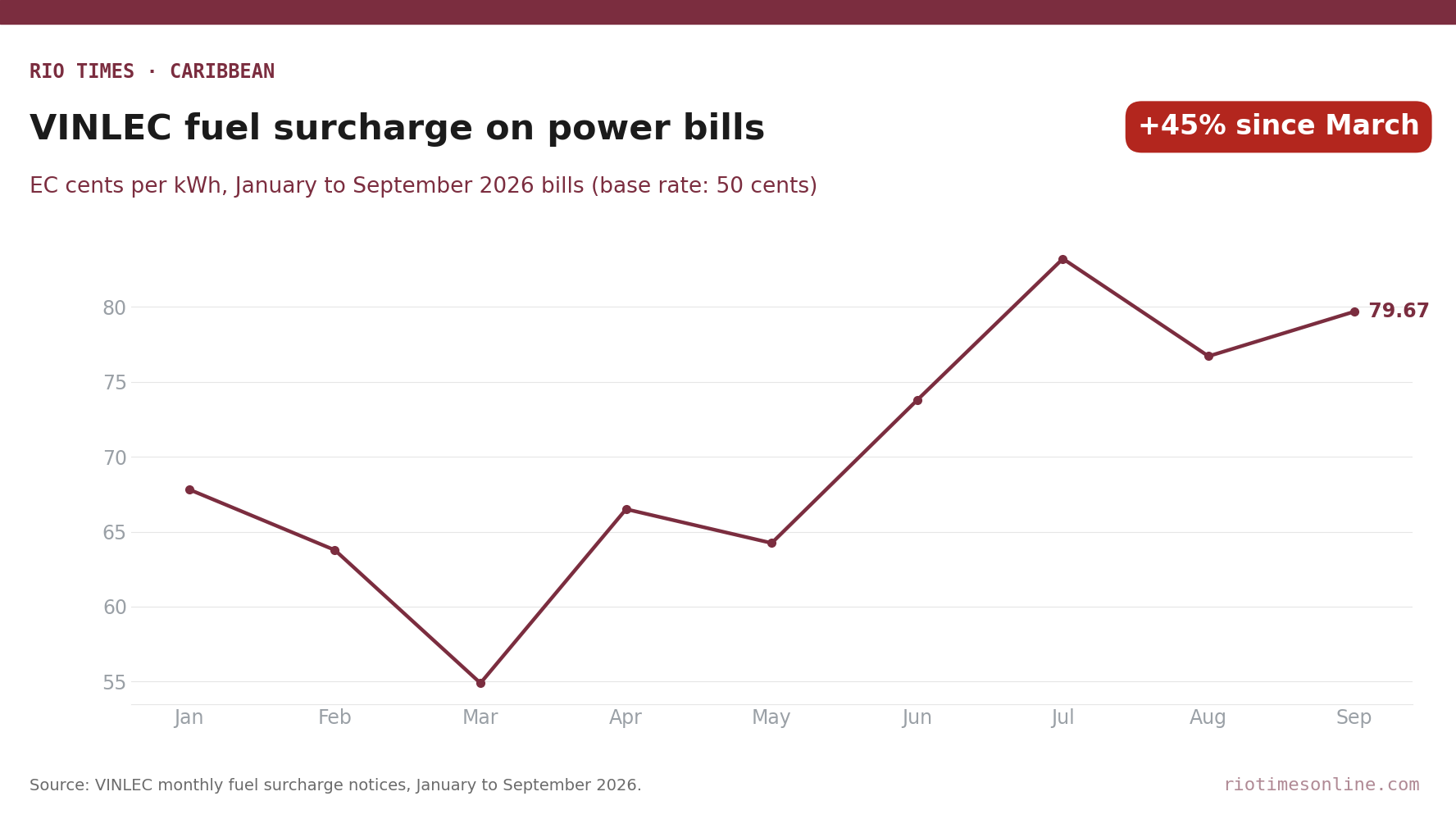
The July rate came after VINLEC applied a subsidy of EC$734,959 (about US$272,000), iWitness News reported on 23 July. The rate eased to 76.70 cents in August, then rose again to 79.67 cents.
Relief measures and their limits
On 27 May Prime Minister Godwin Friday waived customs and excise charges on diesel for power generation for three months. He put the revenue forgone at about EC$1.65m (about US$611,000).
He also told VINLEC to share the cost once the surcharge passed set thresholds, iWitness News reported. Above 71 cents the utility was to match 50%, and above 77 cents it was to match 100% for households.
On 4 August Friday told NBC Radio the surcharge was “too high” but lower than it would have been. Without the measures, he said, it would be over 90 cents.
Opposition leader Ralph Gonsalves said in July there was no cap, citing VINLEC’s chief executive, St Vincent Times reported. He called the government’s account “smoke and mirrors”.
The flat-fee debate
Calls to swap the St Vincent fuel surcharge for a standing charge recur on call-in radio and social media, the column says. It is written by Guevara Leacock under the title A View from the Outside.
A standing charge is a fixed fee per customer, whatever the usage. The column argues it would shift fuel costs from large users onto small households.
A fixed unit price set for a year would not lower costs either, it says. When diesel rose above that price, taxpayers would cover the gap through the state-owned utility.
The frustration is real. A St Vincent Times commentary on 27 September described an EC$318.68 surcharge against an EC$200 energy charge (about US$118 and US$74).
Solar, rivers and an old law
Only about one sixth of the country’s electricity comes from rivers and the sun, the column says. It points to a battery system at Cane Hall and an upgraded Lowman’s Bay solar farm due in November.
It also calls for updating the 1973 Electricity Supply Act to pay a fair price for rooftop solar power. VINLEC chief executive Vaughn Lewis has called for the law to be modernised, the column says.
Background on the economy is in Saint Vincent and the Grenadines Explained 2026. Oil supply decisions abroad, as in G7 Frees 100 Million Barrels as Mexico Needs US Diesel, feed into the price VINLEC pays.
What Is Not Yet Known
VINLEC has not yet published the rate for October bills, which reflects fuel burnt in September. The column expects higher world oil prices to show up on October and November bills.
It is unclear whether the 50% and 100% matching rules announced in May still apply, since rates topped 77 cents in July and September. The column’s figure of EC$100m (about US$37m) in fuel spending this year is not independently confirmed.
The column also expects VAT changes on domestic electricity this month. Their scope has not been set out.
Sources: VINLEC, monthly fuel surcharge rate notices, January to September 2026 bills; iWitness News, “The fuel surcharge: A real problem for Vincentians” (column by Guevara Leacock), 3 October 2026; iWitness News reports of 27 May, 23 July and 4 August 2026; St Vincent Times, 28 July and 27 September 2026.
Editorial responsibility: Matthias Camenzind, Editor-in-Chief · Editorial standards · Report an error