G7 Frees 100 Million Barrels as Mexico Needs US Diesel

ENERGY · MEXICO
Key Facts
- —The country Mexico is not a G7 member but buys much of its diesel from the United States. Published estimates range from about 35% of demand to over half of consumption (October 2026 reports).
- —What happened On 2 October 2026 G7 leaders agreed to release up to 100 million barrels of diesel and crude over four months, coordinated by the International Energy Agency (IEA).
- —Who is involved France, which chairs the G7 this year, announced the deal. US President Donald Trump, who had threatened a diesel export ban, said on 2 October he would not apply it.
- —What it means for you Mexican diesel stays free of the IEPS excise tax from 3 to 9 October. It averaged 27.006 pesos a litre (about US$1.48) on 2 October, El Economista reported.
- —Still open How the 100 million barrels split between diesel and crude, whether the no-ban promise covers non-G7 buyers such as Mexico, and how long the Hormuz disruption lasts.
The G7 strategic fuel release agreed on Friday, 2 October 2026, covers up to 100 million barrels of diesel and crude. The seven large industrial democracies will release it over four months, coordinated by the International Energy Agency (IEA).
For Mexico, which is not a G7 member, the deal matters because much of its diesel comes from the United States. Washington had threatened to ban diesel exports, and on Friday President Donald Trump said it would not.
What the G7 Agreed
French President Emmanuel Macron, whose country chairs the G7 this year, announced the G7 strategic fuel release after a leaders’ video call. Their joint statement said a substantial diesel release would be concentrated in the first 20 days, El Economista reported, citing Reuters.
Members also pledged not to restrict energy exports among themselves, La Jornada and Opera Mundi reported. They left the door open to further releases and promised work on lowering refinery margins and shipping costs.
The push came from Washington. Washington pressed Germany and France to tap diesel stocks, floating an export ban if they refused, La Jornada reported, citing Reuters.
On Friday Trump said Washington would not apply the export ban, according to El Economista and El Financiero. US diesel had climbed above US$6.50 a gallon in late September, La Jornada reported.
How Oil Prices Reacted
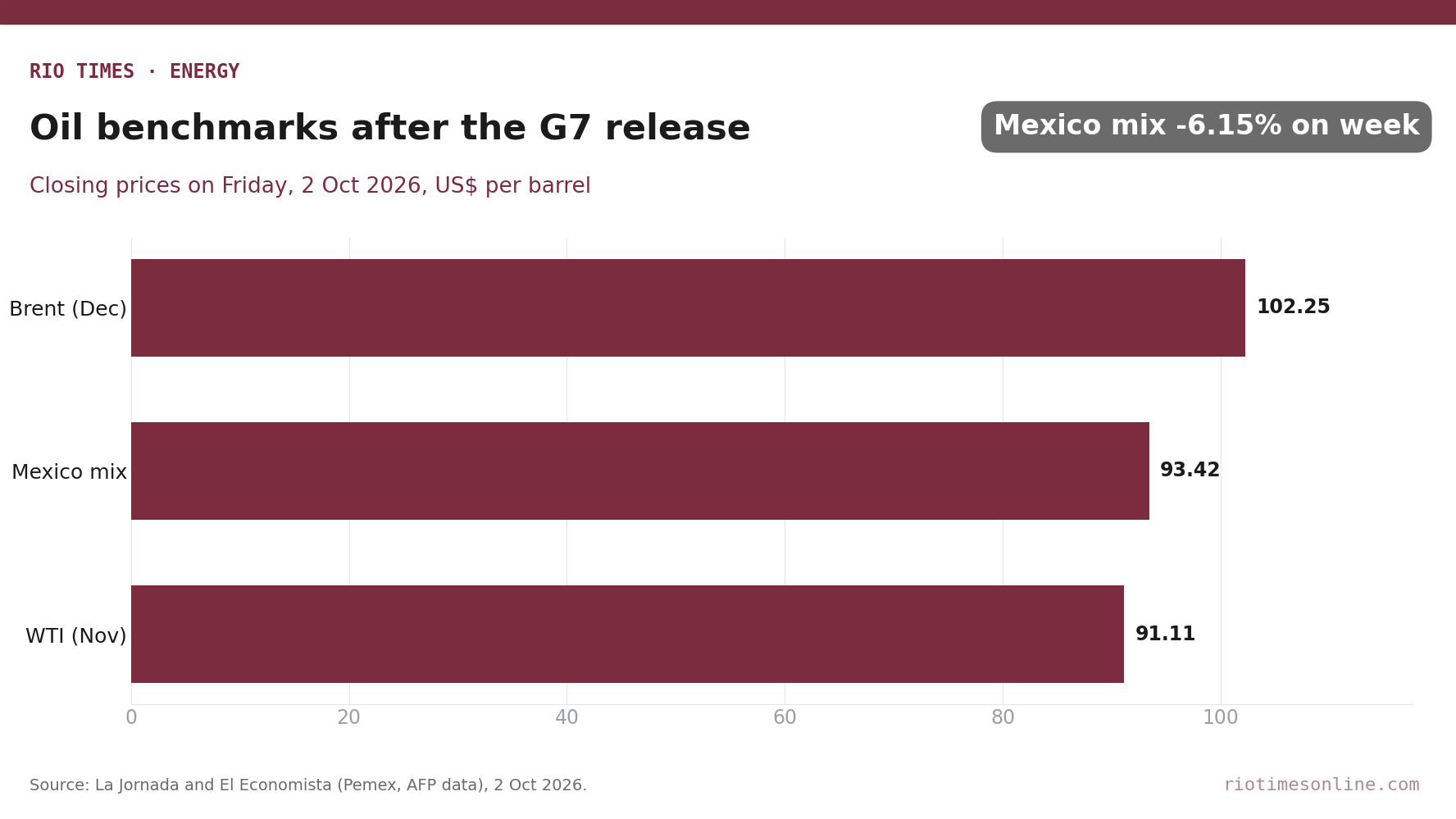
Markets had moved ahead of the announcement. On Friday, December Brent closed at US$102.25 a barrel, down 0.06%, while US benchmark WTI fell 1.9% to US$91.11.
Mexico’s export blend, priced by state oil company Pemex, ended at US$93.42, down 6.15% on the week, La Jornada reported. Worries over the Middle East war kept prices from falling further, El Economista said.
Friday’s market moves are covered in Petrobras ADR Gains 3.2% as G7 Taps Oil Reserves | Oil Report, Oct 2. Latin American oil shares rose that day even as WTI slipped.
Why Mexico Is Exposed
Goldman Sachs analysts called Latin America the region most exposed to any US diesel export ban, Forbes México reported, citing Reuters. US supply covers more than half of diesel consumption in Mexico, Chile, Peru and Ecuador, that analysis said.
Estimates differ: El Financiero put Mexico’s imports at about 35% of diesel demand. It quoted S&P Global Energy analyst Javier Verdugo saying diesel stocks cover only about 10 days of demand.
Goldman Sachs estimated that a sudden cut in US supply could lower Latin American output by about 1% of GDP. It also said supply would probably adjust quickly, because diesel trades on a global market.
Mexico’s Buffer at the Pump
The Finance Ministry (SHCP) kept diesel fully exempt from the IEPS excise tax for 3 to 9 October, El Economista reported. The exemption is worth 7.36 pesos a litre (about US$0.40, at 18.21 pesos per US dollar on 2 October).
Diesel averaged 27.006 pesos a litre (about US$1.48) nationally on 2 October, unchanged from 25 September. The government credits this support with containing inflation (Mexico Says Fuel Subsidies Hold Inflation Below 4%, 1 October).
The support has a fiscal cost. Customs agency ANAM said fuel tax breaks cost 6.95 billion pesos (about US$382 million) at customs in August alone.
What Is Not Yet Known
The G7 has not published how the 100 million barrels split between diesel and crude, or what each member contributes. The statement says it takes account of commitments already met under the IEA’s March 2026 release, so it is unclear how many barrels are new, Reuters reported. It is also unclear how much of the diesel will reach buyers in the Americas.
The scope of Washington’s no-ban promise is open too. El Financiero read it as covering G7 members, while Trump’s remarks reported by El Economista set no such limit.
Prices still hinge on the Strait of Hormuz, where blockades have raised shipping costs. Trump said oil would fall once the Iran conflict is resolved, but gave no date.
Sources: La Jornada, G7 release, 2 Oct 2026; La Jornada, oil prices and Mexican mix, 2 Oct 2026; Opera Mundi (RFI), 2 Oct 2026; El Economista, G7 statement (Reuters), 2 Oct 2026; El Economista, Trump on export ban, 2 Oct 2026; El Economista, SHCP diesel stimulus and DOF decree, 2 Oct 2026; El Financiero, 2 Oct 2026; G7 leaders’ statement, 2 Oct 2026; Reuters, 2 Oct 2026; Forbes México (Reuters, Goldman Sachs), 2 Oct 2026.
In depth
Editorial responsibility: Matthias Camenzind, Editor-in-Chief · Editorial standards · Report an error
LatAm Markets: Live Signals → — real-time movers, turnover leaders and FX across Latin America.