Pro-Democracy Rallies Raise the Tone Against Racism in Brazil
RIO DE JANEIRO, BRAZIL – Thousands of people protested on Sunday, June 7th,throughout the world against racism. It was no different in Brazil.
In the heart of the novel coronavirus pandemic, which has killed over 36,000 people and infected over 690,000 in the country, demonstrators took to the streets, ignoring the recommendation to avoid crowds, to demand an end to racist violence, to raise anti-fascist flags and defend Brazilian democracy, in a counterpoint to the protests that have been taking place for weeks – with the adherence and support of President Jair Bolsonaro – for the closure of the Supreme Court and the National Congress.

“I am more afraid of racism than of the pandemic. Obviously the coronavirus kills, but racism is very cruel,” explained Julia, a young black woman from the southern part of São Paulo, one of the ten Brazilian cities where massive protests took place. “What’s the point of staying at home if most of the black population isn’t able to quarantine?” justified designer Tânia Aquino, 26, who was also in Largo da Batata, the designated location of the pro-democracy protests. Those who didn’t take to the streets, took to their windows: there were pot-banging protests in several capitals. A number of rallies in favor of Bolsonaro were also held, albeit to a lesser extent, in the cities of São Paulo, Rio de Janeiro and Brasília.
The rally in Largo da Batata, in São Paulo’s west side, started timidly and gained momentum for a little over two hours. The scene was crowded at around 3 PM, covering a stretch of Faria Lima Avenue. The State Police estimates the total number of participants at 3,000, which seems somewhat below what the reporter witnessed. Organizers speak of at least 10,000 people. Hundreds of police officers were stationed around the square. People came in a little tense not only for fear of police violence, but also for precautions to avoid contagion by the novel coronavirus.
Armed with protective masks and hand sanitizer -many with face shields-, the crowd was diverse. There were young people, entire families, and even elderly people, who justified going despite belonging to a risk group of Covid-19 because they thought it was important to have their voices heard. Despite the organizers’ requests for people to keep their distance from each other, there was not much respect for the proposed social distancing, of one to two meters.
From the top of a sound car, black leaders were calling for the engagement of white people to save “black lives”. “Democracy never existed. Racism is part of the white man’s DNA, you are criminals,” challenged a young leader, who cautioned: “Now it’s time for black people to take charge,” he added. A black organization shouted the names of innocent people murdered, from Ágatha Félix, through João Pedro, who died in São Gonçalo, to Rio City Councilor Marielle Franco, who died two and a half years ago. “Marielle asked/I will also ask/ how many more have to die/for this war to end,” said a young woman, in the center of a circle of young black men.
Many posters against racism joined others against President Jair Bolsonaro. Banners against the return of the military dictatorship also demanded the maintenance of the democratic regime. Shouts of “Out, Bolsonaro” and “Black lives matter” were the focus of the assembly, which lasted until about 4:30 PM, when the demonstrators decided to march out. There was a sense of hope, but also a sense that the antiracist struggle has a long way to go. “We are standing against authorities that oppress underprivileged classes such as northeasterners and blacks. We are all afraid of the Covid, but since I live alone, I do not pose a risk to others,” explained Rodrigo Silva, 33, who declares himself a punk.
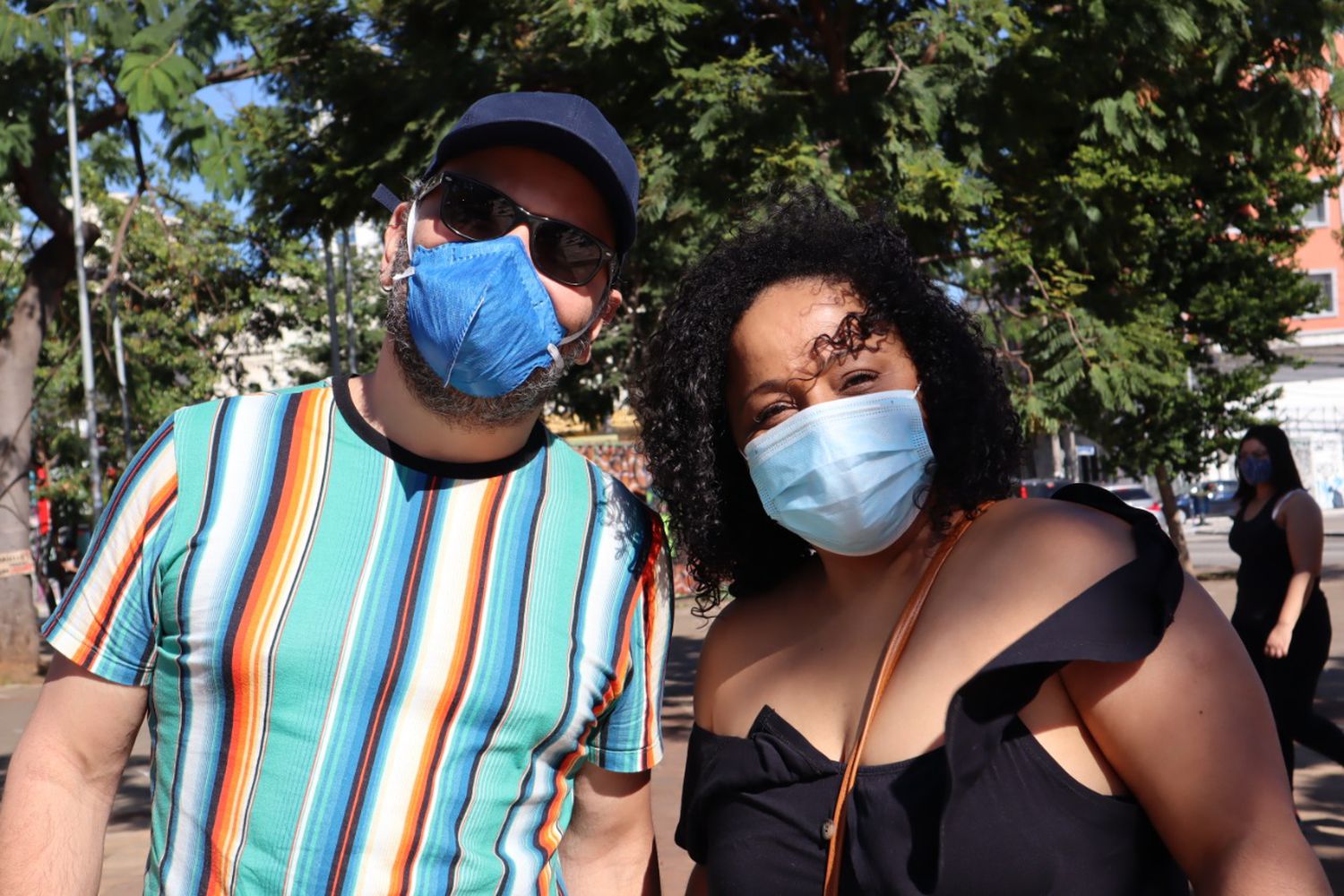
The ostensible policing impressed and tensioned the environment. With tears in her eyes, nurse Ana Paula Braga, 41, said she felt “oppressed”. “We can’t let this force of evil in the country grow, this authoritarianism. I am a woman, black, I feel that we are losing more freedom every day. Unfortunately I do not see hope for the near future. What we are doing here today is building,” she said, a civil servant and tenured by the Ministry of Health.
The clashes with the police were the greatest concern of the governor of São Paulo, João Doria, who intervened so that the demonstrators for and against the government would not meet simultaneously in the same place. “We don’t need street clashes right now in Brazil. This will only serve those who have an authoritarian project and want to justify the presence of the Army and through more authoritarian and tougher measures before a state or set of states,” he said in an interview the week before.
But on a day of anti-fascist and anti-racist protests, four young black men reported being approached by the police. “We came to protest against racism and we suffered racism on the spot. We were approached four times on the way to and during the rally. Now, on the way back too,” says Tainah Andrade, 18, as she points to the car. “We were stopped, but the group of white girls who were right in front of us were not stopped,” said the demonstrator.
Taking part in his first protest, Lucio Lima de Paula, a black student from the suburb of Itaquaquecetuba, chose to carry a poster against intolerance. “We are stopped, we are approached, we are disrespected. That’s part of the routine, but I grew tired. I know the dangers of Covid, but racism has been killing for years and we can’t be afraid. If we don’t speak out, nobody will speak out for us,” said the young man. Veteran Juarez Correa Barros Junior, 63, said he was “addicted to democracy” and explained why he chose to take risks to face a crowd in the middle of a pandemic: “I feel more insecure in Brazil with this President than I have ever felt in my entire life. I left home today to show my anger and outrage”.
Initially, the demonstration was to take place on Paulista Avenue, but the organizers changed the location after a decision by the São Paulo courts, since a pro-government rally would take place in the same location. Around 4:30 PM, the demonstration in Largo da Batata was ended by the organizers, who recommended people to go home.
However, one of the groups decided to march up to Paulista Avenue, but was stopped by a police blockade. Police negotiators tried to persuade members to leave the streets, but they persevered. “Those who are still here are vandals, those who demonstrated were good citizens,” said the executive secretary of the State Police, Colonel Álvaro Camilo, in an interview with CNN Brasil. In the end, the police launched tear gas to disperse those who stayed. According to the PM’s final balance, 14 people were detained.
According to Guilherme Boulos, presidential candidate in 2018 for the PSOL party and one of the leaders of the MTST, one of the organizers, the protest is the beginning of a path to ban fascism in Brazil. “We started last Sunday and continue today. If only the fascists are on the streets, as much as they are a minority in society, an intimidating environment is eventually formed. That’s what we want to avoid,” he said.
Ostensible policing in Curitiba
A week after an anti-racist rally ended in police repression and rioting in the capital of Paraná, a barricade with riot police, vehicles and cavalry surrounded the Santos Andrade Square, where the Black Lives Matter rally was held in Curitiba. The ostensible policing was disproportionate to the number of demonstrators, searched one by one before entering the square.
With their hands on their heads, they had their bodies and backpacks inspected. Water bottles and the now ubiquitous hand sanitizers were opened and checked, while a PM helicopter flew over the square and its surroundings.
Watching the inspections, environmental engineer Everton Rocha, 31, faltered. A black man, born in the interior of Bahia, he has lived in Curitiba for five years, where he completed his master’s degree in Chemical Engineering at the Federal University of Paraná. “For a second I thought about not going and returning home. But someone needs to fight. We are dying,” he lamented.
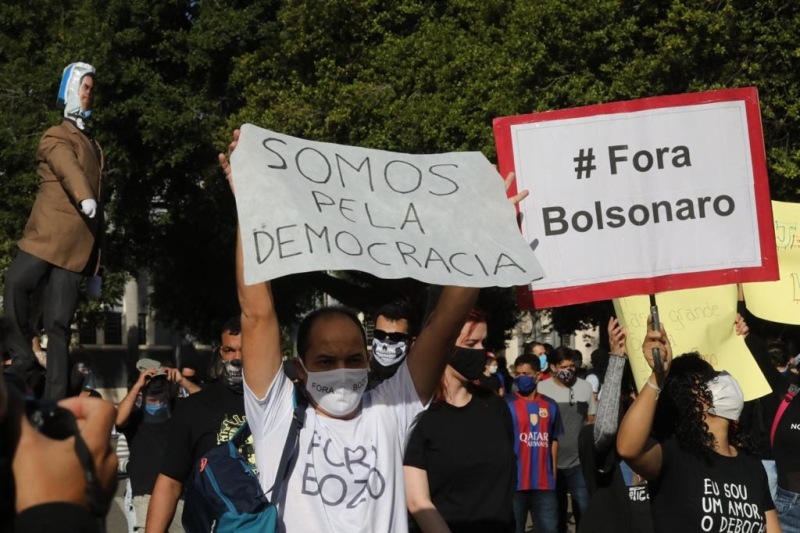
The decision to search the participants, according to the Paraná State Police spokesperson, Lieutenant Michele Trindade, was due to the vandalism that occurred last Monday, June 2nd, and to ensure the demonstrators’ safety. “The organizers were helpful, and the OAB [bar association] and the Prosecutor’s Office also helped in this mediation,” she said.
According to the spokesperson, four people were arrested for carrying narcotics. But Rita Cristina de Oliveira, a public defender and coordinator of the Ethnoracial Policies Group of the Public Defender’s Office, said the PM should not have conducted the searches.
“It’s an illegal way to prevent the right to demonstrate freely,” she says. “It is not frivolous to say that this does not occur as a pattern adopted in the current pro-government or pro-lava-jato or anti-corruption demonstrations, which are common here in the city. At this point it reflects the project of a successful ‘whitening’ that historically stifles the cry and presence of blacks in this city, and which is reflected in police action,” she added.
Miguel Otávio, Ágatha Félix, George Floyd
“It’s a feeling of fear, that my right to speak and to come and go is being limited,” lamented Natasha de Miranda Gomes, 21, a member of a socialist group. In Curitiba, as in other Brazilian capitals, the death of Miguel Otávio Santana da Silva, 5 years old, who fell from one of the “Twin Towers” buildings in Recife, was recalled with emotion. “And we can no longer conform to things as they are. With Miguel, a black boy, dying because his mother had to walk the madam’s dog in quarantine. We fight for anti-racism and anti-capitalism. Black people never win in this system,” added young Natasha.
Part of the demonstrators headed for the Iguaçu Palace, the seat of the state government, under the watchful eye of the police. On the way, from the apartments, the residents banged on pots and joined the choir “Bolsonaro, Out”. The demonstrators and police officers remained there until late evening, and there was no record of any clashes.
In Rio de Janeiro, demonstrators gathered outside the Zumbi dos Palmares monument at around 3 PM and walked to Candelária. In addition to the antiracist posters, the repetition of the names of the black victims of police violence compounded the track of this Sunday’s act: “Marielle, present!”, “Agatha Félix, present!”, “João Pedro, present!”, “George Floyd, present!”.
Source: El País
More: Brazil news in English, every day from The Rio Times.
This article was produced by The Rio Times’ automated newsroom system. How we use AI · Report an error
Read More from The Rio Times