Polls Say Spain’s Opposition Won TV Debate
Two online polls say Spain's opposition leader Feijóo won Thursday's TV debate, while a 40dB poll shows a tight race and Polymarket gives him 87.5%.
Key Facts
- What. Online polls after Thursday’s debate favour conservative Alberto Núñez Feijóo over Prime Minister Pedro Sánchez.
- Polls. SocioMétrica has Feijóo ahead 64% to 32%; Ateneo del Dato has him ahead 45.2% to 31.9%.
- Race. A 40dB poll (fieldwork Nov. 13-17) put the People’s Party (PP) at 31.8% and the Socialists (PSOE) at 30.6%.
- Next. Spain votes Sunday, Nov. 29; the campaign ends at midnight on Friday, Nov. 27 (6:00 p.m. ET).
- Prediction markets. Polymarket priced Feijóo at 87.5% to be next prime minister, Sánchez at 11.8% (Nov. 20, 10:28 a.m. ET).
This story is part of our coverage of the Spain Election 2026. Dates, times and how to follow it are in our guide.
Latest: Spain Probes Possible Third Ceuta Tunnel
Viewers Give the Debate to Feijóo
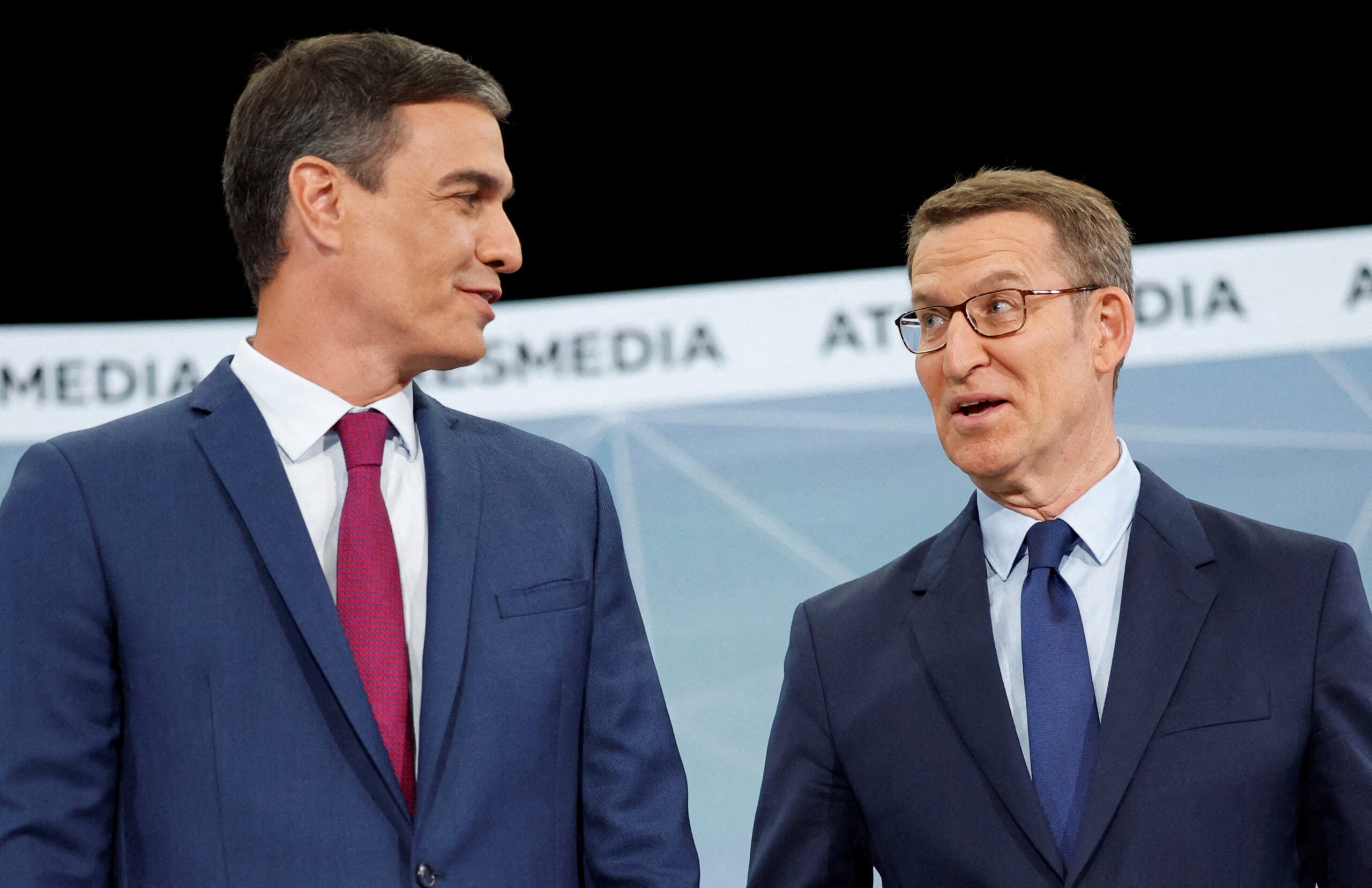
Spain’s opposition leader came out ahead in the first snap polls on Thursday’s television debate, part of our Spain Election 2026 coverage. Two polls found that more respondents thought Alberto Núñez Feijóo, head of the conservative People’s Party (PP), beat Prime Minister Pedro Sánchez, leader of the Socialist Party (PSOE).
SocioMétrica, a Spanish polling firm, reported 64% for Feijóo and 32% for Sánchez. Its online panel of 1,600 adults was questioned on November 20 and is not a probability sample, so it shows a mood rather than a measured result.
Ateneo del Dato, another Spanish pollster, surveyed 1,146 people online on November 19-20. It found 45.2% for Feijóo, 31.9% for Sánchez, 13.7% for neither and 6.2% for both equally, with a margin of error of 3.7 points.
In Ateneo del Dato’s survey, 88% said the debate would not change their vote and 9% are reconsidering. SocioMétrica said Feijóo led on every topic, including housing (60% to 27%) and corruption (62% to 23%), and that 33% of former PSOE voters named him the winner.
Parties Claim Victory
Rebeca Torró, a PSOE official, said 80% of what Feijóo said was a lie. Félix Bolaños, a government minister, called Feijóo “faltón y embustero”, meaning disrespectful and untruthful.
Miguel Tellado, a PP official, called the debate a Feijóo win. Santiago Abascal, leader of the conservative Vox party, acknowledged Feijóo’s “triunfo” (triumph), while Míriam Nogueras of Junts, a Catalan party, said Junts is “very far from Sánchez” but further still from the PP and Vox.
Tight Polls, Lopsided Markets
The 40dB pollster’s tracking poll, with fieldwork on November 13-17 and published on November 18, put the PP at 31.8% and the PSOE at 30.6%. A party needs 176 of the 350 seats in Congress, the lower house, to govern alone.
The gap between that poll and the betting is wide: the polls show a close race for votes, while traders see a Feijóo-led government as very likely. Local media report a newer 40dB poll taken after the debate, but we could not confirm its figures.
What Prediction Markets Say
On Polymarket, a prediction market, traders priced Feijóo at 87.5% and Sánchez at 11.8% to be the next prime minister at 10:28 a.m. ET on November 20. The market has traded US$4.2 million.
These prices are bets, not polls.
Why we show this: prediction markets turn real-money bets into a live probability that moves within minutes of the news, which is why investors, campaigns and newsrooms in the United States now follow them closely. We show them next to polls and official results, never instead of them.
Dates to Watch
Spain votes on Sunday, November 29, under royal decree 806/2026, which dissolved the parliament elected in 2023. The campaign ends at midnight local time on Friday, November 27, which is 6:00 p.m. ET.
The new parliament meets on December 23 at 10:00 local time (4:00 a.m. ET). On Friday, Sánchez held a rally in Santiago de Compostela, while Feijóo travelled to El Hierro, a Canary island.
For more on the race, read our reports on the Socialists’ gains in three new polls and on Spain’s split over Morocco’s role in the Ceuta rush.
What It Means for US Readers
Spain is six hours ahead of US Eastern Time, so election night on Sunday, November 29 will run through the US afternoon and evening. Polymarket’s price on the next prime minister updates continuously and is a quick gauge of how traders read each poll.
A snap poll after a debate rarely moves votes much, and the Ateneo del Dato figures say the same. The next fixed points are the final polls and the vote itself.
What Is Not Known
We do not know the TV audience: about 10.15 million has been reported, but we could not confirm it. We also could not confirm the newer 40dB figures or how long the pre-election poll blackout lasts.
The Eastern Time conversions are ours, based on Spain being six hours ahead. Online snap polls are not representative of all voters.
Sources
Royal decree 806/2026 (Spain’s official gazette, BOE); Interior Ministry election guidance; published results of SocioMétrica, Ateneo del Dato and 40dB; party statements; Polymarket.
This article was produced by The Rio Times’ automated AI newsroom. Editorial responsibility: Matthias Camenzind, Publisher and Editor-in-Chief. The Rio Times also runs Ask Rio Times, which answers from 100,000+ of our own articles, the daily Latin America Power Map, and prediction-market odds on elections and markets.. How we use AI · Report an error
Europe's Political Crisis
- Why Europe’s Politics Are Breaking, From France to Spain
- Why Europe’s Politics Are Breaking, From France to Spain
- Why France Is in Crisis, and How Macron Lost His Grip
- Why Germany’s Top Party in the Polls Is Kept Out of Power
Frequently Asked Questions
Who won the Sánchez-Feijóo debate?
Two online polls found most respondents named Feijóo the winner, 64% to 32% and 45.2% to 31.9%. Neither measures how people will vote.
When is Spain’s general election?
Voters elect a new parliament on Sunday, November 29. The campaign ends at midnight local time on Friday, November 27.
What do prediction markets say?
Polymarket priced Feijóo at 87.5% and Sánchez at 11.8% to be next prime minister on November 20. These are traders’ bets, not polls.