Key Facts
- The S&P/BMV IPC, Mexico’s main stock index, fell 1.23%, closing at 66,476 points as a sharp sell-off in US technology shares soured risk appetite.
- The Mexican peso was barely moved, with USD/MXN edging up just 0.03% to 17.44 per dollar, showing unusual stability during the equity decline.
- America Movil was the heaviest drag, slumping 2.9% as the telecoms giant was caught in the downdraft hitting global communications stocks.
- Mexico’s index is now 7.2% below its 52-week high, reflecting months of pressure from high local interest rates and political uncertainty.
- Traders rotated into defensive names, lifting Walmex by 1.5% while punishing growth-sensitive stocks like Cemex, which lost 1.9%.
Today’s Focus
Mexico’s S&P/BMV IPC — the country’s benchmark stock index — dropped 1.23% to 66,476 points on Wednesday. The decline tracked Wall Street’s S&P 500, which fell 1.52%, as investors dumped mega-cap tech stocks globally. The peso, unusually, barely flinched: USD/MXN, the dollar-peso exchange rate, ticked up a mere 0.03% to 17.44.
The session’s pain was concentrated in Mexico’s most widely held blue chips. America Movil, Carlos Slim’s pan-Latin American telecoms giant, plunged 2.9% with $53 million in turnover. Cemex, the global cement maker often used as a proxy for economic growth expectations, shed 1.9%. Femsa, the Oxxo store operator, was the worst individual performer with a 4.5% drop.
There was no single domestic catalyst driving the selling. Instead, the move was a straightforward import of a souring global mood, after US tech earnings disappointed and investors reduced risk ahead of key Federal Reserve data. Local buyers, wary of holding growth names overnight, parked money in consumer staples.
What matters today. The 1.23% fall marks a broadening of selling pressure beyond the tech-adjacent names, dragging down a cross-section of the Mexican economy from cement to banking.

01 The session in one read
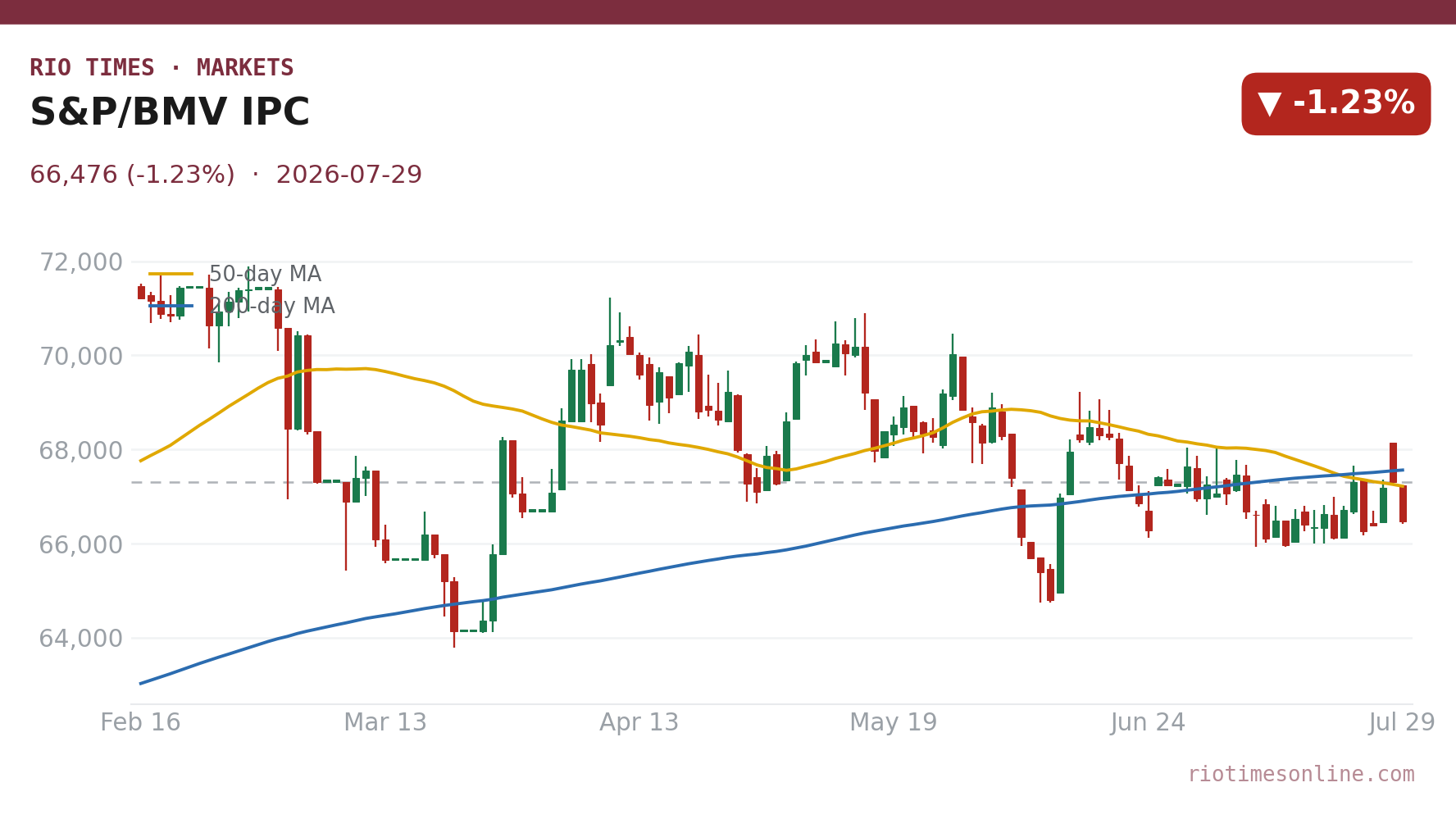
Wednesday’s session on the S&P/BMV IPC was a mirror held up to a bleak day on Wall Street, but the reflection was slightly more bruised. Mexico’s main stock index fell 1.23%, a chunky move by local standards, driven not just by the global tech sell-off but by a sharp markdown in some of the country’s most cherished consumer and industrial names. The peso, by contrast, was a portrait of calm, moving only 0.03% against the dollar — a sign that the currency market saw this as a pure equity repositioning rather than a deeper confidence crisis in Mexico.
The mechanics of the drop were simple enough. With the S&P 500 shedding 1.52% overnight, Mexican traders opened the morning by repricing risk across the board. Giants like the telecoms incumbent America Movil and the cement multinational Cemex acted as shock absorbers for the negative US sentiment. Foreign investors, who own a large chunk of the index, tend to sell their most liquid Mexican holdings first when their home market turns red.
The market’s decline is clearly a reaction to the 1.52% drop on the S&P 500, but the distribution of the selling inside Mexico tells a richer story. The fall in Femsa and Banorte, alongside the expected hit to America Movil, suggests the market is not merely mirroring a US chipmaker rout; it is expressing a genuine anxiety about domestic economic momentum heading into second-quarter GDP data. The variable to watch in the next session is whether the 66,476 close slips decisively below 66,000, a level that has previously attracted chart-based institutional buying.
02 The day’s numbers
| Measure | Level | Change | Read |
|---|---|---|---|
| S&P/BMV IPC | 66,476 | −1.23% | Slipped for a second day |
| US dollar / Mexican peso | 17.44 | +0.03% | Flat; currency largely ignored the sell-off |
| Distance from 52-week high | — | −7.2% | Prior peak at 71,601 marks resistance |
| S&P 500 (Wall Street benchmark) | 7,316 | −1.52% | Tech-led rout was the main drag |
The IPC settled at 66,476 points, a 1.23% decline that left the index 7.2% below its 52-week high of 71,601. The 52-week range now stretches from 60,774 on the floor to that 71,601 ceiling, placing Wednesday’s close in the lower-middle band. The slip followed a 1.52% tumble on the S&P 500, suggesting Mexico’s market remains highly correlated with US risk appetite.
The peso, measured by the USD/MXN exchange rate, showed negligible movement, adding just 0.03% to 17.44 pesos per dollar. That stability tells us the FX market views this as an equity-flow event rather than a macro-driven flight from Mexican assets. The peso has held inside a tight range with the 52-week high at 18.74 and the low at 17.13. Rio Times · Live Market Intelligence
Live Market IntelligenceMexico — Live Market Board
Mexico — Live Market Board
Instrument Last Change YoY Prev. High Low Volume
IPC MEX
63,924.77
-0.28%
+12.17%
64,106.82
66,121
65,405
108,886,187
USD/MXN
17.06
-0.24%
-8.58%
17.10
17.08
17.01
—
WALMEX
48.07
-0.62%
-14.38%
48.37
48.65
48.02
10,781,446
GMEXICO
223.28
+0.35%
+73.59%
222.50
226.18
222.17
1,325,556
FEMSA
201.19
-0.24%
+25.67%
201.67
206.71
199.56
750,706
CEMEX
19.32
+0.89%
+19.10%
19.15
19.35
19.04
14,327,054
GFNORTE
193.98
+1.18%
+14.36%
191.71
195.79
191.83
1,579,115
BIMBO
60.98
-0.96%
+11.89%
61.57
61.46
60.29
1,048,115
TELEVISA
9.71
+0.21%
+12.78%
9.69
9.75
9.60
577,851
AMX
19.80
-0.95%
+12.53%
19.99
20.05
19.70
58,058,525
GAP
366.23
+0.43%
-21.21%
364.68
370.85
362.82
226,946
ASUR
275.04
+1.25%
-15.28%
271.64
275.08
271.31
15,451
OMA
233.50
+0.62%
-6.48%
232.06
235.00
230.62
555,693
KOF
188.04
+0.86%
+18.94%
186.44
188.56
185.52
425,273
GRUMA
252.90
+0.11%
-21.85%
252.61
254.74
250.36
90,048
KIMBER
39.74
+0.43%
+8.85%
39.57
40.09
39.33
490,551
AMX ADR
23.38
-0.23%
+22.25%
23.43
23.49
23.06
1,347,445
03 Why it moved — a US tech rout washes ashore
The dominant force on Wednesday was the downdraft on the S&P 500, which dropped 1.52% as investors abandoned big US technology stocks after a wave of disappointing earnings reports. For Mexico, which trades like a high-beta play on American growth sentiment, a fall on Wall Street almost always means a fall in the IPC. The transmission mechanism is direct: global fund managers, faced with a margin call or a loss elsewhere, sell their most liquid emerging-market holdings to raise cash.
There was no domestic news equal to the negative pressure from abroad. The market instead absorbed broad-based selling that punished names with high foreign ownership. America Movil, with its huge weighting in the index and deep ties to foreign institutional portfolios, acted as the liquidity valve. When the S&P 500 turns red, traders sell what they can, not what they want to — and in Mexico, that usually means the Carlos Slim telecoms empire first.
A subtle but important secondary story was the rotation into defensive, domestically focused names. Walmex, the Walmart-owned retailer that serves Mexican consumers buying basic necessities, rose 1.5%. This tells us that while gun-shy international investors were hitting the sell button, local money was betting that domestic demand for staples can withstand a Wall Street tantrum.
04 The day’s movers
| Driver | Level / Move | Change | Note |
|---|---|---|---|
| America Movil (AMXB) | Most traded board | −2.9% | Caught in global telecoms selling; $53m turnover |
| Cemex (CEMEXCPO) | High-value cement name | −1.9% | Cyclical proxy hit by global slowdown fears |
| Walmex (WALMEX) | Consumer-staple retailer | +1.5% | Safe-haven buying amid equity rout |
| Femsa (FEMSAUBD) | Oxxo owner, consumer name | −4.5% | Biggest single domestic loser on the day |
The most-traded names board read like a list of Mexico’s calling cards to the world. America Movil, the country’s most liquid stock, drew $53 million in turnover and fell 2.9%, making it the heavyweight dragging the index lower. The ETF ‘QQQ’, a US-listed tracker for the Nasdaq that trades in Mexico as a cross-listed instrument, fell 1.6% with $35 million in volume, reflecting the pure tech contagion.
The biggest domestic gainers included Walmex, up 1.5% as money piled into a stock that sells groceries and household basics regardless of the economic weather. Tequila maker Cuervo also rose 3.0%, providing a rare bright spot. On the losing side, Femsa tumbled 4.5% — a move suggesting some local investors were bracing for disappointing consumer-spending data in the coming days.
05 The regional scoreboard
| Index | Country | Change |
|---|---|---|
| S&P/BMV IPC | Mexico | −1.23% |
| Ibovespa | Brazil | −1.52% |
| IPSA | Chile | +0.52% |
| S&P Merval | Argentina | −0.71% |
| COLCAP | Colombia | +0.15% |
Latin America wore a risk-off face on Wednesday, but the mood was not uniform. Brazil’s Ibovespa fell in lockstep with Mexico, matching the 1.52% loss on the S&P 500, while Chile’s IPSA edged up 0.52%, possibly aided by company-specific news in the mining sector. Colombia’s COLCAP was also fractionally higher at +0.15%, and Argentina’s Merval dropped a more modest 0.71%.
The read-across from Mexico’s session is that US-facing sectors took the hardest hit across the region. A live whole-market board embedded above this article carries the closing figures for all regional indices, but the summary here makes clear that the wave of selling was deep in Brazil and Mexico, and almost absent in the smaller Andean markets.
06 The technical picture
The IPC’s close at 66,476 puts it in a fragile spot on the daily chart. The index slipped below the psychologically important 67,000 handle and is now 7.2% below its 52-week high of 71,601. The slope of the decline has accelerated over the past two sessions, increasing the risk of a test of the 52-week low at 60,774 if the US sell-off continues through Thursday.
Volume was concentrated in the largest names, especially the $1,924 million that flowed through the most-active level, suggesting institutional participation rather than retail panic. Bears will note that the current level is mid-range between the two extremes of the 52-week band, giving the market room to fall before the bottom becomes a realistic target. Bulls, however, can take comfort from the peso: its dead-flat showing hints that the macro story is not deteriorating alongside the equity chart.
07 What to watch
- Mexico GDP data due Thursday: The country publishes second-quarter growth figures. A miss on the expected 1.5% year-on-year rate could deepen the equity sell-off by undermining the domestic-demand narrative that partially insulates the IPC.
- Wall Street’s open on Thursday: With the US driving the action, traders in Mexico will watch the S&P 500 futures before the opening bell. Any sign of US tech stabilising would likely reverse a chunk of the IPC’s Wednesday losses.
- Banxico’s next rate decision: Mexico’s central bank has held rates high to anchor inflation, but a shift in language towards easing would be rocket fuel for the index. Watch for any official commentary on the growth outlook.
- America Movil arbitrage flows: With the stock down 2.9% and high turnover, any bounce in AMXB on the New York-listed AMX shares will signal whether this is a one-day rout or the start of a deeper institutional unwind.
Background: Vesta Rides Nearshoring to a Stronger Second Quarter.
Background: Televisa Second Quarter: $28M Loss as Sky Bleeds, ViX Grows.
More: Mexico news in English, every day from The Rio Times.
Frequently Asked Questions
What is the S&P/BMV IPC?
It is Mexico’s main stock index, similar to the S&P 500 in the US. Calculated by S&P and the local exchange, the BMV, it tracks the 35 to 40 most valuable and liquid companies listed in Mexico, including America Movil, Femsa, Banorte, Walmex and Cemex.
Why did Mexico’s stock market fall on Wednesday?
The 1.23% drop was primarily driven by a global sell-off in technology stocks that pushed Wall Street’s S&P 500 down 1.52%. Mexican shares, heavily owned by foreign investors, fell in sympathy as fund managers reduced their risk exposure in emerging markets.
Why did the peso barely move while stocks fell sharply?
The peso’s near-flat 0.03% decline suggests the currency market viewed the equity drop as a technical sell-off by stock investors, not a broader loss of confidence in Mexico’s economy or central bank. Currency traders typically react to interest-rate and macro data more than to one-day stock moves.
Which Mexican stocks were the biggest losers?
Femsa (the Oxxo convenience-store operator) was the worst domestic performer with a 4.5% decline. America Movil, the telecoms giant, fell 2.9%, and Cemex, the cement maker, lost 1.9%. All three were caught in the global risk-off wave hitting cyclical and foreign-owned stocks.
This article was produced by The Rio Times’ automated newsroom system. How we use AI · Report an error
In depth
LatAm Markets: Live Signals → — real-time movers, turnover leaders and FX across Latin America.
Read More from The Rio Times