Key Facts
- The S&P/BMV IPC, Mexico’s main stock index, fell 1.54% to 66,266 points, dragged lower by a global risk-off mood that hit Wall Street overnight.
- The peso weakened 0.75% to 17.52 per dollar, giving back recent gains as traders reduced bets on emerging-market currencies.
- Airport operators led the decline with Grupo Aeroportuario del Centro Norte (OMA) tumbling 4.5% on heavy profit-taking after a strong run.
- Retail giant Walmex dropped 2.7% and lender Banorte slipped 1.4%, as $40m and $32m in turnover respectively signalled broad institutional selling.
- Cemex lost 3.0% in heavy trading worth $1.1bn, with the global growth scare unsettling the construction-materials bellwether.
Today’s Focus
Mexico’s benchmark S&P/BMV IPC index — the barometer for the country’s largest and most-traded companies — slid 1.54% to 66,266 points on Thursday. The peso, Mexico’s currency, weakened 0.75% to 17.52 per US dollar as a sour mood on Wall Street filtered into Latin American assets.
The trigger was a 1.21% drop in the S&P 500, the main US stock gauge, which unnerved investors who had piled into Mexican shares during a recent rally. Heavy selling hit the names that had led the market higher: airport operator OMA sank 4.5%, retailer Walmex fell 2.7%, and cement giant Cemex lost 3.0%.
Trading volumes ballooned well above average, with more than $1.5bn changing hands across the most active names — a sign that big institutional investors were cutting risk rather than simply taking a breather. The 52-week picture added to the discomfort: the IPC now sits 7.5% below its year-high of 71,601.
What matters today. The sell-off was broad and conviction-led, not a one-stock wobble, and it pushed the IPC decisively lower alongside a weakening peso — a twin move that signals genuine unease about the near-term outlook.

01 The session in one read
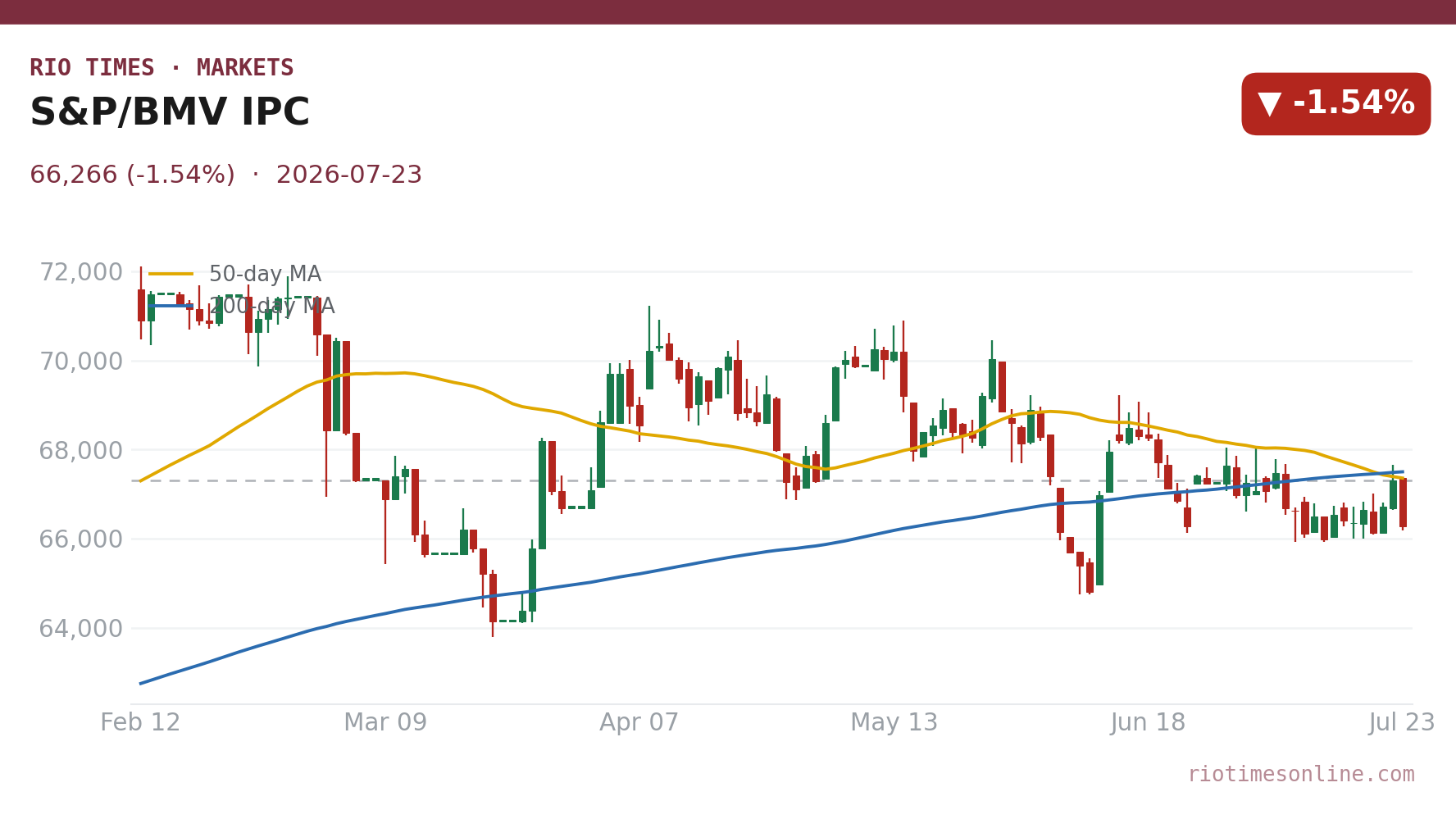
Mexican equities suffered their worst session in weeks on Thursday as a wave of selling that began on Wall Street cascaded into Latin America. The S&P/BMV IPC — the index that tracks the 35-or-so largest and most liquid Mexican stocks — dropped 1.54%, closing at 66,266 points.
The peso, which had been trading near its strongest levels of the year, also stumbled. It weakened 0.75% to 17.52 per US dollar, its biggest single-day decline in over a fortnight. That twin move — stocks down, currency down — told a clear story: foreign and local investors were hitting the sell button in unison.
The spark came from a 1.21% fall in the S&P 500, the main US equity benchmark, as a mix of trade jitters and profit-taking soured sentiment. In Mexico, the pain was concentrated in the shares that had led the market higher in recent months.
Airport operator Grupo Aeroportuario del Centro Norte, known as OMA, plunged 4.5%. Retail behemoth Walmex, the Mexican arm of Walmart, dropped 2.7% on turnover of $40m. Cement maker Cemex gave up 3.0% in the session’s heaviest trading, with $1.1bn changing hands across its various share classes. By the close, only a handful of stocks — including Carlos Slim’s financial holding Grupo Carso, up 2.7% — bucked the trend.
The session’s damage was comprehensive. Eight of the ten most-traded names finished in the red, and the biggest decliners — OMA, Gruma, Volaris, Cemex — span transport, food, and construction, sectors sensitive to both local demand and global growth fears. Crucially, the peso fell alongside stocks, ruling out the idea that this was merely a currency-related re-pricing of foreign-held shares. With the IPC now closer to its 52-week low of 60,569 than its high, the next few sessions will test whether bargain hunters see value or wait for the US mood to stabilise first.
02 The day’s numbers
| Measure | Level | Change | Read |
|---|---|---|---|
| S&P/BMV IPC | 66,266 | −1.56% | 7.5% below 52-week high |
| Session range | — | — | — |
| 52-week high | 71,601 | — | — |
| 52-week low | 60,569 | — | — |
| USD/MXN | 17.5214 | +0.75% | 6.5% below 52-week high |
| 52-week low (peso strongest) | 17.13 | — | — |
| 52-week high (peso weakest) | 18.74 | — | — |
The IPC’s 1.54% slide was the worst single-day showing in the region outside Argentina, and it pushed the index to 7.5% below its 52-week high of 71,601. That is a significant distance from the peak, and it leaves the index closer to its year-low of 60,569 than many traders would like.
The peso’s move to 17.52 per dollar — a 0.75% weakening — was its largest daily decline since early July. Even so, the currency remains 6.5% stronger than its 52-week worst level of 18.74, a reminder that the peso has been one of the world’s best-performing major currencies this year. What changed on Thursday was the direction: until now, local dips had been shallow and short-lived. This one looked different, with the currency sliding steadily through the session alongside equities. Rio Times · Live Market Intelligence
Live Market IntelligenceMexico — Live Market Board
Mexico — Live Market Board
Instrument Last Change YoY Prev. High Low Volume
IPC MEX
69,470.99
-0.58%
+12.74%
69,879.62
70,008
69,383
49,372,306
USD/MXN
18.69
+0.62%
+1.45%
18.57
18.69
18.54
—
WALMEX
49.53
-1.51%
-19.45%
50.29
50.54
49.44
2,069,310
GMEXICO
231.81
+1.57%
+50.31%
228.22
233.41
228.50
1,952,754
FEMSA
232.97
+0.18%
+32.20%
232.54
234.49
230.40
277,092
CEMEX
19.60
+3.48%
+14.42%
18.94
19.63
18.95
9,927,197
GFNORTE
214.68
+0.29%
+24.39%
214.07
215.30
212.24
5,714,524
BIMBO
64.27
+1.56%
+3.36%
63.28
64.60
62.11
988,269
TELEVISA
8.33
-1.77%
-9.16%
8.48
8.52
8.31
1,277,288
AMX
22.47
-0.27%
+7.56%
22.53
22.74
22.39
7,217,012
GAP
418.59
+0.34%
+5.26%
417.18
423.09
413.53
190,130
ASUR
249.54
-1.02%
-18.40%
252.11
253.66
248.64
24,784
OMA
229.76
+0.06%
-3.04%
229.62
231.99
227.86
119,261
KOF
213.92
-0.39%
+31.99%
214.75
216.94
211.01
518,660
GRUMA
245.16
-0.93%
-22.90%
247.46
248.39
245.00
101,929
KIMBER
37.80
+0.13%
+7.64%
37.75
38.38
37.80
2,154,177
AMX ADR
24.01
-0.70%
+5.59%
24.18
24.37
23.99
1,024,581
03 Why it moved — a Wall Street chill hits Mexican assets
The proximate cause was the 1.21% drop in the S&P 500, which spooked investors who had grown comfortable with Mexican risk. When big US indices fall, money managers often sell liquid emerging-market holdings to raise cash or cut overall risk, and Mexico — with its deep, dollar-accessible market — is usually the first port of call.
But the selling was not just mechanical. Levels of turnover in the biggest names — $1.1bn in Cemex alone — suggested that funds were actively choosing to cut exposure rather than simply rebalancing. The breadth was punishing: eight of the ten most-traded stocks finished lower.
Airport operators OMA and GAP had been standout performers this year, lifted by a tourism boom and higher passenger traffic. Their sharp reversals — OMA down 4.5% — hinted at profit-taking after a strong run. Walmex, down 2.7% on chunky volume, has been a consensus long among foreign investors betting on Mexico’s consumer story. Its decline signalled that even the market’s most-loved names were not safe.
The peso’s weakness added a sharper edge. A falling currency typically hurts the foreign-currency returns of international investors, who may then accelerate selling. On Thursday, that feedback loop was in full swing, with the peso dipping as the IPC fell, and the IPC dipping further as the peso weakened. The result was a session with few hiding places.
04 The day’s movers
| Driver | Level / Move | Change | Note |
|---|---|---|---|
| Cemex (CX) | $1,095m turnover | +0.3% | US-listed line bucked weakness on technical flow |
| Fibra Uno (FUNO11) | $305m turnover | −39.7% | Massive distribution adjustment, not an organic fall |
| Grupo México (GMEXICOB) | $46m turnover | −2.4% | Mining giant tracked copper and global growth fears |
| Walmex (WALMEX) | $40m turnover | −2.7% | Consumer bellwether hit by broad institutional selling |
| América Móvil (AMXB) | $37m turnover | +0.3% | Slim’s telecom giant a rare pocket of stability |
| Banorte (GFNORTEO) | $32m turnover | −1.4% | Bank sold off as rate optimism faded slightly |
| Cemex CPO (CEMEXCPO) | $30m turnover | −3.0% | Local Cemex line sold harder than the US-listed CX |
| OMA (OMA) | $29m turnover | −4.5% | Session’s worst large-cap fall; heavy profit-taking |
| Grupo Carso (GCARSOA1) | Top gainer | +2.7% | Conglomerate bucked the trend; sturdy bid |
| Bolsa Mexicana (BOLSAA) | Second gainer | +1.9% | Exchange operator rallied on its own vol dynamics |
| Gruma (GRUMAB) | Big loser | −4.1% | Corn-flour giant tumbled on margin jitters |
| Volaris (VOLARA) | Big loser | −3.2% | Budget airline sold off with airports on traffic fears |
A word of caution on the turnover table. The $305m in Fibra Uno — a real-estate trust — carried a spectacular −39.7% print. That is not a market panic; it is the mechanical adjustment for a large capital distribution or rights issue that temporarily re-prices the shares. Stripping that out, the real action was in Cemex, Walmex, Banorte, and the airports, where genuine selling drove heavy volume.
The gainers’ list was short and defensive. Grupo Carso, Carlos Slim’s holding company for industrial and retail assets, rose 2.7% in what looked like a rotation into a name perceived as less exposed to global cyclical swings. Bolsa Mexicana de Valores, the company that runs the country’s stock exchange, added 1.9% — a quirky counter-trend move possibly driven by the jump in market volatility and trading volumes, which boost its revenue.
05 The regional scoreboard
| Index | Country | Change |
|---|---|---|
| S&P/BMV IPC | Mexico | −1.56% |
| Ibovespa | Brazil | −0.46% |
| IPSA | Chile | −0.84% |
| Merval | Argentina | −1.78% |
| COLCAP | Colombia | −0.60% |
Thursday was a red day across Latin America, with every major index closing lower. Argentina’s Merval, a volatile gauge measured in pesos, led the region’s declines with a 1.78% drop as the country’s ever-present inflation and currency distortions amplified the global move.
The IPC’s 1.54% fall placed Mexico as the second-worst performer, outpacing Chile’s IPSA (−0.84%), Colombia’s COLCAP (−0.60%), and Brazil’s Ibovespa (−0.46%). Brazil’s relative resilience reflected its different macro story — the central bank there has already begun easing interest rates, giving local investors a domestic reason to stay put. Mexico, with its rates still high and the peso exceptionally strong until recently, had less of a cushion when the global mood turned.
06 The technical picture
The 1.54% drop pushed the IPC down to 66,266, a level that technical traders — those who study price charts rather than company earnings — will be watching closely. The index has now sliced through several short-term levels that had previously provided support, and it sits well within the range that has defined 2026: a 52-week high of 71,601 and a low of 60,569.
At the close, the IPC is about 7.5% below its peak but still roughly 9.4% above its trough. That middle-of-the-range position means the next few sessions are likely to be decisive. A bounce that reclaims the 67,000 area would reassure traders that the uptrend is intact. A further slide towards 65,000, especially if accompanied by another leg of peso weakness, would open the door to a test of the year’s lower levels. The fact that turnover was so heavy on Thursday gives the move a conviction that a quieter sell-off would lack — it suggests big investors were behind the selling, not just nervous retail traders.
07 What to watch
- Friday’s US new home sales: A strong or weak reading on the US housing market — due at 14:00 GMT — will set the global tone and could either steady or rattle Mexican construction names like Cemex.
- Weekend CFTC positioning data: Friday’s release of speculative futures positions on the peso (previous +73k net long) will show whether hedge funds had been caught leaning the wrong way before the sell-off.
- Banorte and Walmex stabilisation: Both stocks were sold on heavy volume. A quick bounce would suggest Thursday was a one-day purge; a second day of declines would signal deeper institutional repositioning.
- US S&P Global PMIs: The flash July PMIs for the US — released Friday — are a real-time health check on the world’s largest economy. A print below 50 on the services side would deepen the global growth scare.
Background: Nemak’s Sales Jump 19% but Costs Squeeze Its Profit.
Background: Cemex Second Quarter: Mexican Cement Giant Lifts Outlook.
More: Mexico news in English, every day from The Rio Times.
Frequently Asked Questions
What is the S&P/BMV IPC?
It is Mexico’s main stock market index, tracking the 35-or-so largest and most-traded companies listed on the Bolsa Mexicana de Valores — the Mexican stock exchange. Think of it as Mexico’s equivalent of the S&P 500.
Why did the peso weaken while stocks fell?
When global markets turn nervous, investors often sell emerging-market currencies to move money into US dollars, which are seen as a safer harbour. The peso’s 0.75% decline alongside the stock sell-off suggests a broad retreat from Mexican assets rather than a company-specific issue.
What does Fibra Uno’s −39.7% move mean?
That dramatic number is almost certainly a technical adjustment for a large distribution or corporate action, not a genuine market crash in the company’s value. Real-estate investment trusts like Fibra Uno periodically return capital to investors, and the share price is adjusted downward mechanically on the ex-date.
Should I be worried about a 1.54% down day?
One day does not make a trend, but the breadth — lots of stocks down on heavy volume — and the simultaneous peso decline make this more notable than a random dip. In the context of the year’s trading range, the IPC is in the middle, so there is no reason to panic, but the session warrants attention.
This article was produced by The Rio Times’ automated newsroom system. How we use AI · Report an error · Editorial responsibility: Matthias Camenzind, Editor-in-Chief
In depth
LatAm Markets: Live Signals → — real-time movers, turnover leaders and FX across Latin America.