Madre de Dios Mining Raid Destroys Dredges and Camps, No Arrests
Environment · Peru
Key Facts
- —What happened A Madre de Dios mining raid by Peru’s environmental prosecutors ran from 24 to 27 September 2026.
- —How big La Razón reported 36 dredges and over 35 camps wrecked, worth more than S/34 million (about US$9.9 million).
- —The wider count Mongabay Latam, reporting from inside, counted at least 100 dredges and 200 camps destroyed within the Tambopata National Reserve.
- —The catch No one was detained; both outlets reported that the machine operators had left before the teams arrived.
- —What comes next Prosecutors count 201 raids on Madre de Dios mining this year, against 193 in all of 2025.
Peru’s environmental prosecutors spent four days burning rafts, motors and shelters in the southern Amazon. Both outlets that covered it report the people who ran them had already gone.
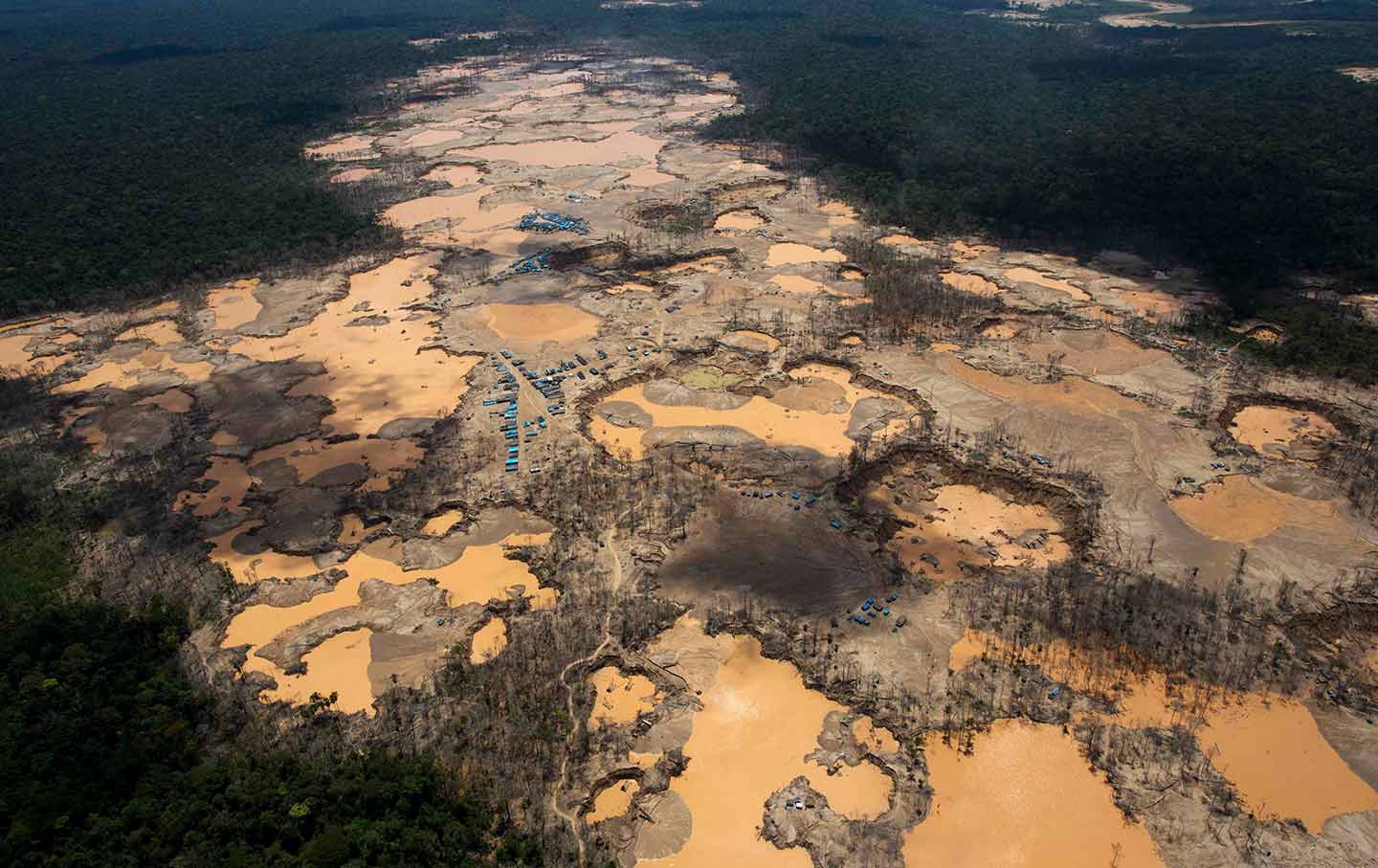
A four-day Madre de Dios mining raid has left rafts, motors and shelters burning in Peru’s southern Amazon. It ran from Thursday 24 to Sunday 27 September 2026.
The Ministerio Público, Peru’s prosecution service, said its environmental unit led the operation. The national police, the navy, the air force and the army supplied transport and security.
No detentions were announced. Reporters who flew in saw miners drop a motor into a pit and run as the helicopter descended.
What the prosecutors put on the record
The unit in charge is the FEMA, the network of prosecutors that handles environmental crime. Its national coordinator, Frank Almanza, directed the work on the ground.
The statement issued on Monday 28 September lists what was wrecked. Rafts, camps, hoppers, fuel drums, pipes, outboard motors and dredging machinery all appear on it.
It carries no totals and no operation name. The prosecutors describe it simply as a megaoperativo, a large joint raid.
The numbers came from elsewhere. The Lima daily La Razón reported 36 dredges and more than 35 camps put out of action in the Inambari district.
It named four sectors: Balata, Primavera, Chiple and Aguas Negras. It valued the equipment at more than S/34 million (about US$9.9 million).
That conversion uses a rate of 3.44 to the US dollar. It is the banking-system selling rate published by Peru’s central bank for 28 September 2026.
A larger count from inside the reserve
Mongabay Latam flew in with the prosecutors and the navy and stayed two days. It reported at least 100 dredges and 200 camps destroyed over the four days.
Those lay inside the Tambopata National Reserve, which the outlet puts at 274,690 hectares. The La Razón figure covers four named sectors of one district.
Both accounts agree on the ending. Mongabay Latam and La Razón each reported that the authorities announced no detainees.
One camp still had half-finished food on the table, a stocked larder and a small refrigerator. Two dogs and a couple of hens had been left behind.
What the dredges do to the forest and the water
The Madre de Dios mining that prosecutors target is alluvial. Crews suck sediment from riverbeds, or from flooded pits cut into the forest.
Peru lost 18,200 hectares of Amazon forest to gold mining in 2025, more than any other Amazon country. The figure comes from the Monitoring of the Andean Amazon Project, known as MAAP.
MAAP is run by the group Conservación Amazónica. Its 2025 numbers were published in June 2026 by the Peruvian environmental outlet Actualidad Ambiental.
Inside the Tambopata reserve the losses are smaller and relentless. The radar monitoring service RAMI recorded 1.68 hectares cleared between July and August 2026.
An earlier RAMI report, from May 2026, put the cumulative loss inside the reserve at about 500 hectares. Mongabay Latam carried both figures.
Margoth Quispe directs Global Conservation for South America, a group that works alongside Peru’s park service. She told Mongabay Latam that roughly 1,000 hectares inside the reserve now show mining activity.
Then there is the mercury. Miners use it to bind gold dust, and it ends up in the water, the fish and the people.
A Mongabay Latam investigation took 3,380 samples from people in 102 native communities and settlements along the Madre de Dios river. It found 78% above the World Health Organization limit.
The state is only now building a steady local measure. In June 2026 the Peruvian Amazon research institute, IIAP, signed an agreement with the main indigenous federation of the region.
It sets up mercury monitoring in ten communities on the Tahuamanu, Las Piedras and Alto Madre de Dios rivers. Each community trains one man and one woman to take the readings.
La Pampa and the belt around the reserve
A protected area in Peru is ringed by a buffer zone, where activity is limited to shield the core. The environment ministry has called La Pampa exactly that, the reserve’s buffer zone.
La Pampa straddles kilometres 106 to 108 of the Interoceanic highway, in the Inambari district. That road is the main route through the region.
Mongabay Latam calls La Pampa the busiest mining area in the department. On Tuesday 14 April 2026 about 5,000 residents blocked the highway from 10 a.m. to 5 p.m. Peru time.
They burned two police pickups, one from the highway police and one from the environmental police. The raid that set it off was at kilometre 110, inside the buffer zone.
What the people who mine there say
Óscar Guerrero Solís leads the Nueva Arequipa settlement at La Pampa. With Benjamín Everett Cala Caso, the teniente gobernador or local state representative, he said the protest answered repeated complaints of police abuse.
They said officers had injured miners and taken gold and cash during raids. Those remain allegations, and no court or authority has ruled on them.
General Michael Flores Álamo, who commands the police in Madre de Dios, described what his officers found. The list included an AR-15 rifle, a pistol without a serial number, a grenade, dynamite and detonators.
The livelihood argument is fought over a register called the REINFO. It lets small-scale miners keep working while they finish becoming legal.
In December 2025 miners shut the Panamericana Sur highway for four days over its terms. Confemin, their national confederation, rejected an extension that stopped at December 2026 and left 50,000 miners out.
Why the machines come back
Congress extended the register anyway. Law 32537 was signed on 27 December 2025.
It runs the process to 31 December 2026, or until a new artisanal mining law takes effect. The paperwork has not kept pace.
Peru’s comptroller reported in September 2026 on the region’s stalled files. More than 2,000 environmental files still sit with the Madre de Dios regional government.
Its inspection measured a gap of one year and 28 days between two transfers to the ministry. The law had allowed 60 days.
Almanza has watched the cycle turn. “We have seen rafts already blown up, and camps burned earlier, found working again,” he told Mongabay Latam.
He was blunt about the trend in the reserve. “Far from falling, I would say it is rising,” he said of illegal mining there.
His own office counts 201 interdiction operations in the region so far this year. That compares with 193 in the whole of 2025.
So enforcement here is not absent. It is frequent, costly and, on the prosecutors’ own arithmetic, still behind the thing it chases.
The levers they name next are duller than a helicopter. Almanza points to customs control over gold and mercury, and to closer supervision of fuel sales.
For the families along these rivers, that is the measure that counts. Burned rafts change a photograph, while fuel, trade and finished files change the arithmetic.
More: Peru coverage, every day from The Rio Times.
Frequently Asked Questions
Where is Madre de Dios, and why does mining there matter?
Madre de Dios is a region in Peru’s southern Amazon, bordering Brazil and Bolivia, with Puerto Maldonado as its capital. The Interoceanic highway runs through it. Alluvial mining there strips forest and releases mercury into rivers that feed indigenous communities and fishing villages. Peru lost 18,200 hectares of Amazon forest to gold mining in 2025, the largest figure of any Amazon country, according to the Monitoring of the Andean Amazon Project.
Was anyone arrested in the September 2026 operation?
No. Mongabay Latam, whose reporters accompanied the prosecutors and the navy, reported that the authorities announced no detainees. The Lima daily La Razón reported the same, and said the machine operators appeared to have left the sites before the teams arrived. The prosecutors’ statement of 28 September 2026 does not mention detentions, and no charges arising from the operation have been announced.
What is the REINFO?
The REINFO is Peru’s integral mining formalisation register. It allows small-scale and artisanal miners to keep operating while they complete the permits, environmental instruments and labour paperwork that would make them legal. Law 32537, signed on 27 December 2025, extended the process to 31 December 2026, or until a new law for small-scale and artisanal mining and its regulations enter into force. Miners’ organisations have repeatedly blocked highways to demand longer deadlines.
What is La Pampa?
La Pampa is the best-known illegal mining zone in Madre de Dios, in the buffer zone of the Tambopata National Reserve. The settlement of Nueva Arequipa sits between kilometres 106 and 108 of the Interoceanic highway, in the Inambari district of Tambopata province. A buffer zone is the belt of land around a protected area where activity is restricted to shield the core. Mining is not permitted inside Peru’s protected natural areas, and dredges are banned in all watercourses.
Sources: Ministerio Público on the joint operation of 24 to 27 September 2026, Mongabay Latam from inside the Tambopata reserve, La Razón on the Inambari sectors and the value of the equipment, Actualidad Ambiental on the MAAP deforestation figures for 2025, Gestión on the comptroller’s report into the stalled files, Ministry of Energy and Mines on Law 32537, Inforegión on the La Pampa protest of April 2026, El Búho on the December 2025 highway blockade, IIAP on indigenous mercury monitoring, Central Bank of Peru exchange-rate series
This article was produced by The Rio Times’ automated newsroom system. How we use AI · Report an error
Read More from The Rio Times