Haiti’s economic agony finds no brake
By Milo Milfort
The high cost of living in Haiti does not allow breathing for a population already suffocated by fuel shortages, fed up with an unprecedented socio-political crisis and battered by the violence of armed gangs fighting for control of the territory.
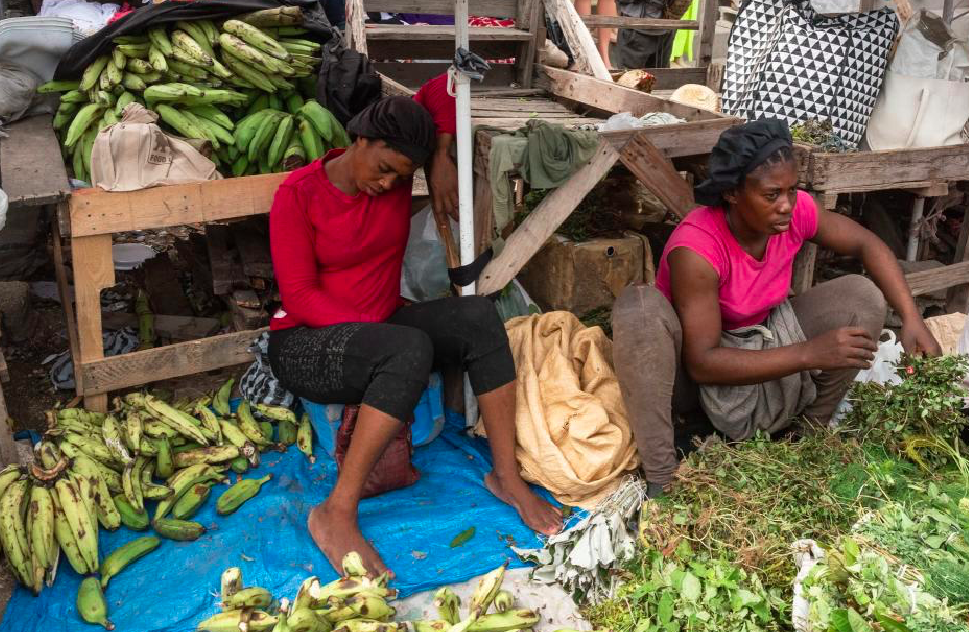
Many Haitians don’t have enough to eat, like Daphney, a trader at the Pétion-Ville Public Market in the capital.
“Life is hard for me. I can’t buy food. I can’t buy anything. I have a business, but people don’t come to buy,” she explains to Efe, accompanied by one of her children as she classifies the gingers with which she tries to earn life.

Another merchant, Marie, has been selling her products for at least three years in the Tabarre market, near the United States embassy in Haiti, and, according to what she tells Efe, she has not seen any change in prices, despite a series of measures announced by the authorities to reduce the cost of living.
“There is no change. The price at which I buy the products has not changed. Chicken is still expensive. Only the price of beans has decreased more or less. A sack of rice sells for 3,000 gourdes (about US$20). So it hasn’t gone down yet,” she says.
BAD PROSPECTS
In Port-au-Prince and in several provincial cities, such as Jacmel, Cap-Haïtien and Petit Goave, demonstrations have been organized to denounce the rise in prices and the shortage of fuel, mobilizations that have left at least five dead and an undetermined number of injured.
The economic situation in Haiti is “worrying”, recognized the Governor General of the Bank of the Republic of Haiti (BRH), Jean Baden Dubois, given the forecasts of a negative growth of 0.4% from the Ministry of Economy and Finance.
The macroeconomy “is full of challenges”, especially after having reached, last June, the highest inflation rate of the last ten years, of 29%, while the price of imported products is increasing by 40%.
VIOLENCE AGGRAVATES THE CRISIS
The armed groups have aggravated the crisis with their actions, among which is the blockade of the southern entrance to Port-au-Prince, which has left four departments isolated from the rest of the country.
There are the centers of production of consumer goods that supply Port-au-Prince, so “this affects the economic situation of the country in a very strong way”, in a context marked by at least three months of serious fuel shortages.
In recent years, armed conflicts, robberies and rapes have increased, while kidnappings and murders reach an alarming level, frightening a population unable to continue with their normal lives.
“Today there are people who simply stay at home. This has a negative impact on the consumption of goods and services. Internal tourism practically does not exist (…) Access to the port at Port-au-Prince customs is increasingly more difficult,” which makes it difficult to attract resources through customs, not to mention the amount of heavy weapons entering the country, Dubois said.
In addition, the Haitian migratory movement, accelerated by the lack of security, is causing the outflow of dollars from the economy to other countries, in particular the neighboring Dominican Republic. “Our remittances to Santo Domingo have increased drastically,” said the head of the BRH.
This means that Haiti is sending more money to the Dominican Republic than it is entering from the neighboring country due to the intense migration of the population fleeing the terror imposed by armed gangs, one of the reasons that explains the 3% reduction in remittances arriving in Haiti.
MEASURES OF POOR RESULT
The Haitian authorities have announced a series of measures to “reduce the cost of living” in the country, among which are the obligation to set prices in gourdes and the injection of between US$100 and US$150 million in the market of foreign exchange.
“Injections never give lasting results. These results are very temporary. It is not the first time that the Central Bank has made injections, but it does not allow the problem to be stabilized,” according to economist Enomy Germain, who considers the authorities incapable of complying with those provisions.
Another of the measures imposed was a significant drop in the dollar against the local currency, but less than a week later the U.S. currency began to recover, with the risk of reaching a much higher price than the previous one, of 150 gourdes per dollar.
With information from EFE
More: Latin America news in English, every day from The Rio Times.
Read More from The Rio Times