
HAITI · CULTURE
Key Facts
- —What is happening Haiti is producing global names in music, books, film and football despite gang violence, and compas, Creole and carnival remain alive at home and abroad as of October 2026.
- —Why it matters Haiti has about 11.9 million people as of 2025, and its artists reach American audiences through books, films and music, so culture travels further than news about the country.
- —The numbers Compas was listed as world heritage in 2025, joumou soup in 2021 and cassava bread in 2024, and Haiti played its first World Cup since 1974 in June 2026, losing all three matches.
- —Who is who Nemours Jean-Baptiste and Webert Sicot formed the konpa band Conjunto International, Edwidge Danticat and Dany Laferrière write, Raoul Peck and Gessica Généus direct films, and Silvio Cator won Olympic silver in 1928.
- —What to watch Whether the 2027 national carnival gets a host city, how insecurity affects artists and journalists, and the Month of Creole Language and Culture now under way in Haiti.
- —What it means for you US travel advice says not to go to Haiti for any reason, so Americans meet Haitian culture through books, films, concerts and diaspora events at home.
Compas, carnival, a prize-winning literary tradition and a World Cup return explain Haiti better than headlines do. Here are the people and traditions that matter in October 2026.
Haiti Culture in Brief
Haiti culture draws on the Creole language, Vodou and the memory of a revolt by enslaved people against France. The World Bank counted 11,906,095 people in Haiti in 2025.
Haiti declared independence on 1 January 1804, after a revolt of enslaved people against France. Creole and French are the two official languages under the constitution.
A 2003 presidential decree recognised Vodou as a religious practice, the US State Department said in its 2012 religious freedom report. One interfaith leader estimated that about half of Haitians practise some form of it, which is not a census figure.
This guide names the key figures in music, writing, film, sport and heritage as of October 2026. It leaves out gossip and anyone whose record could not be checked against a primary source.
Security is the backdrop to all of it. The US State Department tells Americans not to travel to Haiti for any reason, citing kidnapping, crime, terrorism and unrest.
Power and money are covered in the Haiti politics explainer and the guide to who runs Haiti’s economy. The Haiti hub carries daily news from the country.
Compas, the Sound Haiti Gave the World
Compas, also spelled konpa, is a major Haitian dance music. UNESCO added The Compas of Haiti to its Representative List of the Intangible Cultural Heritage of Humanity in 2025.
UNESCO describes a syncopated rhythm that blends African, European and Indigenous influences. Its lyrics deal with love, freedom, peace and resistance, carried by guitars, keyboards and drums.
The saxophonists Nemours Jean-Baptiste and Webert Sicot formed the band Conjunto International. WXPN, a US public radio station, says it first played on 26 July 1955 in Port-au-Prince, which it treats as konpa’s birthday.
Jean-Baptiste called the music konpa dírèk, or direct konpa, WXPN says, because its songs used only two chords. UNESCO describes the dance as a rhythmic walk marked by pelvic movements and alternating steps.
UNESCO calls compas an important part of festive and ritual events and a key element of personal milestones. It describes the genre as a symbol of resilience and shared identity.
Wyclef Jean is a founding member of the Fugees, who won the 1997 Best Rap Album Grammy for The Score. The World Economic Forum says he founded Yéle Haïti in 2005.
Carnival, Kanaval and the Street Festivals
Carnival, called kanaval in Creole, is a major annual festival, and Jacmel is a city known for its arts scene. It opened its 2026 season on Sunday, 18 January 2026, under the theme “Jacmel in Our Dreams,” Haiti En Marche reported.
Le Nouvelliste reported on 9 January 2026 a national theme, “Ayiti Devan,” or Haiti Forward, and a season start on 18 January. Weekend celebrations in Jacmel were set to run until 17 February 2026.
Marching bands such as Paj d’Art, Explosion, Grand Soleil and Asotò took part, along with rope-throwing troupes. The Haiti En Marche report described the day as orderly.
Le Nouvelliste reported on 12 February 2026 that the national carnival would have no host city, with festivities spread across municipalities. It said the last single-city national carnival was in Port-de-Paix in 2021.
Edwidge Danticat wrote a memoir of the festival, After the Dance: A Walk through Carnival in Jacmel, Haiti (2002). It is a good English-language way into the tradition.

Writers and Filmmakers Who Tell Haiti’s Story
Edwidge Danticat is a Haitian novelist who writes in English. The MacArthur Foundation named her a fellow in 2009 for depictions of the Haitian immigrant experience.
Her books include Breath, Eyes, Memory (1994), The Farming of Bones (1999) and Claire of the Sea Light (2013). Her memoir Brother, I’m Dying appeared in 2007.
Dany Laferrière was born in Port-au-Prince on 13 April 1953 and was elected to the Académie française on 12 December 2013. The academy lists his Prix Médicis for L’Énigme du retour in November 2009.
His other titles include L’Odeur du café (1991) and Tout bouge autour de moi (2010). The Académie française is the body that guards the French language.
Frankétienne was born on 12 April 1936 and died in Port-au-Prince on 20 February 2025, aged 88, Le Nouvelliste reported. The paper’s obituary says he founded the Collège Franck Étienne.
Director Raoul Peck made I Am Not Your Negro, an Oscar nominee for Best Documentary (Feature) announced on 24 January 2017. The film uses James Baldwin’s words, read by Samuel L. Jackson.
Peck’s earlier work includes Haitian Corner (1988), Lumumba (2000) and Moloch Tropical (2009). His series Exterminate All the Brutes (2021) is a Peabody Award winner.
Gessica Généus, a Haitian actor, singer and documentarian, premiered Freda in the Un Certain Regard section at Cannes in 2021. Shot in Port-au-Prince in 2019 and 2020, it follows a mother and two daughters and touches on colorism, class and Vodou.
Freda was submitted for the Academy Awards’ International Feature category, only the second Haitian film to be. Francis Ford Coppola served as executive producer.
Painters and the Haitian Art Scene
The Centre d’Art in Port-au-Prince was created in 1944 and recognised as a public utility in 1947. It says the American watercolorist DeWitt Peters drove its creation when Haiti had no art galleries or public art schools.
The Centre says it launched Hector Hyppolite, Georges Liautaud and Édouard Duval Carrié, and the so-called naïve movement from 1945. These are the Centre’s own claims, not an independent ranking.
Caribbean Beat, a regional magazine, describes Hyppolite as a Vodou priest whose work Peters first noticed on a bar door in Montrouis. It says Philomé Obin was born on 20 July 1892 near Cap-Haïtien and died in August 1986.
Caribbean Beat adds that Obin painted Haitian history and northern daily life, teaching at the Centre’s Cap-Haïtien annex. The January 2010 earthquake destroyed Holy Trinity Cathedral, which held two large Obin murals.
The Centre says the quake brought down its building and killed its director, Francine Murat. It stayed closed to the public for four years and reopened in November 2014 in temporary facilities in its garden.
Football, Athletics and Sport Icons
Haiti beat Nicaragua 2-0 on 18 November 2025 to reach its first World Cup since 1974, Le Nouvelliste reported. Don Deedson Louicius scored the opener.
At the finals Haiti lost 1-0 to Scotland on 13 June 2026 at Gillette Stadium in Foxborough, Massachusetts. Coach Sébastien Migné’s side then lost 3-0 to Brazil and 4-2 to Morocco, finishing the group without a point.
Wilson Isidor scored a long-range goal against Morocco, Arab News reported. Haiti also benefited from an own goal by the Moroccan goalkeeper in that match.
Haiti’s previous World Cup was in 1974 in West Germany, Le Nouvelliste noted. Emmanuel Sanon scored in the 46th minute against Italy on 15 June 1974 in Munich, Concacaf records.
That goal ended the Italian goalkeeper Dino Zoff’s run of 1,142 minutes without conceding. Italy went on to win the match 3-1.
In athletics, Silvio Cator won silver in the long jump at the 1928 Olympics, Olympics.com records. A few weeks later he jumped 7.937 metres, a world record and the first jump beyond 26 feet.
Heritage, Food and the Creole Language
Haiti has three elements on UNESCO’s list of intangible heritage. Joumou soup was added in 2021, cassava bread in 2024 and compas in 2025.
Joumou soup is a pumpkin soup with vegetables, plantains, meat, pasta and spices, eaten traditionally on 1 January, Independence Day. UNESCO says it was once reserved for enslavers and that Haitians claimed it after independence.
Cassava bread was listed in 2024 together with Cuba, the Dominican Republic, Honduras and Venezuela. UNESCO says households and communities pass the knowledge down informally.
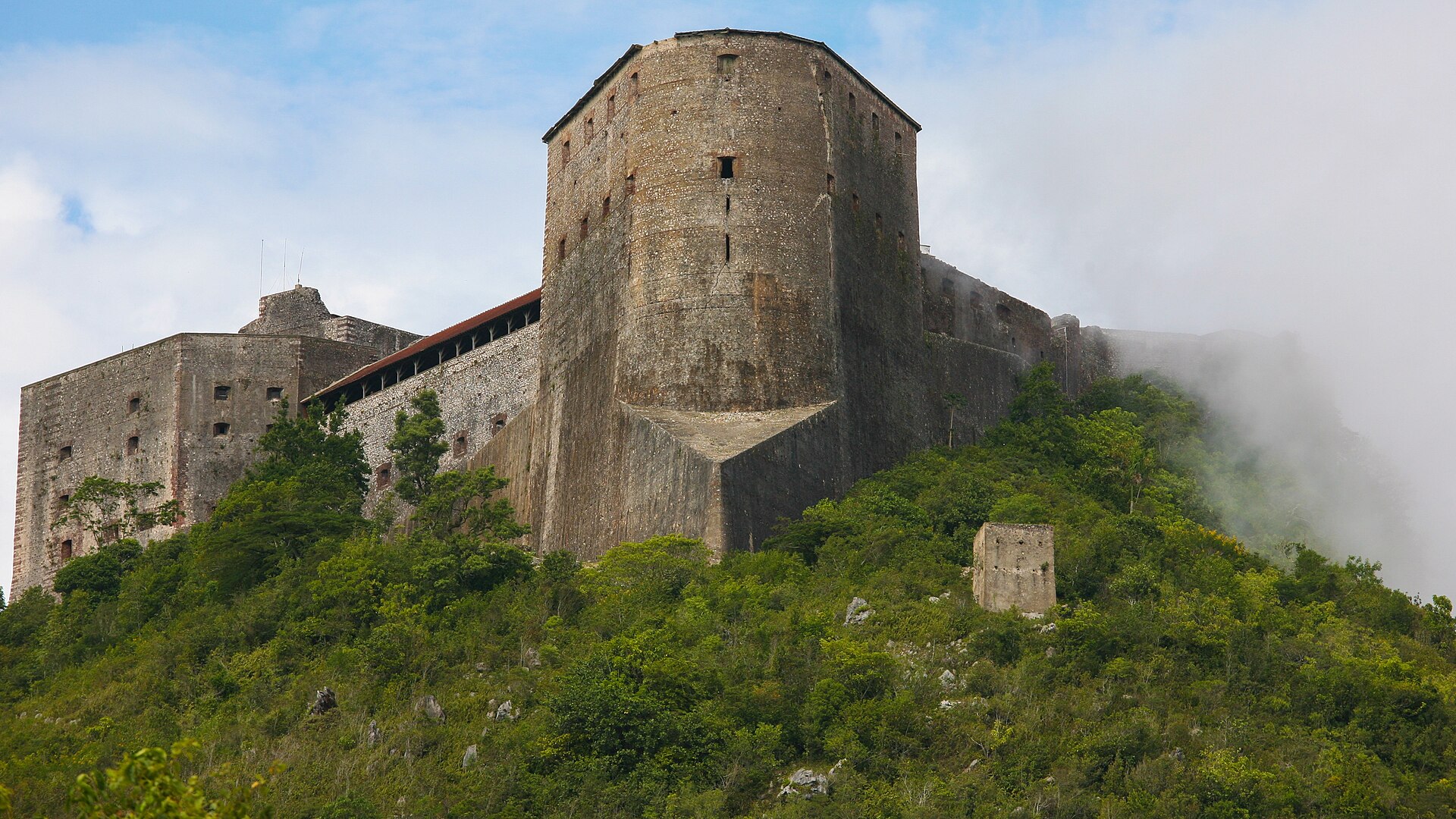
The National History Park with the Citadelle, Sans-Souci Palace and Ramiers is Haiti’s only World Heritage property, inscribed in 1982. UNESCO calls these the first monuments built by formerly enslaved people who had won their freedom.
Henri Christophe, who proclaimed himself king in the north in 1811, built the Citadelle. The fortress and Sans-Souci Palace were inaugurated in 1813, and the park was created by decree in 1978.
UNESCO’s tentative list also holds the historic centre of Jacmel, dated 2004, and the Matheux national historic park, dated 2024. Neither is yet a World Heritage site.
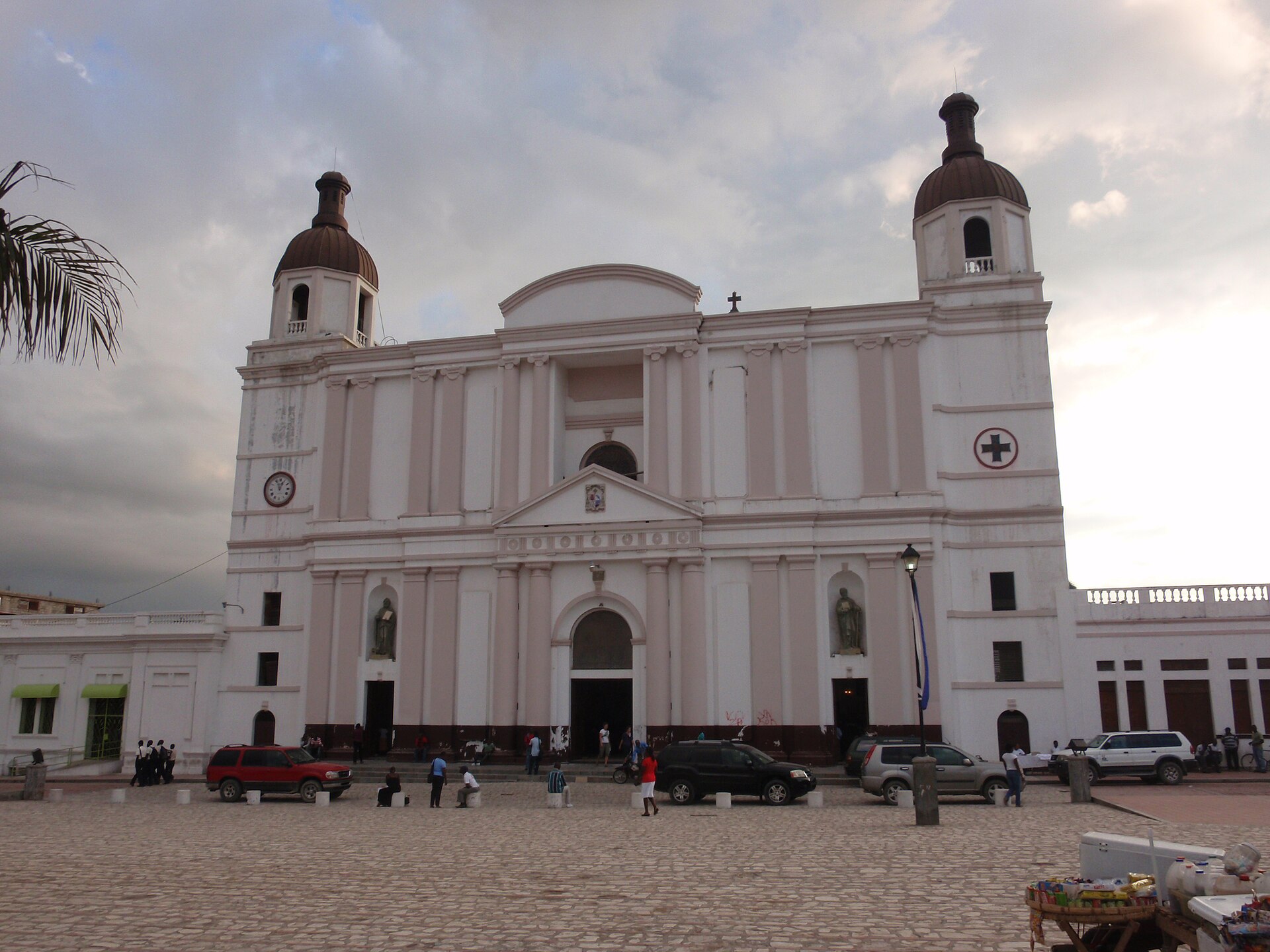
The photo below shows the cathedral on the main square of Cap-Haïtien, a port city in northern Haiti. The caption follows the Wikimedia Commons file description.
The Akademi Kreyòl Ayisyen, an institution that promotes Haitian Creole, is running a Month of Creole Language and Culture. Its communication director presented the programme on 22 October 2026 under the theme “Lang kreyòl: Fòs, Kreyasyon ak Konesans.”
Media, Radio and the Pressure on Journalists
Radio reached Haiti 100 years ago. President Louis Borno inaugurated HHK, which Le Nouvelliste calls Haiti’s first radio station, on 22 October 1926.
Le Nouvelliste, a Haitian daily, also publishes an English edition. It is one of the regional sources used for this guide.
Armed gangs now threaten that world. The Committee to Protect Journalists reported on 10 September 2026 that radio host Joseph Willard Vancol was found dead after abduction.
On 12 September 2026 the committee reported that gunmen abducted Wesly Renaud Jean of Radio-TV Métropole in Port-au-Prince, seeking ransom. In November 2025 a reported arson attack hit Radio Émancipation, the fifth on a station in six months.
In January 2026 the committee urged the Transitional Presidential Council to rescind a decree that broadens criminal defamation laws. Press freedom is therefore part of the cultural picture, not separate from it.
What It Means for US Readers
Most Americans will meet Haitian culture at home. Danticat’s novels, Peck’s films and compas concerts are available without any travel.
US advice is not to travel to Haiti, so buying books and music and attending diaspora events are the practical options. The State Department cites kidnapping, crime, terrorist activity, civil unrest and limited health care.
For the political and security background, read the Haiti geopolitics pillar and the election and travel guide for US readers. This guide quotes no Haitian gourde prices, and open.er-api.com showed about 131 gourdes per US$ on 23 October 2026.
What Is Not Known
It is not confirmed whether Port-au-Prince held a national carnival in 2026. Le Nouvelliste reported no host city in February, and no later report of a Port-au-Prince event was found.
This guide does not rank Haitian painters or sculptors, and its visual-arts facts come from the Centre d’Art and one magazine. There is also no official count of Haitian musicians, filmmakers or festivals.
Raoul Peck’s birthplace, any government roles and Wyclef Jean’s birthplace were not checked against a primary source and are left out. The population figure is the World Bank’s, because the national statistics office was not consulted.
Frequently Asked Questions
What is Haiti culture best known for?
Haiti culture is known for compas music, carnival, Vodou, Creole-language literature and football. UNESCO lists compas, joumou soup and cassava bread as intangible heritage.
What is compas?
Compas, or konpa, is a Haitian dance music with a syncopated rhythm. WXPN dates its birth to 1955, and UNESCO listed it in 2025.
Who are the most famous Haitian writers?
Edwidge Danticat, a 2009 MacArthur Fellow, writes in English, and Dany Laferrière sits in the Académie française. Frankétienne, an author who founded a Port-au-Prince school, died in February 2025.
Which Haitian films should I know?
Raoul Peck’s I Am Not Your Negro was nominated for an Oscar in 2017. Gessica Généus’s Freda premiered at Cannes in 2021.
How did Haiti do at the 2026 World Cup?
Haiti lost all three group matches, 1-0 to Scotland, 3-0 to Brazil and 4-2 to Morocco. It was the team’s first World Cup since 1974.
Is it safe for Americans to visit Haiti?
The US State Department says not to travel to Haiti for any reason because of kidnapping, crime, terrorism and unrest. Check its advisory before making any plans.
Sources: UNESCO, The Compas of Haiti; UNESCO, joumou soup; UNESCO, cassava bread; UNESCO World Heritage Centre, National History Park; UNESCO, Haiti World Heritage and tentative list; World Bank, Haiti; Constitution of Haiti; US State Department, 2012 religious freedom report; US State Department, Haiti travel advisory; MacArthur Foundation, Edwidge Danticat; Académie française, Dany Laferrière; PBS, I Am Not Your Negro nomination; Velvet Film, Raoul Peck; Filmmaker Magazine, Freda; Le Nouvelliste, Frankétienne; Le Nouvelliste, World Cup qualification; Le Nouvelliste, Haiti v Scotland; Le Nouvelliste, radio in Haiti; Le Nouvelliste, Akademi Kreyòl Ayisyen; Haiti En Marche, Jacmel Carnival 2026; Arab News, Morocco v Haiti; Concacaf, 1974 World Cup; Olympics.com, Silvio Cator; Committee to Protect Journalists, Haiti; WXPN, birth of konpa; World Economic Forum, Wyclef Jean; Grammy.com, Best Rap Album 1997; Peabody Awards, Exterminate All the Brutes; Le Nouvelliste, carnival theme; Le Nouvelliste, decentralised carnival; CPJ, Wesly Renaud Jean; Centre d’Art; Caribbean Beat, Haitian art; open.er-api.com exchange rates (all accessed 23 October 2026).
This article was produced by The Rio Times’ automated newsroom system. How we use AI · Report an error · Editorial responsibility: Matthias Camenzind, Editor-in-Chief
Expat Guide to Haiti
What The Rio Times publishes for foreigners who live in or move to Haiti.
Start here
Coming up in Haiti
Understand Haiti
Read More from The Rio Times