Haiti in Latin America, Its Role, Weight and Alliances

GUIDES · HAITI
Key Facts
- —Haiti in the region About 11.9 million people in 2025, or 1.8% of Latin America and the Caribbean, but only 0.4% of its economy (World Bank).
- —Who governs Prime Minister Alix Didier Fils-Aimé, sole head of the executive since the transitional council’s mandate ended on 7 February 2026. There has been no president since July 2021.
- —Regional clubs A full member of CARICOM, the OAS and CELAC. Haiti began joining CAF, the regional development bank, in August 2026.
- —Security The UN-authorised Gang Suppression Force, capped at 5,550 personnel, has a mandate to 31 March 2027 (Security Council, 29 September 2026).
- —Neighbour The Dominican Republic deported 265,412 undocumented foreigners from January to August 2026, its migration agency says.
- —US link Level 4, Do Not Travel, since the advisory of 10 July 2026. Duty-free US access for Haitian apparel now runs to 31 December 2028.
Haiti is the most populous country in the Caribbean Community, with the lowest income per head in Latin America and the Caribbean. Its regional role now runs through a UN-authorised anti-gang force, a hard border and an unfinished election.
For a US reader, the Haiti continent story matters because migration, security and apparel trade all lead to the United States.
This guide sets out Haiti’s weight, its regional seats and the alliances and disputes that shape it in October 2026. Every figure is dated and sourced, and what is still open is listed at the end.
Haiti’s Weight in Numbers
The World Bank puts Haiti’s population at 11.9 million in 2025. That is about 1.8% of the 666.6 million people in Latin America and the Caribbean.
It also makes Haiti slightly larger than the Dominican Republic, its only land neighbour, at 11.5 million.
Economic weight is far smaller. Haiti’s gross domestic product was about US$32.1 billion in 2025, against US$7.40 trillion for the whole region.
That is roughly 0.4% of regional output, and about a quarter of the Dominican economy of US$127.4 billion.
Income per head was about US$2,694 in 2025, the World Bank says. The regional average was US$11,095 and the Dominican figure US$11,059.
Among the regional economies with 2025 data, Haiti ranks last, behind Nicaragua at US$3,173.
The economy has shrunk in real terms every year from 2019 to 2025, according to World Bank data. The contraction was 4.2% in 2024 and 2.7% in 2025.
Over the same two years the regional economy grew by about 2.3% a year.
Money sent home by Haitians abroad keeps the country afloat. Personal remittances equalled 16.9% of GDP in 2024, against 2.5% for the region and 9.1% for the Dominican Republic.
Only 55.6% of Haitians lived in towns and cities in 2025, against 81.5% across the region.
Haiti in CARICOM, the Bloc It Leads by Size
CARICOM, the Caribbean Community, groups 15 member states and eight associate members. Haiti is a full member, alongside Jamaica, Trinidad and Tobago, Guyana, Suriname and smaller island states.
By population Haiti dominates the bloc. On World Bank figures for 2025, about three in five people living in CARICOM’s sovereign member states are Haitian.
Jamaica, the next largest, has 2.8 million people.
In current US dollars Haiti also reported the largest economy among CARICOM members in 2025, at about US$32.1 billion. Guyana, the oil producer, followed at US$27.1 billion.
Per head, though, Guyana’s income of US$32,414 is twelve times Haiti’s.
In October 2026 Haiti took the chair of COHSOD, CARICOM’s Council for Human and Social Development. The term lasts one year, Le Nouvelliste reported.
CARICOM has also acted as a broker in Haitian politics. In August 2026 its secretary-general, Carla Barnett, joined the OAS chief on a mission to Port-au-Prince on security and elections.
The OAS, CELAC and Latin American Lenders
The Organization of American States, or OAS, groups all 35 independent states of the Americas. Its secretary-general, Albert Ramdin, led a four-day mission to Haiti that closed on 19 August 2026.
Ramdin called security and elections the two most urgent priorities for the country, Le Nouvelliste reported. He urged partners to honour their security commitments and to speed up voter identification and public information.
CELAC, the Community of Latin American and Caribbean States, is a forum that leaves out the United States and Canada. Haiti’s foreign minister, Raina Forbin, took part in the CELAC–Africa High-Level Forum in Bogotá on 20 and 21 March 2026.
On the sidelines she met the foreign ministers of Mexico and Colombia, according to Le Quotidien 509.
Forbin, minister of foreign affairs and worship since March 2026, has also turned Haiti towards Latin American finance. On 17 August 2026 she signed an immunities agreement with CAF, which is the Development Bank of Latin America and the Caribbean.
The same day Haiti’s finance minister signed a share subscription agreement, Le Nouvelliste reported. Both steps are part of Haiti’s accession to CAF as a shareholder member, and no amount was disclosed.
Latin America has a longer record in Haiti too. MINUSTAH, the UN stabilisation mission, ran from 1 June 2004 to 15 October 2017.
Brazil sent more than 30,000 military personnel to it over 13 years, its defence ministry said in 2017.
The Dominican Republic, a Neighbour Under Strain
Haiti and the Dominican Republic share the island of Hispaniola. The Dominican president, Luis Abinader, is serving a term that runs from 2024 to 2028, his office states.
Migration dominates the relationship. The Dominican General Directorate of Migration says it deported 265,412 undocumented foreigners from January to August 2026, a monthly average of 33,176.
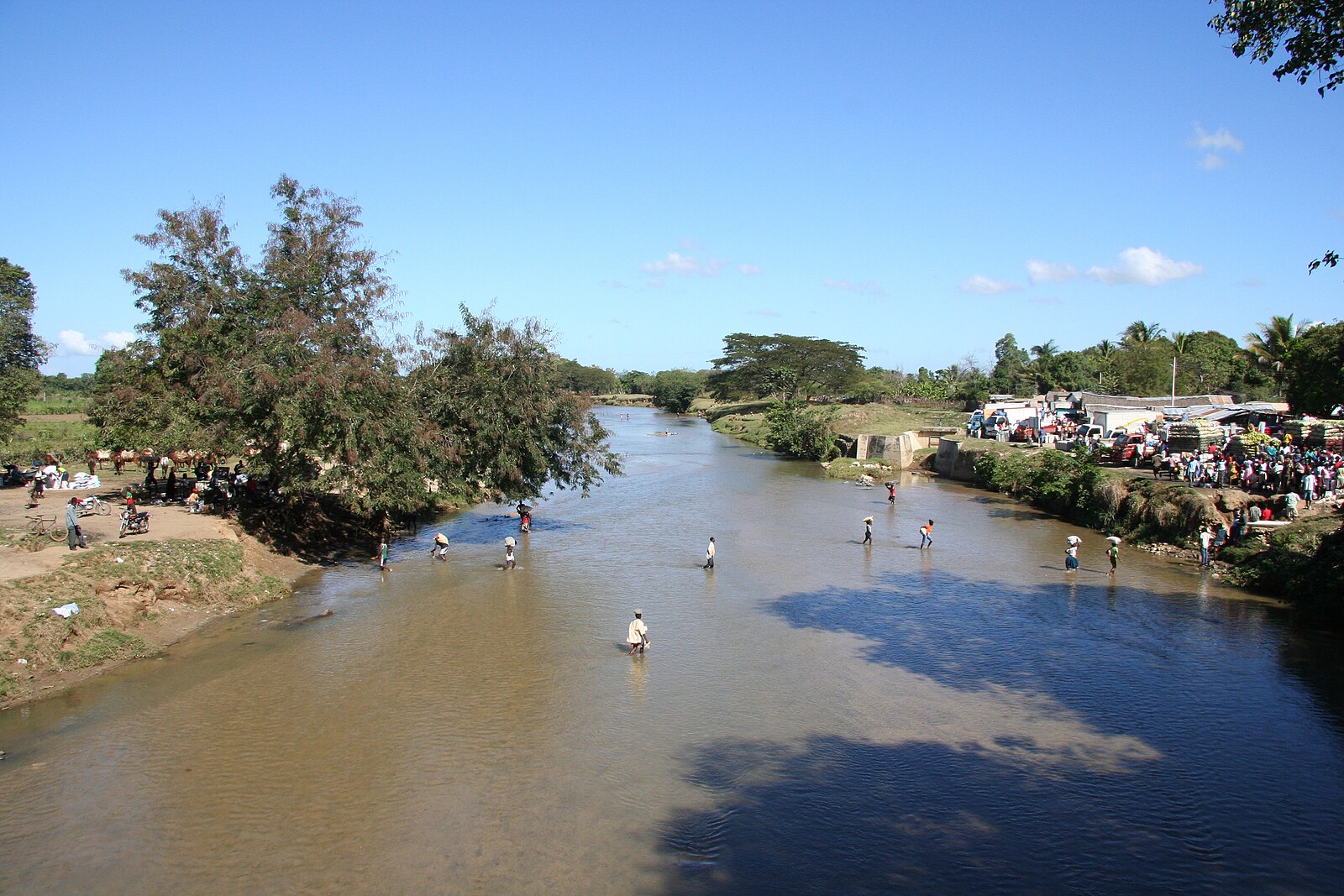
In August alone it handed 34,195 people to Haitian authorities. They crossed at Dajabón, Elías Piña, Jimaní and Pedernales, the four main border posts.
Diplomacy continues despite the strain. On 3 September 2026 Forbin met her Dominican counterpart at the site of CODEVI, the Industrial Development Company, Le Nouvelliste reported.
They discussed border governance, migration management and more air links.
Kenya, the UN and the Gang Suppression Force
Haiti’s security now rests on a force that is not UN peacekeeping. The Security Council authorised the Gang Suppression Force, or GSF, on 30 September 2025 under resolution 2793.
The vote was 12 in favour, none against and three abstentions, from China, Pakistan and Russia. The resolution set a ceiling of 5,500 uniformed personnel and 50 civilians.
It allows the force to “neutralize, isolate and deter” gangs.
The GSF replaced the Multinational Security Support mission, first authorised in October 2023. Kenyan personnel formed the bulk of that mission and left in April 2026, Security Council Report notes.
New contingents arrived from Chad, Jamaica, Mongolia and Sri Lanka. At the September 2026 vote, the US representative praised troops and police from El Salvador and Guatemala, two Latin American contributors, Caribbean National Weekly reported.
Panama and the United States hold the pen on Haiti at the Council.
Strength remains the weak point. As of 8 July 2026, the GSF’s military component had 1,083 personnel, according to the UN Secretary-General’s report.
A UN Support Office in Haiti, set up under the same resolution, has been fully operational since 1 April 2026.
On 29 September 2026 the Council adopted resolution 2829, again by 12 votes with three abstentions. It extends the force’s mandate by six months, to 31 March 2027.
On 27 July 2026 the force signed an agreement with the Haitian government on its legal status and immunities, Security Council Report notes. Jack Christofides is the special representative for the GSF.
Washington’s Role, From Sanctions to Trade
The United States is Haiti’s most important outside power. Secretary of State Marco Rubio designated the gang coalitions Viv Ansanm and Gran Grif as Foreign Terrorist Organizations on 2 May 2025.
A presidential proclamation signed on 4 June 2025 fully suspended the entry of Haitian nationals as immigrants and visitors. It took effect on 9 June 2025.
The Department of Homeland Security published a notice on 28 November 2025 ending Haiti’s Temporary Protected Status. That decision has since been fought in US courts.
Trade runs the other way. Congress extended the HOPE and HELP programmes, which give Haitian apparel duty-free access to the US market, to 31 December 2028.
The Haitian government welcomed the extension in early September 2026.
How Haiti Compares With Its Peers
Against its neighbour, Haiti has a slightly larger population but a quarter of the output. The Dominican Republic grew 2.1% in 2025 while Haiti shrank, on World Bank figures.
Against the poorer Central American states, the gap is narrower but still clear. Nicaragua’s income per head was about US$3,173 in 2025 and Honduras’s about US$3,598, both above Haiti’s US$2,694.
Within the Caribbean, Jamaica earned about US$8,003 per head in 2025 and Suriname about US$7,070. Remittances weigh about as much in Jamaica, at 16.2% of GDP in 2024, as in Haiti.
They weigh more in Nicaragua and Honduras, at over a quarter of GDP.
Politically Haiti also stands apart. It has held no national election since 2016 and has had no president since Jovenel Moïse was assassinated in July 2021.
What It Means for US Readers
For investors, Haiti is a small market with one clear US channel. That channel is apparel assembly under HOPE and HELP.
The 2028 horizon gives buyers some planning certainty, though security risk remains high.
For travellers, the State Department advice is unambiguous. Its Level 4 Do Not Travel warning, issued on 10 July 2026, cites crime, kidnapping, terrorism, unrest and limited health care.
A national state of emergency has been in force since March 2024.
For Haitian Americans, the key questions are TPS, the entry ban and deportations from the US and the Dominican Republic. Remittances worth near a sixth of the economy depend on how those rules settle.
For policy watchers, Haiti is a test of US-led coalition security without a UN peacekeeping force. The March 2027 mandate date and the delayed vote are the two markers to follow.
Connected Coverage
Haiti Gang Suppression Force Faces UN Renewal Vote After Reprisal Kills at Least 11
US Renews Haiti Police Support, Backs 4,000 Officers
Haiti Leaves December Election Without a Date
UN Says Haiti Freed 3 Arms Suspects Held by Dominicans
Haiti Gang Violence Has Killed or Injured 5,700 People
Dominican Republic Geopolitics 2026, US, China, Gulf
What Is Not Known
No new date for Haiti’s general election has been set. The electoral council suspended the campaign in October 2026 and extended candidate registration to 31 October, Anadolu Agency reported.
It is not known when, or whether, the Gang Suppression Force will reach its 5,550 ceiling. Funding beyond 31 March 2027 is also open.
The final court outcome on Haitian TPS in the United States is unsettled. How far CAF will lend to Haiti once it becomes a shareholder has not been disclosed.
Frequently Asked Questions
Is Haiti part of Latin America?
Yes. Haiti is counted in Latin America and the Caribbean by the World Bank and belongs to the OAS and CELAC. It is also a full member of CARICOM, the Caribbean Community.
How big is Haiti compared with the rest of the region?
Haiti had about 11.9 million people in 2025, roughly 1.8% of the region. Its economy of about US$32.1 billion was only about 0.4% of regional output, World Bank data show.
Who runs Haiti in 2026?
Prime Minister Alix Didier Fils-Aimé has led the executive alone since the transitional presidential council’s mandate ended on 7 February 2026. Haiti has had no president since July 2021.
What is the Gang Suppression Force?
It is a UN-authorised multinational force created by Security Council resolution 2793 on 30 September 2025. It has a ceiling of 5,550 personnel, and resolution 2829 extended its mandate to 31 March 2027.
Why are Haiti and the Dominican Republic at odds?
Migration is the main issue. The Dominican migration agency deported 265,412 undocumented foreigners from January to August 2026, including 34,195 people handed to Haitian authorities in August.
Can Americans travel to Haiti?
The State Department rates Haiti Level 4, Do Not Travel, in an advisory issued on 10 July 2026. It cites crime, kidnapping, terrorism, unrest and limited health care.
Sources: World Bank Open Data, population, GDP, remittances, urbanisation, https://data.worldbank.org/country/haiti; UN Security Council, resolution 2793 meeting coverage, https://press.un.org/en/2025/sc16185.doc.htm; Security Council Report, Haiti GSF renewal, https://www.securitycouncilreport.org/whatsinblue/2026/09/haiti-vote-on-a-draft-resolution-extending-the-mandate-of-the-gang-suppression-force-and-un-support-office.php; UN Peacekeeping, MINUSTAH, https://peacekeeping.un.org/en/mission/minustah; Brazil Ministry of Defence, MINUSTAH statement, https://www.gov.br/defesa/pt-br/arquivos/2017/pronunciamento/junho/minustah.pdf; CARICOM, member states, https://caricom.org/member-states-and-associate-members/; OAS, member states, https://www.oas.org/en/member_states/default.asp; Dominican General Directorate of Migration, August 2026, https://migracion.gob.do/en/in-august-dgm-deported-34195-undocumented-immigrants-through-border-crossings/; Presidency of the Dominican Republic, https://presidencia.gob.do/noticias; US State Department, Haiti travel advisory, https://travel.state.gov/content/travel/en/traveladvisories/traveladvisories/haiti-travel-advisory.html; White House, proclamation of 4 June 2025, https://www.whitehouse.gov/presidential-actions/2025/06/restricting-the-entry-of-foreign-nationals-to-protect-the-united-states-from-foreign-terrorists-and-other-national-security-and-public-safety-threats/; Federal Register, Haiti TPS termination, https://www.federalregister.gov/documents/2025/11/28/2025-21379/termination-of-the-designation-of-haiti-for-temporary-protected-status; Le Nouvelliste, CAF agreement, https://lenouvelliste.com/en/article/270976/signature-dun-accord-entre-le-maec-et-la-banque-de-developpement-de-lamerique-latine-et-des-caraibes; Le Nouvelliste, Haiti and Dominican foreign ministers, https://lenouvelliste.com/en/article/271573/cooperation-meeting-between-the-haitian-minister-of-foreign-affairs-and-her-dominican-counterpart; Le Nouvelliste, OAS mission, https://lenouvelliste.com/en/article/271063/albert-ramdin-discusses-his-mission-in-haiti-and-calls-for-accelerated-security-efforts; Le Nouvelliste, HOPE/HELP extension, https://lenouvelliste.com/en/article/271568/the-government-praises-the-extension-of-hopehelp-programs-until-2028; Le Quotidien 509, Forbin and CELAC, https://lequotidien509.com/en/?p=31431; Caribbean National Weekly, GSF renewal, https://www.caribbeannationalweekly.com/posts/un-security-council-extends-haiti-gang-suppression-force-mandate-through-march-2027; Anadolu Agency, election calendar, https://www.aa.com.tr/en/americas/haiti-postpones-elections-as-political-instability-continues/4080437. All accessed 13 October 2026.
This article was produced by The Rio Times’ automated newsroom system. How we use AI · Report an error · Editorial responsibility: Matthias Camenzind, Editor-in-Chief
Expat Guide to Haiti
What The Rio Times publishes for foreigners who live in or move to Haiti.
Start here
Coming up in Haiti
Understand Haiti