GUINEA-BISSAU · NEIGHBOURHOOD
Key Facts
- The country Guinea-Bissau has 2.25 million people and a US$2.53 billion economy as of October 2026 (2025 data), on the Atlantic coast.
- The neighbours Senegal to the north and Guinea to the east and south, plus an Atlantic coast with the Bijagós archipelago.
- The transition Soldiers seized power on 26 November 2025, three days after elections, and the West African bloc ECOWAS suspended the country the next day.
- Cashew and trade India recorded US$72.3 million of imports from Guinea-Bissau in 2023, against US$217 thousand for Senegal.
- The Senegal link Senegal chairs ECOWAS and mediates in Bissau, and about 100 women cross the Mpack and São Domingos border daily.
- Money and blocs Guinea-Bissau shares the CFA franc with seven other states, including Burkina Faso, Mali and Niger, which left ECOWAS in January 2025.
- What it means for US readers The State Department rates Guinea-Bissau Level 3, Guinea Level 2 and Senegal Level 1, with no US embassy in Bissau.

The Guinea-Bissau neighbours, Senegal to the north and Guinea to the east and south, shape how this small Atlantic country trades, moves people and finds mediators when its politics break down. Soldiers seized power there on 26 November 2025, and Senegal, whose president chairs the regional bloc ECOWAS as of October 2026, leads the bloc’s mediation.
In Plain English
ECOWAS: the Economic Community of West African States, a 12-member regional bloc headquartered in Abuja, Nigeria, that suspended Guinea-Bissau on 27 November 2025. AES: the Alliance of Sahel States, made up of Burkina Faso, Mali and Niger, which left ECOWAS with effect from 29 January 2025.
UMOA: the West African Monetary Union, whose eight member states share one currency, the CFA franc. BCEAO: the Central Bank of West African States, an international public institution seated in Dakar that issues that currency.
Mirror data: trade figures reported by the partner country instead of the country itself, which this guide uses because Guinea-Bissau’s own reports stop at 2018 in World Bank tables. WITS: the World Bank’s trade database, the source of every trade figure here.
UNHCR: the UN refugee agency, which counts refugees country by country. World Bank: the global development lender whose data on population, income and remittances this guide uses.
Guinea-Bissau Neighbours at a Glance
Guinea-Bissau had 2.25 million people in 2025 and covers 36,125 square kilometres, which works out at about 62 people for every square kilometre as of October 2026 in World Bank data. Its economy produced US$2.53 billion in 2025, or US$1,124 per person.
Senegal, to the north, has 18.93 million people, more than eight times as many, and a US$37.0 billion economy. Guinea, to the south, has 15.10 million people and a US$28.3 billion economy.
The regional central bank, the BCEAO, describes Guinea-Bissau as bounded by Senegal to the north, by Guinea to the east and south, and by the Atlantic Ocean. The World Bank adds that the coast includes the Bijagós archipelago, which it counts as 88 islands.
Output per person was US$1,955 in Senegal and US$1,877 in Guinea, against US$1,124 in Guinea-Bissau as of October 2026. Growth in 2025 was 5.8% in Guinea-Bissau, 6.7% in Senegal and 7.4% in Guinea.
The World Bank calls Guinea-Bissau one of the world’s poorest and most fragile countries and projects growth of 4.9% in 2026, helped by strong cashew exports. It projects inflation at 2.0% after 0.9% in 2025, and a current account deficit of 7.1% of GDP, up from 4.9%.
The Rio Times Guinea-Bissau explained guide covers politics, the economy and risks in more depth. Daily coverage of the region sits on the Africa page.
Senegal, the Northern Neighbour
Senegal’s foreign ministry said on 27 October 2026 that President Bassirou Diomaye Faye chairs the ECOWAS Conference of Heads of State and Government. In its own words, Senegal holds the ECOWAS chair and acts as the mediator in Guinea-Bissau, which puts the northern neighbour at the centre of the regional response.
ECOWAS records the Governor of Ziguinchor, Mor Talla Tine, saying in March 2026 that about 100 women cross the Mpack and São Domingos border every day without adequate knowledge of the travel documents required. On 16 March 2026 ECOWAS presented its national biometric identity card to 262 women traders from the two border communities, with the governors of Ziguinchor and Cacheu present.
Senegal reported US$157.4 million of exports to Guinea-Bissau in 2023, 3.0% of its total exports of US$5.32 billion, according to World Bank trade tables. It reported buying only US$217 thousand of goods from Guinea-Bissau that year, so the reported flow runs almost entirely one way.
The State Department’s advisory for The Gambia, dated 16 January 2026, says a separatist rebel group operates in the Casamance region of southern Senegal. It adds that there has been sporadic fighting along The Gambia’s southern border in the recent past.
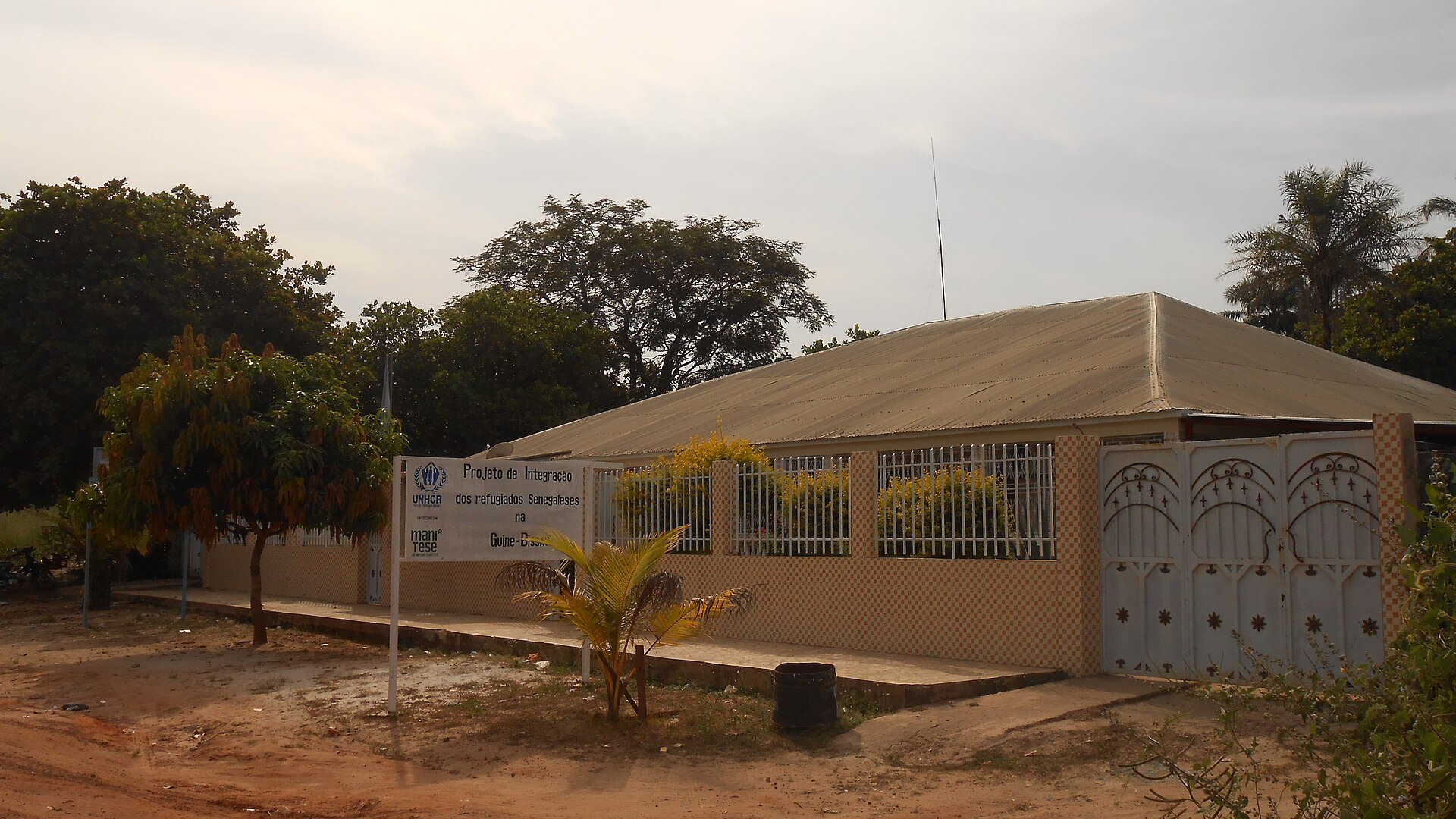
The sign in the photo below, taken in 2017, belongs to a United Nations project for the integration of Senegalese refugees in São Domingos, near the Senegal border. UNHCR counted only 8 Senegalese asylum seekers and no Senegalese refugees in Guinea-Bissau at the end of 2025.
Guinea, the Southern Neighbour
Guinea, to the south, is the larger and faster-growing neighbour: its economy grew 7.4% in 2025 and reached US$28.3 billion, more than 11 times Guinea-Bissau’s output as of October 2026. Its population of 15.10 million is about 6.7 times Guinea-Bissau’s.
The Guinean presidency’s website names Mamadi Doumbouya as President of the Republic in items dated 22 October 2026. ECOWAS recorded that the Supreme Court validated nine candidates for Guinea’s presidential election of 28 December 2025, including the military transition’s president, General Mamadi Doumbouya.
ECOWAS announced that the West African Power Pool will hold its 21st General Assembly in Conakry on 6 and 7 November 2026, under the high patronage of President Doumbouya. The pool’s 60 member utilities will discuss cross-border electricity trade and the regional electricity market, ECOWAS says.
The State Department rated Guinea Level 2, exercise increased caution, on 25 February 2026, citing crime, unrest and inadequate health infrastructure. That is one level below the Level 3 it gives Guinea-Bissau, whose advisory was issued on 11 December 2025.
Cashew and Who Buys It
The World Bank’s overview says strong cashew production and exports are expected to support Guinea-Bissau’s economy in 2026, even as growth slows to 4.9% from 5.8% in 2025. It adds that agriculture and services will remain the key drivers of growth.
Guinea-Bissau’s own reports to the World Bank’s trade tables stop at 2018, when it reported total exports of US$244.8 million. This guide therefore uses mirror data, which are figures reported by the partner country.
India reported imports from Guinea-Bissau of US$72.3 million in 2023, down from US$202.7 million in 2022. Of the 2023 figure, US$71.7 million, or 99%, fell in the vegetable product group, which includes cashew nuts.
The data reviewed do not split that group into individual products, so the cashew share of India’s purchases is not confirmed here. Four other reporters checked recorded far smaller 2023 purchases, from US$1.5 thousand for China to US$228 thousand for Portugal, with US$217 thousand for Senegal.
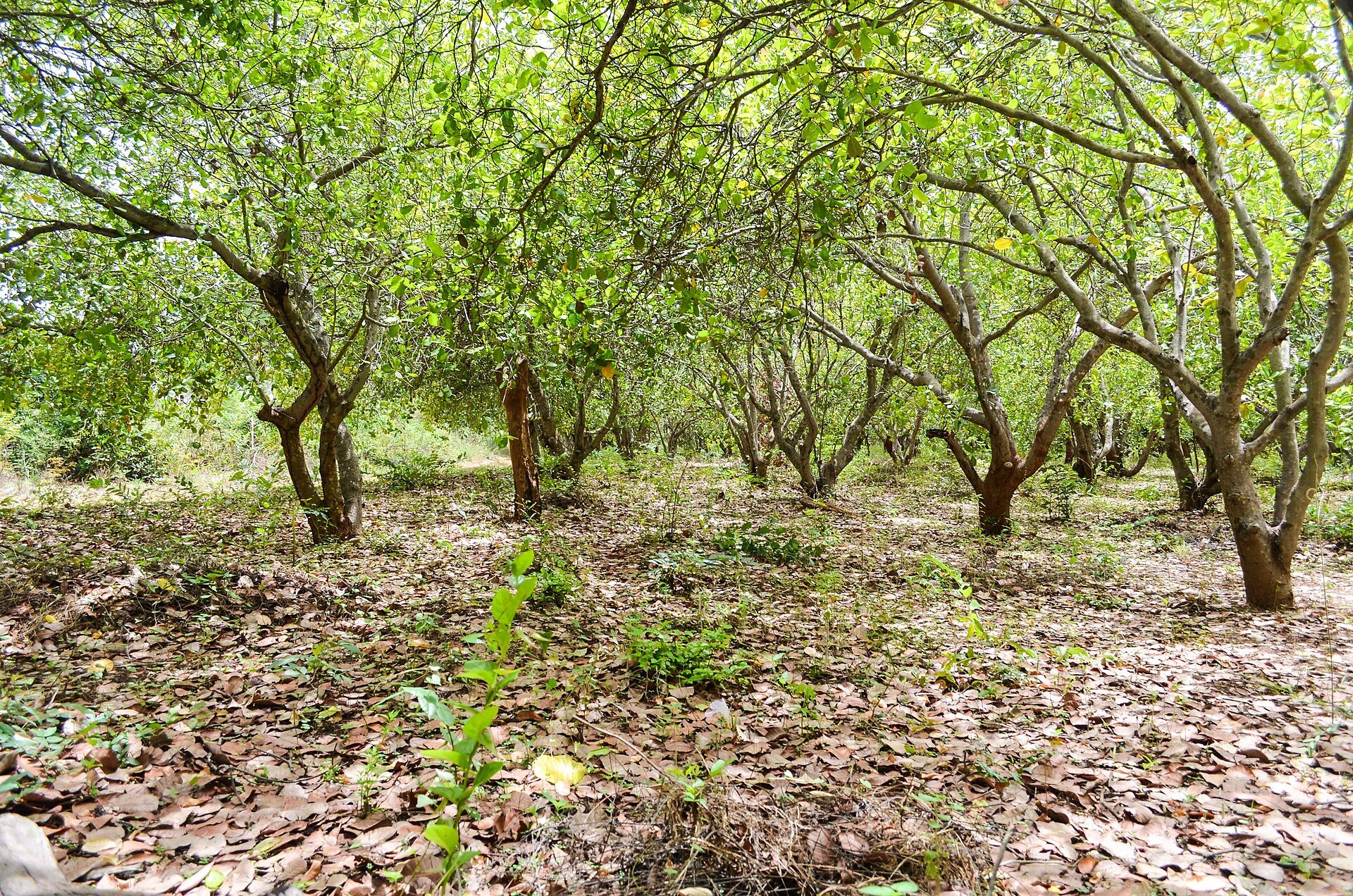
The Rio Times report on Guinea-Bissau’s cashew economy and bank loans adds the banking side. The photo below shows an orchard in Guinea-Bissau.
The Port, the Road North and the Power Grid
The World Bank is financing the rehabilitation of a section of the Safim–Mpak northern road corridor, from Safim to Antotinha, which it calls a key connection between Bissau and the border with Senegal. The project combines a US$70 million grant from the Bank’s International Development Association with US$14.7 million of additional financing.
A US$225 million ECOWAS Regional Electricity Access Project includes US$60 million for Guinea-Bissau and aims to extend distribution networks from the West African Power Pool’s interconnection lines. The World Bank says the project has built 1,696 kilometres of medium-voltage line in the country and closes in December 2026.
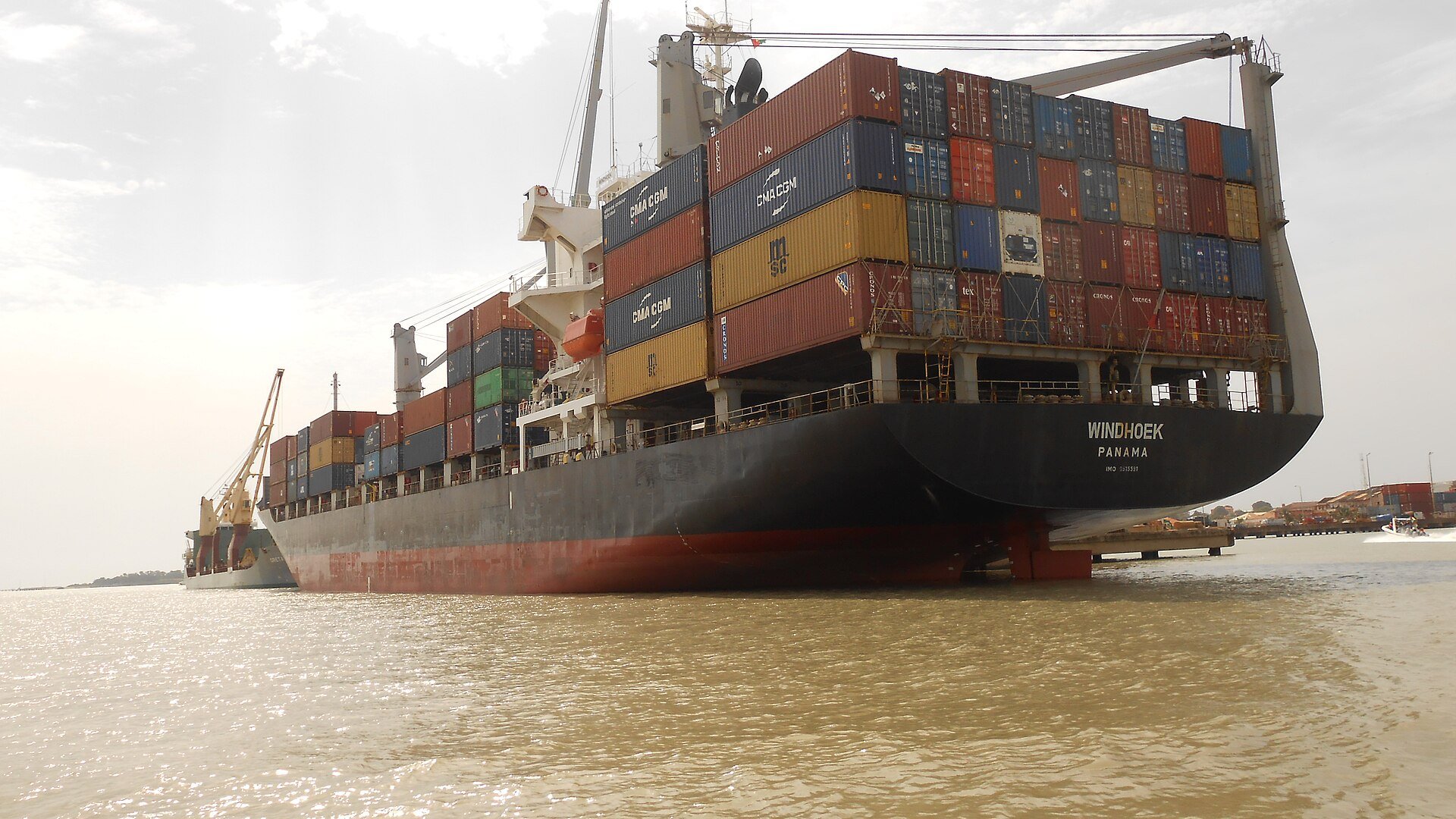
A container ship at the port of Bissau, photographed in 2017, is shown below. No official port-traffic figure was available for this guide, so how much trade moves through the port rather than across the land borders is not known.
The Coup, ECOWAS and the Mediators
Guinea-Bissau held presidential and parliamentary elections on 23 November 2025, and soldiers seized power on 26 November 2025, before results were announced. ECOWAS condemned the coup and demanded that the National Electoral Commission be allowed to declare the results.
The World Bank says the soldiers removed President Umaro Sissoco Embaló and suspended the electoral process. On 27 November 2025 ECOWAS suspended Guinea-Bissau from all its decision-making bodies until constitutional order is restored.
ECOWAS also ordered its Stabilization Support Mission in Guinea-Bissau to keep helping to protect state institutions. It named the leaders of Togo, Cabo Verde and Senegal to a high-level mediation mission.
According to the World Bank, Major-General Horta Inta-A was sworn in as Transitional President and Ilídio Vieira Té appointed Prime Minister, under a 12-month transition charter that bars them from contesting elections. In August 2026 a constitutional referendum approved reforms that expand presidential powers and cut parliament from 102 to 65 seats, and the PAIGC party called for a boycott.
The World Bank’s overview still lists presidential and legislative elections for 6 December 2026, while Senegal’s foreign ministry calls that date the initial one and records the transitional authorities citing legal, technical and institutional constraints. Senegal says any change to the calendar must be consensual, inclusive and transparent, and it urges lifting restrictions on political and civil activity.
On 29 June 2026 ECOWAS rejected a claim by a former presidential candidate’s campaign committee that remarks by the head of an ECOWAS mission were foreign interference. It said the mission acted on a collective mandate and neither announced nor validated any constitutional process.
On 26 October 2026 Senegal’s foreign minister, Cheikh Niang, held consultations in Bissau as part of the ECOWAS-mandated mediation, meeting political parties, civil society, the transitional president, the prime minister, the National Transition Council and diplomats, Dakar said on 27 October 2026. The Rio Times covered the visit in its report on Senegal’s mediation in Bissau and the vote in its report on the December 2026 election timetable.
ECOWAS, the CFA Franc and the Sahel States
ECOWAS lists 12 member states as of October 2026, among them Guinea-Bissau, Senegal and Guinea. Burkina Faso, Mali and Niger left the bloc with effect from 29 January 2025 and now form the Alliance of Sahel States (AES), ECOWAS says.
On 23 March 2026 ECOWAS appointed Lansana Kouyaté, a former prime minister of Guinea and former executive secretary of ECOWAS, as chief negotiator for talks with the AES countries. Senegal’s foreign ministry also lists discussions on the future of relations between ECOWAS and the AES among its latest news items as of October 2026.
ECOWAS ministers meeting in April 2025 were to consider contingency plans for the AES exit, including the impact on programmes, the relocation of institutions and the continued free movement of people and goods. On 18 March 2026 ECOWAS and Guinea-Bissau signed an agreement to move the ECOWAS Regional Animal Health Centre from Bamako, Mali, to Bissau, though the release does not link the move to the AES exit.
The BCEAO says the West African Monetary Union has eight member states: Benin, Burkina Faso, Côte d’Ivoire, Guinea-Bissau, Mali, Niger, Senegal and Togo. Guinea-Bissau therefore shares one currency, the CFA franc, with Senegal and with all three AES states, while Guinea is not on the list.
Five states, Benin, Côte d’Ivoire, Guinea-Bissau, Senegal and Togo, sit in both ECOWAS and the monetary union as of October 2026. That leaves Guinea-Bissau in a currency union with three states that have left its main political bloc.
People on the Move Across the Borders
Guinea-Bissau had 15,064 international migrants in 2024, against 281,867 in Senegal and 117,416 in Guinea, World Bank data show. Its count fell from 17,945 in 2020.
Personal remittances received were US$217 million in 2024, about 9.9% of that year’s economic output of US$2.20 billion. Guinea received US$616 million in 2024, and Senegal US$3.27 billion in 2023.
UNHCR counted 1,800 Bissau-Guinean refugees and 1,355 asylum seekers in 23 asylum countries at the end of 2025, with France hosting the most refugees at 1,357. It lists only 5 Bissau-Guinean asylum seekers and no refugees in Senegal, and none in Guinea.
In the United States UNHCR counted 20 refugees and 156 asylum seekers from Guinea-Bissau at the end of 2025, and in Portugal, the former colonial power, 280 asylum seekers. Angola counted 268 asylum seekers and Brazil 103 refugees.
What It Means for US Readers
The State Department rates Guinea-Bissau Level 3, reconsider travel, citing unrest, inadequate health infrastructure and landmines, in an advisory dated 11 December 2025. It says there is no US embassy or consulate in Guinea-Bissau and that consular services come from the US embassy in Dakar, Senegal.
Landmines and unexploded ordnance exist throughout Guinea-Bissau, with the greatest risk in Bafatá, Oio, Biombo, Quinara and Tombali, the advisory says. Even a minor health issue may require medical evacuation at the traveller’s own expense.
Senegal is Level 1, exercise normal precautions, in its advisory of 1 December 2025, and Guinea is Level 2, exercise increased caution, as of 25 February 2026. The Gambia is also Level 2, and its advisory tells travellers near its southern border to stay on main roads and avoid night travel because of the Casamance rebel group.
Remittances were about 9.9% of Guinea-Bissau’s economic output in 2024, so money sent home by relatives abroad matters to household income as of October 2026. The country uses the CFA franc, which the BCEAO issues for seven other states as well.
The Rio Times travel advice for Americans explains the Level 3 rating in plain terms. Its guide to The Gambia and its neighbours covers West Africa’s other small Atlantic country.
What Is Not Known
No primary source reviewed for this guide measures drug flows through Guinea-Bissau, and the UN Office for West Africa and the Sahel page reviewed describes drug trafficking only as a threat to West Africa and the Sahel as a whole. The size and routes of any such trade are therefore not covered here.
The date of the next elections is not known: the World Bank lists 6 December 2026, while Senegal’s foreign ministry calls that date the initial one and cites constraints. How long the transition will last, and when ECOWAS will lift the suspension, is also not known as of October 2026.
Guinea-Bissau’s own trade reports stop at 2018 and Guinea reports no 2023 figures, so its trade with Guinea, the cashew share of its sales to India and any buyers beyond the five reporters checked are not measured here. How the Casamance rebel group affects the Guinea-Bissau border is not known either, because the sources reviewed describe fighting only along The Gambia’s southern border.
Frequently Asked Questions
Which countries border Guinea-Bissau?
Senegal lies to the north and Guinea to the south and east, the regional central bank says. The Atlantic Ocean forms the coast, which includes the Bijagós archipelago.
Who is mediating in Guinea-Bissau?
ECOWAS suspended Guinea-Bissau on 27 November 2025, and Senegal, whose president chairs ECOWAS, says it acts as mediator. Senegal’s foreign minister held consultations in Bissau on 26 October 2026.
Does Guinea-Bissau use the CFA franc?
Yes, the BCEAO lists Guinea-Bissau among the eight members of its monetary union, with Benin, Burkina Faso, Côte d’Ivoire, Mali, Niger, Senegal and Togo. Guinea is not on that list.
Did the Sahel states leave ECOWAS?
Burkina Faso, Mali and Niger left ECOWAS with effect from 29 January 2025 and form the Alliance of Sahel States. Guinea-Bissau remains one of ECOWAS’s 12 members, suspended from its decision-making bodies since 27 November 2025.
What does Guinea-Bissau sell, and to whom?
The World Bank says cashew exports support the economy. India reported US$72.3 million of imports from Guinea-Bissau in 2023, against US$217 thousand reported by Senegal.
What is the US travel advice for the region?
The State Department rates Guinea-Bissau Level 3, Guinea Level 2 and Senegal Level 1. There is no US embassy in Bissau, and consular help comes from Dakar.
What is Casamance?
It is a region of southern Senegal where, the State Department says, a separatist rebel group operates. Its advisory for The Gambia reports sporadic fighting along The Gambia’s southern border in the recent past.
Sources: World Bank, World Development Indicators API (population, area, GDP, growth, migrants, remittances, life expectancy), Guinea-Bissau, Senegal, Guinea and The Gambia, opened 30 October 2026; World Bank, Guinea-Bissau country overview, 30 October 2026; World Bank WITS, trade data reported by India, Senegal, The Gambia, Portugal and China, 2022 and 2023; UNHCR Refugee Data Finder, Guinea-Bissau as country of origin, end of 2025; ECOWAS, final communique of the extraordinary session of 27 November 2025; ECOWAS, statement on Guinea-Bissau, 29 June 2026; ECOWAS, member states page, 30 October 2026; ECOWAS, release on biometric cards at São Domingos and Mpack, 20 March 2026; ECOWAS, release on the Regional Animal Health Centre, 23 March 2026; ECOWAS, release on the chief negotiator for the AES talks, 29 March 2026; ECOWAS, release on the Council of Ministers session on the AES withdrawal, 23 April 2025; ECOWAS, notice of the West African Power Pool general assembly, 30 October 2026; ECOWAS, release on the Guinea presidential election, 25 December 2025; Senegal Ministry of Foreign Affairs, communique on the mission to Bissau, 27 October 2026; Senegal Ministry of Foreign Affairs, statement on the political situation in Guinea-Bissau; BCEAO, member states of the West African Monetary Union, 30 October 2026; BCEAO, Guinea-Bissau country page, 30 October 2026; UN Office for West Africa and the Sahel, page on drug trafficking and organised crime, 30 October 2026; US State Department, travel advisories for Guinea-Bissau, Senegal, Guinea and The Gambia, feed of 30 October 2026; Presidency of Guinea, news page, 30 October 2026.
This article was produced by The Rio Times’ automated newsroom system. How we use AI · Report an error · Editorial responsibility: Matthias Camenzind, Editor-in-Chief