Corn Fund Falls 1.08% as Soybeans Slip 0.72% | Grains, Oct 27
Key Facts
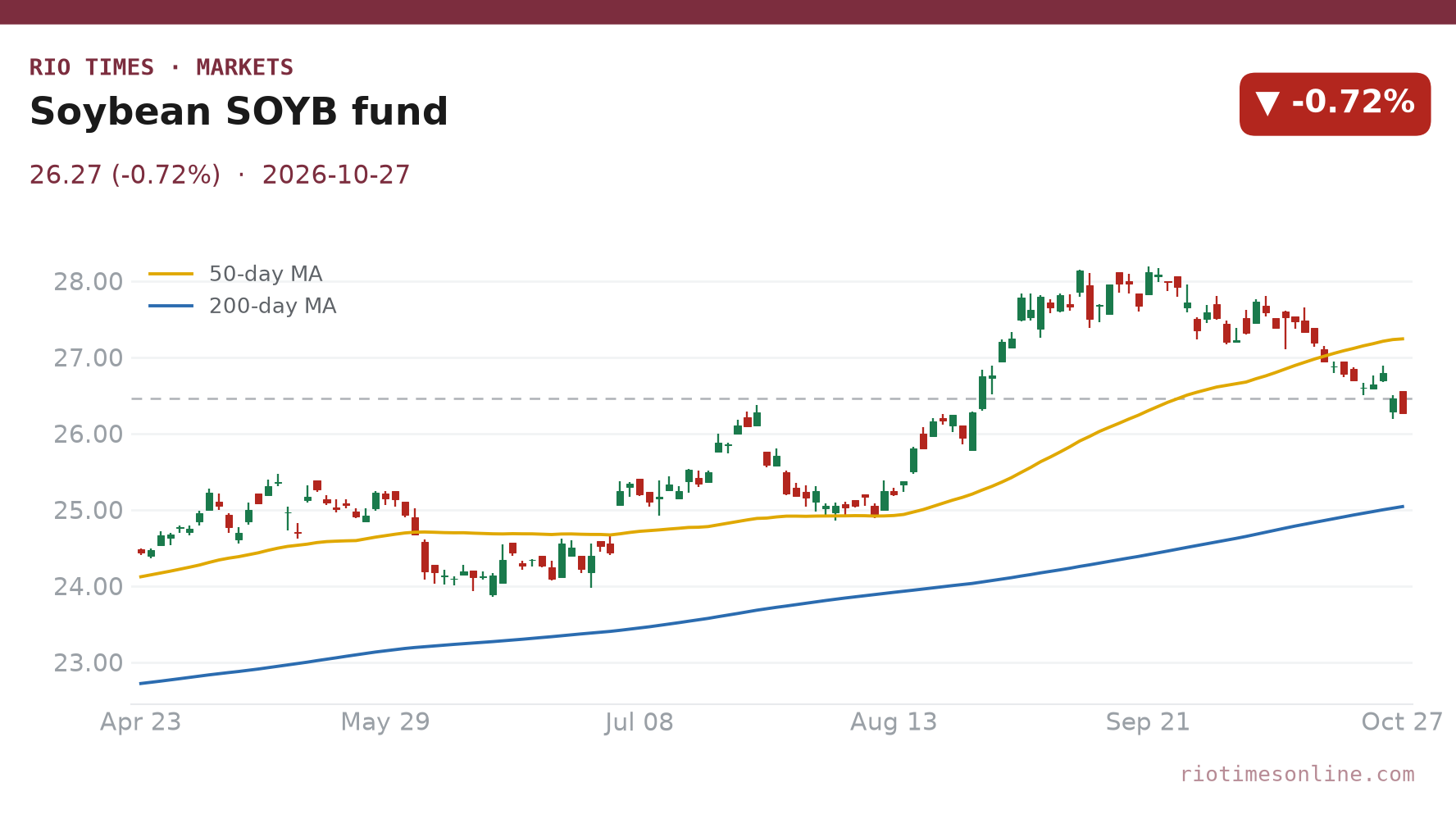
- The SOYB soybean fund fell 0.72% to US$26.27 on Tuesday, October 27.
- The CORN fund fell 1.08% to US$17.44, the biggest drop of the three.
- The WEAT wheat fund fell 0.84% to US$22.35, and the broad DBA farm fund lost 0.72%.
- Brazil’s real strengthened about 1% to R$5.35 per US dollar, a partial recovery from Monday.
Today’s Focus
Grain funds fell across the board on Tuesday, October 27. The CORN fund lost 1.08%, the WEAT wheat fund 0.84% and the SOYB soybean fund 0.72%.
Brazil is the world’s largest soybean exporter, so its currency matters for global prices. The real strengthened about 1% on Tuesday after a heavy fall on Monday, which makes Brazilian beans slightly less cheap in dollar terms.
Even so, grain prices drifted lower in a day when Wall Street rose and investors favoured technology shares. The Nasdaq gained 1.18%.
The quick read: grain funds are following the broader risk mood and the dollar rather than a single crop headline.
What matters today. Brazil’s currency and the US Federal Reserve decision on Wednesday are the nearest levers for soybean, corn and wheat prices.
01 The session in one read
Grain proxies fell in unison on Tuesday, October 27, led by a 1.08% drop in the corn fund. The soybean fund slipped 0.72% and the wheat fund 0.84%.
The broad DBA agriculture fund lost 0.72%, which shows the weakness was widespread across farm commodities.
The consistent driver across all three markets is the pull of the broader market and the dollar. The dollar-tracking UUP fund rose 0.4% on the day, a headwind for dollar-priced grains.
02 The board
SOYB, the soybean fund, settled at US$26.27, down 0.72% on the day. CORN, the corn fund, closed at US$17.44 after falling 1.08%, the steepest decline of the three.
WEAT, the wheat fund, ended at US$22.35 with a 0.84% loss. These funds hold futures contracts, so they can differ from cash prices.
| Asset | Level | Change |
|---|---|---|
| Soybeans (SOYB) | US$26.27 | -0.72% |
| Corn (CORN) | US$17.44 | -1.08% |
| Wheat (WEAT) | US$22.35 | -0.84% |
Source: RT close, 2026-10-27. Where a commodity has no spot feed, an exchange-traded tracker or leading producer is shown as a labelled proxy.
Live Market IntelligenceThe live market board
Rio Times · Live Market Intelligence
Latin America — Cross-Market Board
| Instrument | Last | Change | YoY | Prev. | High | Low | Volume |
|---|---|---|---|---|---|---|---|
| IBOV | 175,710.05 | -0.51% | +19.56% | 176,608.23 | 178,526 | 175,157 | — |
| IPSA | 10,766.85 | +1.81% | — | 10,575.69 | 10,722 | 10,633 | — |
| IPC MEX | 69,734.34 | +0.38% | +12.74% | 69,470.99 | 70,008 | 69,383 | 49,372,306 |
| MERVAL | 2,848,945 | — | +12.65% | 2,859,051 | — | — | — |
| COLCAP | 2,506.51 | +0.06% | — | — | — | — | — |
| USD/BRL | 5.34 | -1.32% | -0.84% | 5.42 | 5.42 | 5.30 | — |
| EUR/BRL | 5.95 | +7.53% | -4.87% | 5.54 | 6.04 | 5.92 | — |
| USD/MXN | 18.69 | +0.62% | +1.45% | 18.57 | 18.69 | 18.54 | — |
| USD/CLP | 983.47 | -0.57% | +5.64% | 989.13 | 991.87 | 979.07 | — |
| USD/COP | 3,149 | +3.06% | -18.02% | 3,056 | 3,173 | 3,111 | — |
| USD/PEN | 3.45 | +0.17% | +3.85% | 3.44 | 3.45 | 3.44 | — |
| USD/ARS | 1,537 | -0.28% | +3.77% | 1,541 | 1,541 | 1,537 | — |
| USD/UYU | 40.21 | +3.57% | +2.29% | 38.83 | 40.21 | 40.08 | — |
| USD/PYG | 5,803 | +3.78% | -16.54% | 5,592 | 5,803 | 5,735 | — |
| USD/BOB | 11.97 | +4.93% | +77.92% | 11.41 | 11.97 | 11.82 | — |
| USD/DOP | 60.54 | +1.83% | -4.34% | 59.45 | 61.14 | 59.85 | — |
| USD/CRC | 451.24 | +2.13% | -7.80% | 441.83 | 451.40 | 450.04 | — |
| USD/GTQ | 7.64 | +3.23% | +2.18% | 7.40 | 7.64 | 7.64 | — |
03 What moved it
For soybeans, Brazil’s currency is the key link. After Monday’s sell-off, the real recovered about 1% on Tuesday, but it is still about 7% weaker than before the election.
A stronger dollar tends to weigh on dollar-priced grains. The UUP fund, which tracks the dollar, rose 0.4% on Tuesday.
Wheat and corn followed the same pattern, down 0.84% and 1.08% in a session when investors waited for the US Federal Reserve decision.
04 The Latin American read
Brazil and Argentina are the principal South American export engines for soybeans, corn and wheat, so harvests, planting and local currencies set global prices.
For investors, a crop report from Mato Grosso or a currency move in Buenos Aires can move Chicago futures as much as a US weather headline. Argentina’s peso was almost unchanged at 1,538 per dollar on Tuesday.
05 The names to watch
Watch the Brazilian real against the dollar for any sustained move, since a rebound or a renewed slide would change the competitiveness of US soybeans.
Chinese purchasing remains the demand-side anchor for soybeans, and weekly US export sales show whether demand can offset currency and harvest pressure.
06 The outlook
The near-term path for grains depends on the dollar, on South American supply and on the real. A weather setback in Argentina or a slowdown in Chinese buying would test current lows.
07 What to watch
- Brazilian real: A weaker real makes Brazilian soybeans cheaper in dollar terms and pressures Chicago futures.
- US Federal Reserve decision: The Fed announces its rate decision on Wednesday, which can move the dollar and grain funds.
- Chinese purchases: Weekly US soybean bookings show whether demand can offset harvest and currency pressure.
- South American weather: Planting and crop conditions in Argentina and Brazil can move prices quickly.
Frequently Asked Questions
How does Brazil’s currency affect U.S. soybean prices?
A weaker real makes Brazilian soybeans cheaper in dollar terms, pressuring US prices. The real strengthened about 1% on Tuesday.
What happened to the CORN fund on Tuesday?
It fell 1.08% to US$17.44, the biggest drop among the three grain funds.
Why did the US dollar matter for grains?
Grains are priced in dollars, so a stronger dollar makes them more expensive for foreign buyers. The UUP dollar fund rose 0.4% on Tuesday.
What do the grain funds hold?
They hold futures contracts on soybeans, corn and wheat, so they track futures prices rather than cash prices.
Market data: RT
This article was produced by The Rio Times’ automated newsroom system. How we use AI · Report an error · Editorial responsibility: Matthias Camenzind, Editor-in-Chief
LatAm Markets: Live Signals → — real-time movers, turnover leaders and FX across Latin America.