Dominican Republic Integrity: OECD Says Rules Are Strong but Enforcement Lags
POLITICS · DOMINICAN REPUBLIC
Key Facts
- —The country The Dominican Republic, a Caribbean state of about 11 million people, is seeking to join the OECD, the Paris-based club of 38 mostly wealthy economies.
- —What happened On 30 September 2026 the OECD presented its integrity study of the country at the National Palace in Santo Domingo, with President Luis Abinader present.
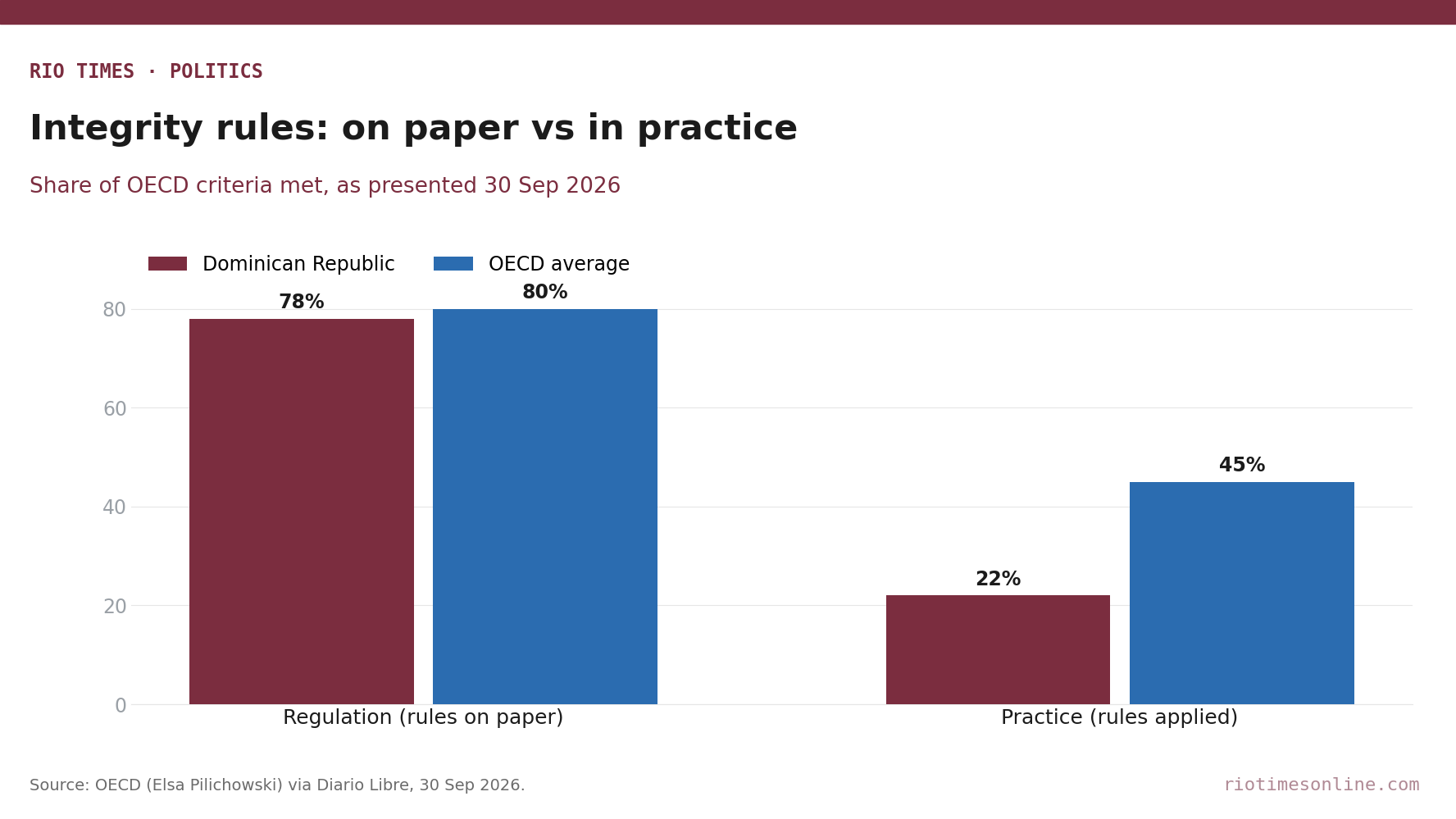
- —The numbers The country meets 78% of OECD integrity criteria in regulation but 22% in practice, against OECD averages of 80% and 45%, an OECD official said (Diario Libre).
- —What it means for you The OECD recommends a lobbying register, whistleblower protection, caps on political donations and freer access to public information, changes that would affect investors and residents.
- —Still open No bill, timetable or budget has been announced. The full study and the 2026–2036 national integrity strategy have not yet been published in full.
The OECD integrity study of the Dominican Republic, presented in Santo Domingo on 30 September, finds a country with good rules that it applies only patchily. The Organisation for Economic Co-operation and Development (OECD) also says there is no regulation of lobbying at all.
The tone was not hostile. Elsa Pilichowski, the OECD’s director of public governance, praised the country’s progress and said it already uses some of the best practices in the world.

A wide gap between rules and practice
According to Diario Libre, Pilichowski said the country meets 78% of OECD criteria on regulation but only 22% on practical application. The OECD averages she cited were 80% and 45%.
She called closing that gap the most important challenge for the next phase. The difficulty is common across OECD members, she added, but the Dominican Republic has wide room to improve.
Listín Diario quoted her saying that many institutions already have “strong rules” and only need to apply them. The newspaper said work on the study began about two years ago, and the presidency says it was prepared with the government’s ethics office.
Lobbying, whistleblowers and political money
The OECD integrity review says there is no framework making lobbying transparent. Acento, another Dominican outlet, reports it recommends a mandatory lobbying register created by law, with independent oversight and sanctions.
Whistleblower channels are described as fragmented, with limited protection. The study proposes confidentiality, anonymous reporting and protection against retaliation.
On party and campaign finance, a legal framework exists, but reports are incomplete and checks are thin. The OECD suggests caps on individual donations and stronger audit powers for the Central Electoral Board (JCE), which runs elections.
Campaign money is already a live issue, as covered in Dominican Republic Business Chief Warns Early Campaigns Invite Crime Money.
Weak points inside the state
The ethics office, the Directorate General of Government Ethics and Integrity (DIGEIG), was created by decree. Acento reports the OECD finds it lacks legal guarantees of independence.
Only a limited share of officials’ asset declarations is verified, the study says. It also finds that fewer than half of citizens, on average, express trust in public institutions.
Access to information has improved considerably, the OECD acknowledges. It still wants openness by default and an independent body able to hear appeals and issue binding decisions.
How the government responded
Abinader said the country must move “from diagnosis to action”, according to the presidency. Listín Diario quoted him saying the study is “not the end” but the start of a new stage.
He linked the reforms to the bid to join the OECD, which has 38 members. Presidency minister José Ignacio Paliza said his office would help DIGEIG and other bodies apply the recommendations.
The presidency says a National Public Integrity Strategy for 2026–2036 will turn the study into targets, measures and indicators. Judicial appointments are a parallel test, as seen in Dominican Republic Judge Selection Advances: 88 Vie for Six Supreme Court Seats.
What Is Not Yet Known
The government has not announced a lobbying bill, whistleblower bill or donation cap in response to the study. It has given no date for doing so.
The 78% and 22% figures come from Pilichowski’s presentation as reported by Diario Libre. The full study text was not available to check the underlying methodology.
Sources: Diario Libre (30 Sep 2026); Listín Diario (30 Sep 2026); Acento (1 Oct 2026); Presidency of the Dominican Republic (30 Sep 2026).
Read More from The Rio Times