Cubans vote in referendum on gay marriage/parenthood and surrogacy
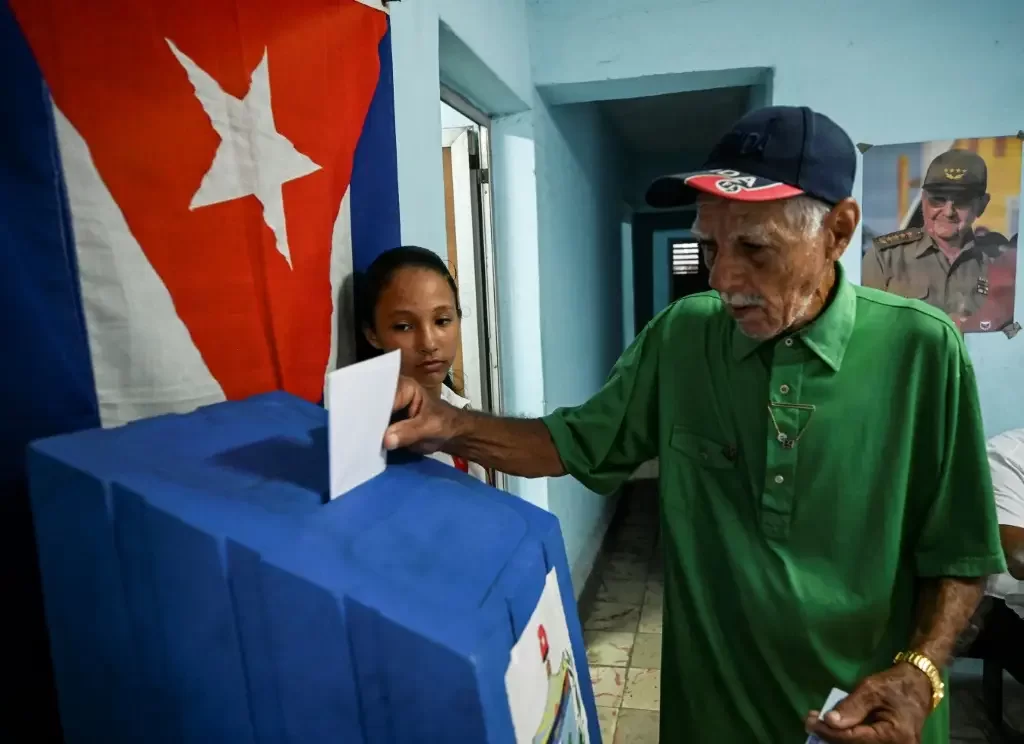
Cubans began voting Sunday (25) in a referendum on a new family code that includes same-sex marriage and surrogacy.
AFP journalists reported that polling stations in Havana opened at 7 am local time (8 am in Brasilia).
President Miguel Díaz-Canel voted early accompanied by his wife Lis Cuesta in the municipality of Playa, west of the capital.
The Family Code “is a just, necessary, updated and modern norm that gives rights and guarantees to all people, to all the diversity of families, people, and beliefs,” the president told the press after the vote.
More than eight million Cubans are expected to vote “yes” or “no” at the polls to the question, “Do you agree with the Family Code?
If approved, the new legislation will replace that in effect since 1975.
The proposed text defines marriage as a union “between two persons,” opening the door to homosexual marriages and adoption by same-sex couples.
It also allows for the legal recognition of multiple fathers and mothers in addition to biological fathers and mothers, as well as surrogacy – provided it is non-profit.
Several of these issues are sensitive in a society still dominated by machismo, which was exacerbated in the 1960s and 1970s when the government condemned many homosexuals to ostracism or sent them to militarized agricultural labor camps.
Authorities have changed in recent decades, and now the new code is the subject of an intense government media campaign.
“We will not vote with the PCC (Communist Party of Cuba).”
The PCC is voting ‘yes’ with us,” gay activist Maykel Gonzalez stressed on his Twitter account, showing his ballot marked “yes.”
“I don’t have these prejudices”
In Latin America, equal marriage is legal in Argentina, Uruguay, Brazil, Colombia, Ecuador, Costa Rica, Chile, and several Mexican states.
“A few years ago I would not have accepted this code, but (…) it is necessary to update it. It’s a very human code that includes everyone,” Elio Gómez, a 78-year-old former Marxism professor, told AFP at a polling station in Old Havana.
The former professor believes many Cubans have suffered from prejudice and that the code “will settle a debt with them.”
The government attempted to include same-sex marriage in the 2019 constitution but was forced to back down in the face of strong criticism from Catholic and Protestant churches.
In a statement this month, the Cuban Bishops’ Conference spoke out again, opposing several points in the text, such as adoption by same-sex couples, pregnancy support, and extended parenthood.
Between February and April, a consultation on the Family Code was conducted in 79,000 neighborhood meetings.
This resulted in a 48% change to the original text.
However, the broad scope of the code, with its nearly 500 articles, raise doubts among some who support same-sex marriage, for example, but not adoption.
For Cuban political scientist Rafael Hernández, this is “the most important human rights legislation” that has existed in Cuba since the major changes at the beginning of the 1959 revolution.
And for the first time, Hernández adds, groups are claiming that the government has “lost its hand” because it has delivered “too much” of what was promised.
“The government is making it easier for the most conservative sectors of society to come up with their own ideas without inventing them,” he explained.
This is the first time Cubans will vote to confirm a law.
Against the backdrop of a deep economic crisis, the exodus of migrants, and more than a year after the historic July 11, 2021 demonstrations, some citizens are tempted to abstain from voting in protest.
“I think I was one of the first to say no. There are no food or hygiene items here. We survived, and we survived multiple power outages. I see no reason to vote ‘yes,'” said 47-year-old Jose Antonio Callejas as he left a polling station in Old Havana.
Opponents have called on social media to vote against the text or abstain.
The law will take effect immediately if it receives more than 50% of the vote.
More: Latin America news in English, every day from The Rio Times.
This article was drafted with automated assistance and reviewed before publication. How we use AI · Report an error · Editorial responsibility: Matthias Camenzind, Editor-in-Chief
Cuba and the United States
- What Is Going On Between Cuba and the United States?
- What Is Going On Between Cuba and the United States?
- Can Americans Still Travel to Cuba in 2026?
- Who Runs Cuba in 2026? Raúl Castro and the US Murder Charge