Bangladesh’s Political Crisis: Beyond the Misleading Narratives of Religious Conflict
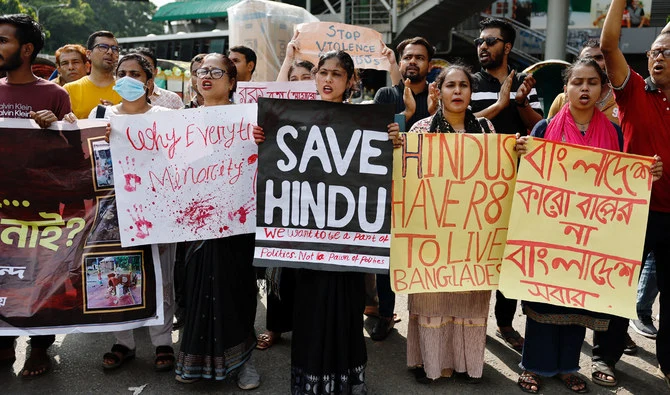
In the aftermath of Sheikh Hasina’s resignation as Bangladesh’s Prime Minister on August 5, 2024, a wave of violence swept the nation.
The unrest primarily targeted supporters of the Awami League (AL), the political party Hasina has led since 2009.
Both Muslims and Hindus faced attacks, not due to their religious identities but because of their political affiliations.
Despite this, misinformation quickly transformed the narrative, portraying the violence as religiously motivated attacks against Hindus by Islamists.
This narrative, largely propagated by Indian media, misrepresented the situation. Fact-checkers in Bangladesh and India debunked several viral claims.
For instance, a video circulated on social media purportedly showed a Hindu woman being threatened by Islamists.
However, the woman was actually Muslim actress Azmeri Haque Badhan, speaking about national unity.
Another claim involved a Hindu temple in Chittagong allegedly set ablaze by Islamists. Investigations revealed that the fire targeted an adjacent Awami League office, not the temple itself.
Similarly, reports of cricketer Liton Das’s house being burned were false; the house belonged to another cricketer linked to the AL.
The spread of such misinformation had significant implications. In India, it fueled Islamophobia and communal tensions.
Right-wing groups used these false narratives to incite anti-Muslim sentiment, aligning with political agendas to polarize society.
This environment of misinformation not only threatened Bangladesh’s stability but also strained its relationship with India.
Indian Prime Minister Narendra Modi expressed concerns over the alleged attacks, prompting Bangladesh’s interim leader, Muhammad Yunus, to assure him that reports were exaggerated.
Bangladesh’s Unity in Crisis
In Bangladesh, the interim government, led by Yunus, focused on protecting all citizens and countering the false narratives.
Muslim groups took proactive measures, guarding Hindu temples to prevent potential attacks and showcasing a spirit of solidarity.
This response highlighted the importance of unity and understanding in combating divisive misinformation.
The situation underscored the broader challenges of sectarian nationalism in South Asia. Misinformation, when left unchecked, can inflame communal tensions and undermine democratic values.
As Bangladesh navigates its political transition, its commitment to pluralism and democracy remains crucial.
The interim government’s efforts to protect minority rights offer a glimmer of hope for a more inclusive future.
This narrative of misinformation and its consequences serves as a reminder of the power of false narratives in shaping public perception and influencing political dynamics.
It highlights the need for vigilance, fact-checking, and cross-community solidarity to counteract the divisive forces that threaten societal harmony.
This article was produced by The Rio Times’ automated newsroom system. How we use AI · Report an error
Read More from The Rio Times