Costa Rica Central Bank Chief Sees No Broad Labour Market Hit From Layoffs

ECONOMY · COSTA RICA
Key Facts
- —The country Costa Rica, a Central American economy of about 5 million people, built much of its export model on foreign firms in tax-free zones.
- —What happened Central bank president Róger Madrigal told El Financiero (4 October 2026) that available data do not show company exits causing a broad labour-market slide.
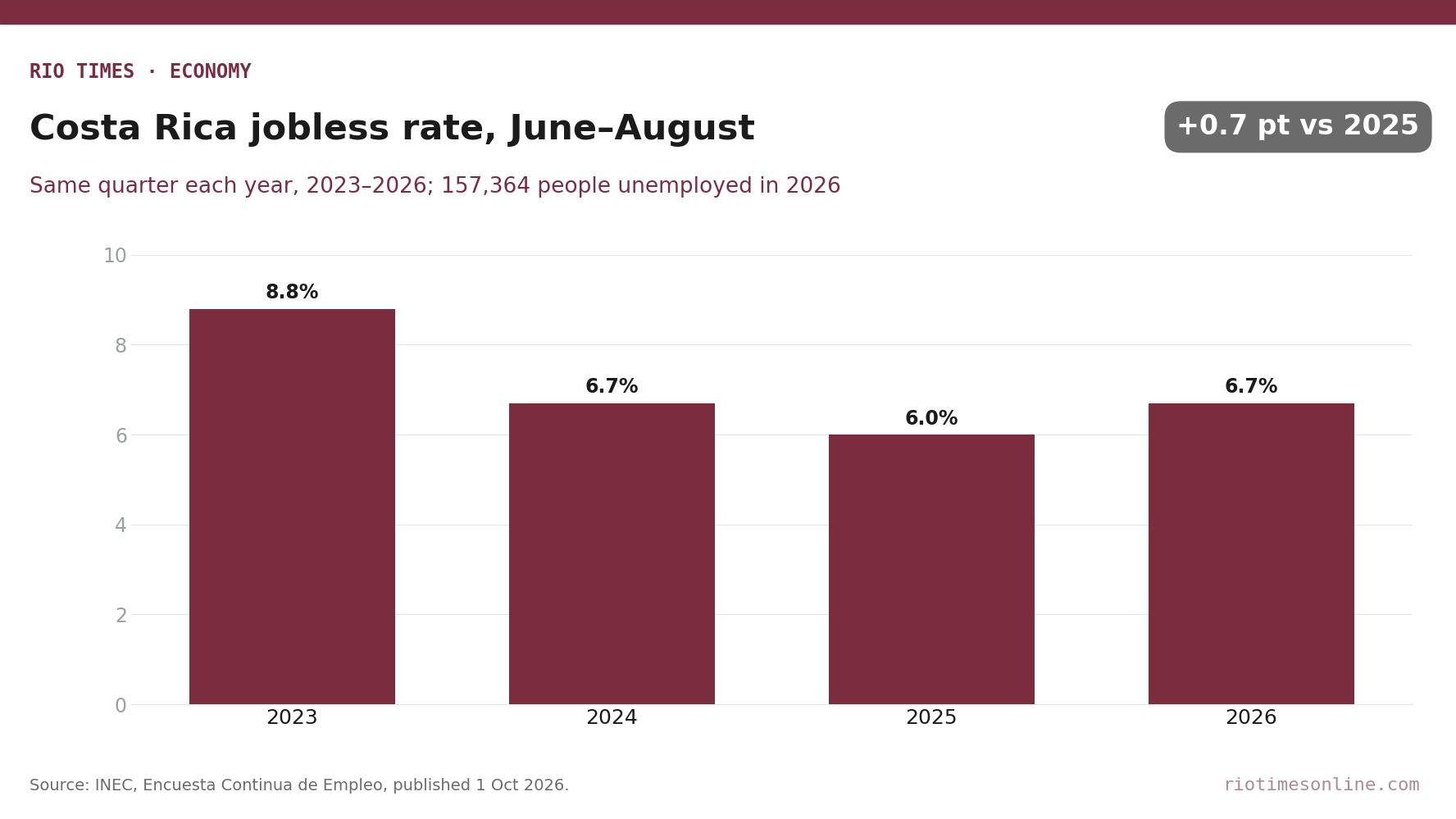
- —The numbers Unemployment was 6.7% in June–August 2026, up from 6.0% a year earlier (INEC). Madrigal cited about 1,600 free-zone jobs lost since January.
- —What it means for you Income tax and VAT made up about three quarters of tax revenue in early 2026. Lost jobs reach the treasury mainly through weaker household spending.
- —Still open Madrigal said tariff decisions still pending could shape these firms’ long-term plans. No official estimate of the fiscal cost of this year’s layoffs has been published.
The Costa Rica central bank chief says this year’s wave of multinational layoffs is not yet causing a broad deterioration of the labour market, the main channel through which it could reach state accounts. Róger Madrigal, president of the Central Bank of Costa Rica (BCCR), told El Financiero so in an interview published on Sunday, 4 October.
He did not dismiss the risk. He acknowledged roughly 1,600 jobs lost in the country’s free-trade zones since January and flagged tariff decisions still to come.
What the central bank president said
“According to the available data, it cannot be said that this phenomenon is causing a generalised deterioration of the labour market,” Madrigal told the business paper. In his reading, some companies are leaving while others are arriving.
He pointed out that unemployment has held at 6.7% while the share of adults in work has kept rising. He also said that firms’ long-term decisions could still turn on tariffs, “but we are not there yet.”
Firms announcing cuts this year include Amazon, Qorvo, Microsoft, Boston Scientific, Fresh Del Monte Produce, Western Union, GSK and Mondelēz, El Financiero reports. The list covers job cuts, not only full departures from the country.
Jobs data show growth and strain at once
The national statistics institute INEC published its latest employment survey on 1 October. The jobless rate for June–August 2026 was 6.7%, against 6.0% in the same quarter of 2025.
About 157,000 people were unemployed, close to 20,000 more than a year earlier. Yet the economy still added a net 22,291 jobs, because the labour force grew faster, by 42,158 people.
The losses are concentrated. Roxana Morales, an economist at the public Universidad Nacional, said manufacturing shed 29,857 jobs and financial services 18,650 over the year.
Commerce and repairs added 47,942 jobs, and education and health another 33,835, she told El Financiero. Manufacturing output, measured by the monthly activity index IMAE, fell 0.56% in July after growing 9.6% a year earlier.
How layoffs reach state accounts
The link to public finances runs mainly through tax collection. In the first quarter of 2026, income and profit taxes made up 38.9% of tax revenue, and VAT another 35.9%.
A company that cuts staff earns less, and laid-off households spend less. That slower spending then feeds into VAT receipts, so the fiscal hit tends to arrive late and indirectly.
Madrigal accepted that this channel exists. “If unemployment rises, household income falls, or stops rising, and consumer spending moderates,” he said. He added at once: “that is not necessarily what is happening today.”
Why the picture is mixed
Foreign investment has not dried up. Inflows rose in the first half, as reported in Costa Rica FDI Rises 23.4% in First Half of 2026. That fits the central bank’s view of firms coming and going.
The burden of the cuts is uneven, though. Women and young people carry more of the unemployment, as covered in Costa Rica Unemployment Hits Women and Youth Hardest.
What Is Not Yet Known
Beyond the Costa Rica central bank view, the finance ministry has not published an estimate of revenue lost to this year’s layoffs. The 1,600 free-zone figure comes from Madrigal’s interview and has not been confirmed by the zones’ own data.
It is also unclear which tariff decisions Madrigal had in mind and how exporters in the zones will respond. The next INEC survey, for July–September, will show whether manufacturing losses deepen or level off.
Sources: El Financiero (Costa Rica), interview with Róger Madrigal, 4 October 2026; INEC, Encuesta Continua de Empleo, June–August 2026, published 1 October 2026; Centroamérica360, 3 October 2026.
This article was produced by The Rio Times’ automated newsroom system. How we use AI · Report an error · Editorial responsibility: Matthias Camenzind, Editor-in-Chief
LatAm Markets: Live Signals → — real-time movers, turnover leaders and FX across Latin America.