Colombia surpasses for the first time the 30,000 daily Covid cases barrier (June 4)
RIO DE JANEIRO, BRAZIL – Colombia surpassed this Friday for the first time the barrier of 30,000 daily infections of covid-19, a figure that shows that the third peak of the pandemic continues unstoppable in the country that totals 3,518,046 infections.
According to data from the Ministry of Health, the country today added 537 deaths and accumulated with them 90,890 deaths.
The largest number of confirmed cases today was in Bogotá, which added 11,398 infections, its highest figure since the beginning of the health emergency and with which it surpassed one million infections.

The authorities have been warning for weeks of the epidemiological risk posed to the country by the anti-government demonstrations, which began on April 28 and have lasted longer than any forecast, and in which not only crowds have been seen without keeping the recommended distance for health reasons, but also many people without face masks.
“There are many areas of the country that, in practice, have returned to normal. For example, in Bogotá, the restrictions were lifted a long time ago,” said epidemiologist Jorge Martin Rodriguez, a researcher at the Institute of Public Health of the Javeriana University in Bogotá, about the increase in contagions.
According to the expert, “I would put in second place, of course, the agglomerations of the marches, with the advantage that they take place in open spaces so that the risk would be much lower”.
BOGOTÁ EXCEEDS 10,000 INFECTIONS PER DAY
The effect of the demonstrations on the pandemic has been most noticeable in Bogotá, where the number of people infected has increased from an average of 4,000 per day confirmed in the last week of April to more than 10,000 in the last two days.
“The third peak of covid had started to drop in the first week of May. The crowds of the Paro Committee demonstrations caused more than 25,000 additional infections, overwhelmed the hospital system, and are causing the highest mortality since the pandemic began,” lamented the mayor of Bogotá, Claudia Lopez, on Twitter.
The concern is not in vain because the Colombian capital had a record 168 deaths yesterday and should surpass this Friday the million infected since the beginning of the pandemic, 16 months ago.
At the same time, the occupation of the intensive care units (ICU) for patients with covid-19 is at 97.3%, that is to say, that out of the 2,241 units available, 2,180 are occupied.
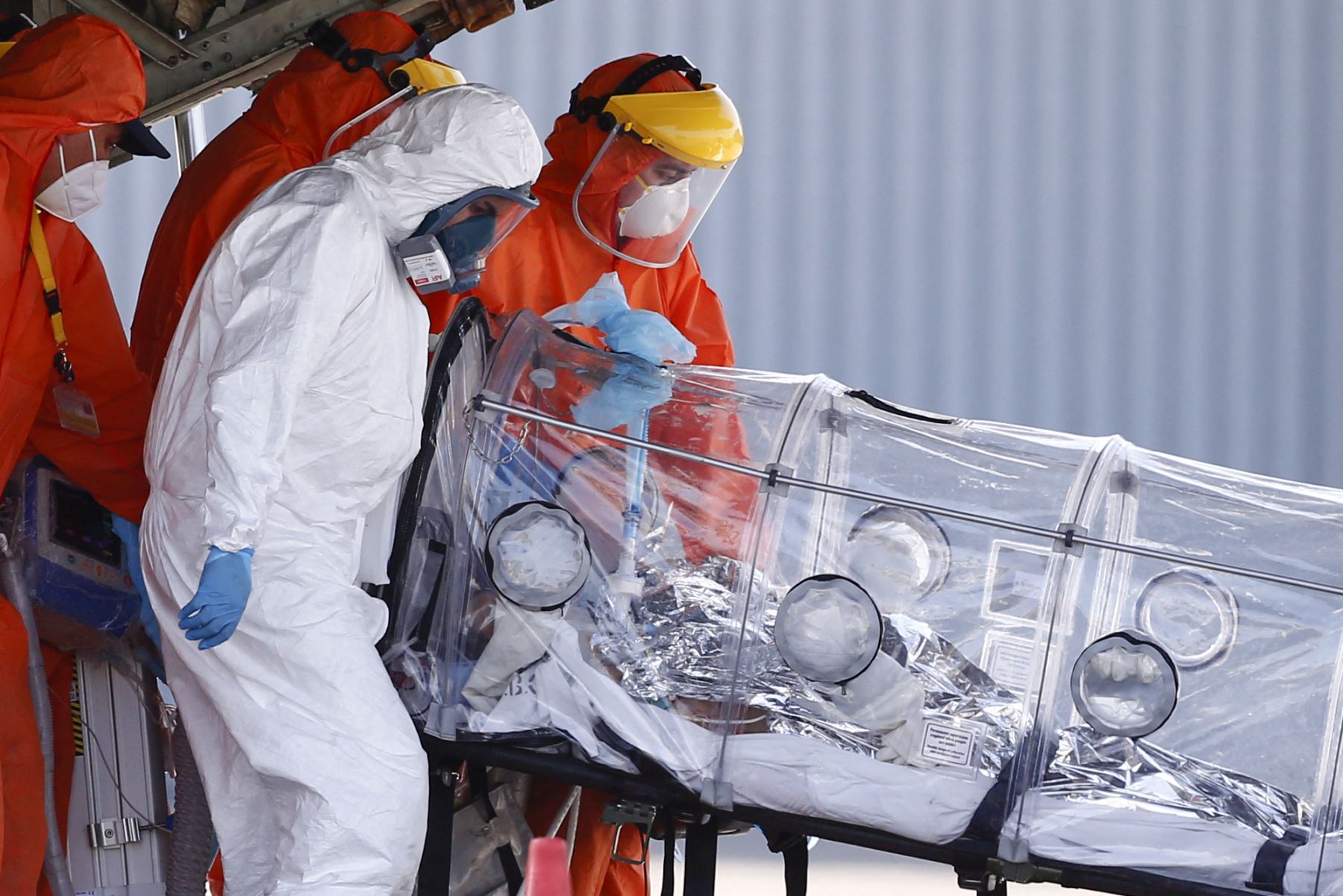
However, medical organizations warn that care for critically ill patients is collapsed in Bogota and throughout the country. In all cities, there are waiting for lines to access an ICU. The few beds that are released each day are for patients who are dying.
“What is also happening in mortality (is that) cases are now occurring in people under 55 or 60 years of age, who are in vaccination coverage, that has led to much longer occupancy in ICUs and of course mortality is much higher,” added Martin.
PROJECTIONS EXCEEDED
The pandemic has broken any projection about the country’s health outlook. To date, 90,353 people have lost their lives, a figure that was not even in the most pessimistic calculations, out of a total of 3,488,046 infected people.
In March 2020, when only 75 cases of covid-19 had been detected in the country, the Government projected in the state of emergency decree that the coronavirus could infect 3,989,853 people without public health interventions. Still, despite all the prevention campaigns and the millionaire investment in health services, the country is only 500,000 contagions away from reaching that scenario, which seemed exaggerated.
One of the priorities was to avoid deaths at all costs, so much so that the state of emergency decree did not make any projection in that sense. Still, Colombia is now in tenth place worldwide in deaths, and if the current rate continues before the end of the month, it will exceed 100,000 deaths.
This figure is equivalent to multiplying by four the fatalities of the worst natural tragedy suffered by the country, the eruption of the Nevado del Ruiz volcano on November 13, 1985, which devastated the town of Armero, killing some 25,000 people.
Meanwhile, vaccination, which Colombia started on February 17, later than other Latin American countries, has accelerated in the last weeks, and according to experts, thanks to the 10,979,983 vaccines applied so far, of which 3,369,264 are second doses, the outlook is no worse.
REACTIVATION IN SIGHT
And in full acceleration of the pandemic, the Government issued Decree 580 and Resolution 777 of 2021, two documents that will be the roadmap to regulate the economic reactivation of the country and which allow, among other things, the reopening of mass events such as concerts and sporting events with an occupancy of 25% of the capacity of the scenarios.
However, the Minister of Health, Fernando Ruiz, warned that “this does not mean that we cannot have a fourth peak”.
“The affectation continues, but also to the extent that we manage to vaccinate, advance and finish phase 1 of vaccination, of these three initial stages where we are with the most vulnerable people, we can surely have an affectation with a lower mortality rate,” he said.
For example, in this line, the entry of some 10,000 people was authorized for the match between Colombia and Argentina next Tuesday in Barranquilla, in the qualifiers for the World Cup Qatar 2022.
More: Colombia news in English, every day from The Rio Times.
Read More from The Rio Times