
ECONOMY · CHILE
Key Facts
- —The country Chile is the world’s largest copper producer. Copper accounts for the bulk of its mining output, and mining is a major driver of its economy.
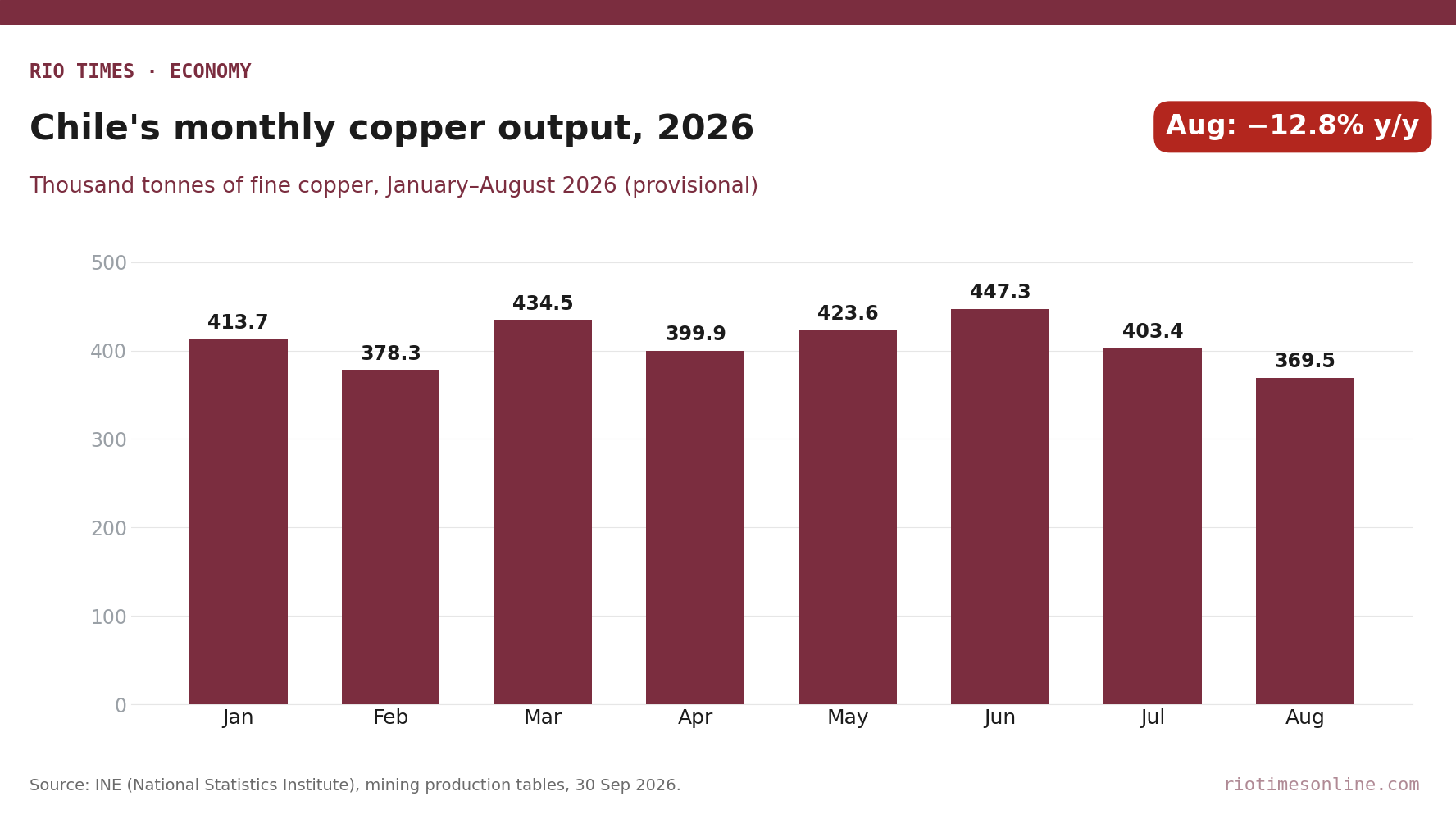
- —What happened Chile mining output fell 11.7% year on year in August 2026, the statistics institute INE reported on 30 September. Copper output dropped 12.8% to 369,500 tonnes.
- —Who is involved The Mining Council, which groups Chile’s large mining companies, on 2 October named four causes: storms, lower ore grades, delayed investment and deferred maintenance.
- —What it means for you Weaker copper output trims Chile’s growth and export income this year. The finance minister said on 2 October the government is now more cautious about 2026.
- —Still open Whether output recovers in September, and when new projects, about US$47 billion now under construction according to the council, start adding tonnes.
Chile mining output fell 11.7% in August from a year earlier, the National Statistics Institute (INE) reported on 30 September. Output of copper, gold, silver and molybdenum all fell below August 2025 levels.
On Friday 2 October the Mining Council (Consejo Minero), the trade body of the country’s large miners, gave its explanation. Its head named four causes, most of them temporary, in an interview with the newspaper La Tercera.
How far output fell in August
INE’s tables show 369,500 tonnes of copper in August 2026, down 12.8% from 423,643 tonnes a year earlier. La Tercera reported it was the weakest month for Chilean copper since February 2011.
The fall went beyond copper. Gold output dropped 28.7%, silver 21.2% and molybdenum, a by-product of copper mining, 31.1%, according to the same INE tables.
INE linked the copper decline partly to a July storm whose effects ran into August. It also cited lower ore grades at important mines.
The Chile mining slump hit the wider economy too. The central bank’s monthly activity index fell 1% in August, as Rio Times reported in Chile Imacec Falls 1% in August as Mining Slumps 17.4%.
The industry’s four reasons
Joaquín Villarino, executive president of the Mining Council, first pointed to the weather. He said a harsh winter in the north brought mudslides, snow and very strong winds, halting some large mines for days.
Second, several big deposits are passing through a dip in ore grades at the same time. Villarino called this part of normal mine planning, but said two or three large companies coincided.
Third, he blamed four or five years of legislative debate, including the constitutional process and the mining royalty, for freezing investment decisions. Fourth, miners are catching up on maintenance deferred during the pandemic.
Where the recovery could come from
Not every part of mining shrank. INE said non-metallic mining rose 22.3% in August on higher lithium carbonate output, and gold and silver are still up for January–August.
Villarino said projects worth about US$47 billion are under construction, with more than US$50 billion under study. He credited the current government with speeding up approvals but warned that mining cycles take time.
In July, the council’s head of studies, José Tomás Morel, told El Mercurio that an earlier dip in output was temporary. He argued that faster, more predictable permits are needed to turn the project pipeline into output.
What the government says
Finance Minister Jorge Quiroz said on Friday the figures confirmed a risk his team had flagged, though it had not measured its size. He said this makes the government “much more cautious” about how the year will close, La Tercera reported.
Copper output for January–August totalled about 3.27 million tonnes, 7.8% below the same period of 2025, by INE figures. Rio Times reported in September that Top Copper Miner Chile Posts Its Weakest Seven Months Since 2003.
What Is Not Yet Known
It is not yet clear how much of the August drop was weather and how much was ore grade. Neither INE nor the council has split the loss by cause or by mine.
INE’s next monthly release, covering September, will show whether the storm effect has passed. INE notes that its 2025 and 2026 figures are provisional.
Sources: INE (National Statistics Institute), Industrial Production Index, August 2026, 30 September 2026; INE mining production tables; La Tercera, interview with Joaquín Villarino, 2 October 2026; Consejo Minero (Mining Council), note on José Tomás Morel’s remarks to El Mercurio, 24 July 2026.
This article was produced by The Rio Times’ automated newsroom system. How we use AI · Report an error · Editorial responsibility: Matthias Camenzind, Editor-in-Chief
In depth