Chile Imacec: Economic Activity Falls 1% in August as Mining Slumps 17.4%
ECONOMY · CHILE
Key Facts
- —The country Chile is the world’s largest copper producer, and mining weighs heavily on its monthly economic data.
- —What happened The Imacec, the central bank’s monthly gauge of economic activity, fell 1.0% year on year in August, the bank reported on 1 October 2026.
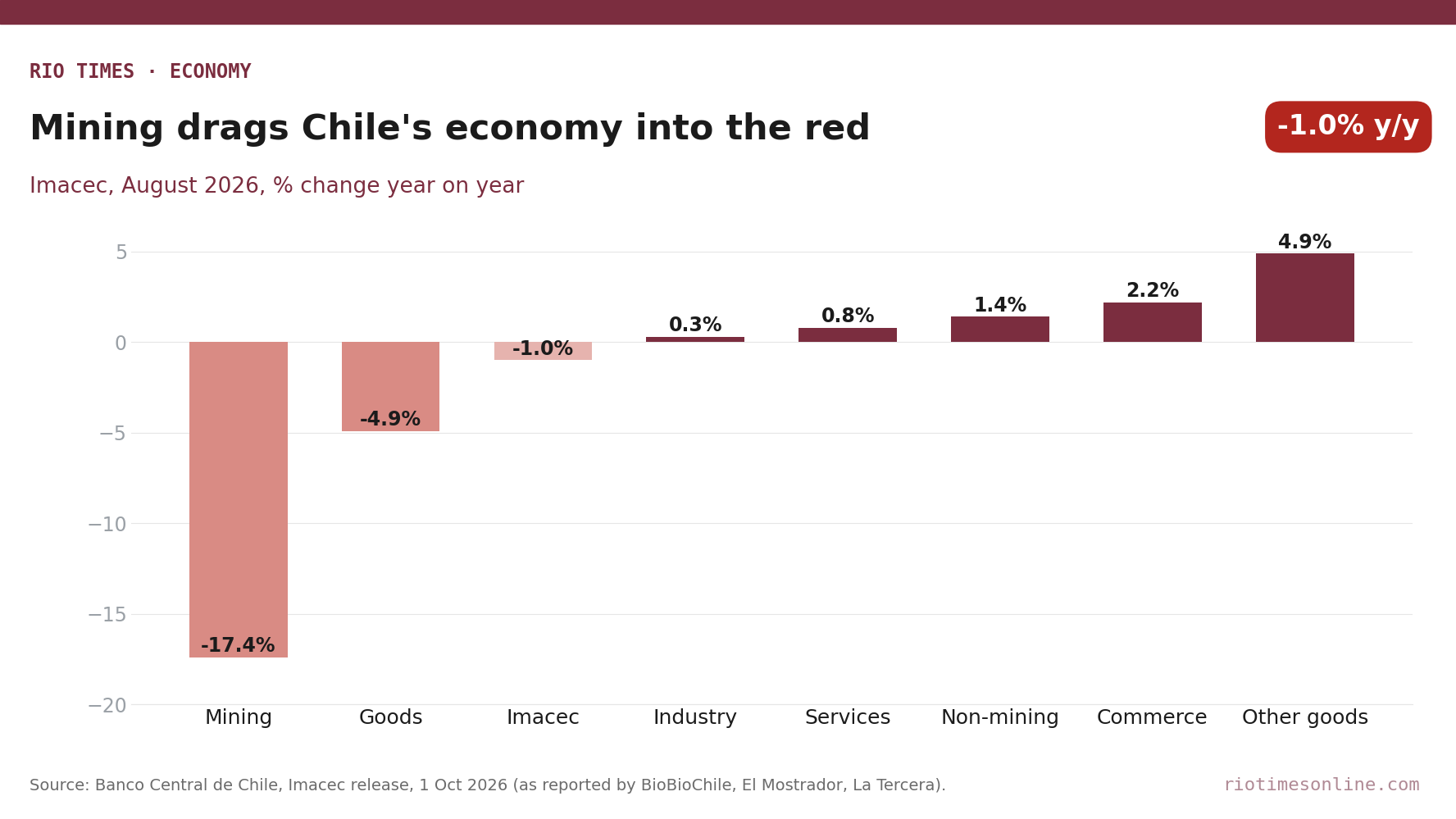
- —The numbers Mining output fell 17.4% year on year in August; non-mining activity grew 1.4%. Seasonally adjusted, the Imacec fell 0.7% from July (Banco Central de Chile, 1 Oct 2026).
- —What it means for you Chile’s economy has now shrunk in six of the first eight months of 2026, with unemployment at 9.6% in the quarter to August.
- —Still open Whether copper output recovers in September, and how far forecasters cut their 2026 growth estimates.
The Chile Imacec, the central bank’s monthly index of economic activity, fell 1.0% in August from a year earlier. The Banco Central de Chile published the figure on Thursday 1 October.
Mining output dropped 17.4%, while the rest of the economy grew 1.4%. It is the second annual fall in a row, after a 1.5% decline in July.

Mining accounts for almost the whole fall
Mining subtracted 2.3 percentage points from the annual Chile Imacec rate, La Tercera reported from the central bank’s contribution data. The bank blamed lower ore grades, maintenance work and adverse weather.
Seasonally adjusted, mining fell 10.7% from July, after a 10.4% drop the month before. Santander, the bank, said mining activity has reached its lowest level since 1996.
National copper output was 369,500 tonnes in August, according to INE (the National Statistics Institute) figures cited by La Tercera. That was 13% below August 2025.
The rest of the economy kept growing
Non-mining activity rose 1.4% year on year and 0.7% from July after seasonal adjustment. Commerce grew 2.2%, helped by sales of vehicles, clothing, food and online purchases.
Services rose 0.8%, led by health. Other goods, which include electricity, grew 4.9% as more water was available for power generation.
Manufacturing was almost flat, up 0.3%. August also had one more working day than August 2025, which flattered the annual comparison.
A weak year in numbers
Seasonally adjusted, the overall Chile Imacec fell 0.7% from July and 2.1% from a year earlier. Activity is down 0.5% over January–August, La Tercera reported.
The paper said only the recession years 1999, 2009 and 2020 began with similarly negative eight-month averages since 1997. Separately, Chile’s unemployment rose to 9.6% in the quarter to August.
Analysts had expected anything from growth of 0.5% to a fall of 1.5%, BioBioChile and El Mostrador reported. The result landed in the weaker part of that range.
Government and analysts see temporary factors
Daniel Mas, minister for both economy and mining, attributed the fall “in good part” to one-off, temporary factors in mining. He pointed to the Chile Despega job plan and a 2027 budget aimed at reviving growth.
Santander said much of the decline is temporary and expects a gradual recovery in coming months. It noted mining fell this far despite a weak base, after the El Teniente mine stoppage in 2025.
Priscila Robledo, chief economist at Fintual, said the non-mining rebound supports the view that July’s slump was partly transitory. The OCEC-UDP research centre said storm systems again hit activity in August, La Tercera reported.
What Is Not Yet Known
It is not yet clear whether copper output recovers in September after two weak months. Cochilco, the state copper commission, projects national output down 2.6% to 5.27 million tonnes in 2026.
The central bank currently projects 2026 growth of 0.5%, Juan Ortiz of OCEC-UDP told BioBioChile. Whether August’s data will push that estimate lower is not yet known.
Sources: Banco Central de Chile, Imacec August 2026 (1 October 2026), as reported by BioBioChile, El Mostrador and La Tercera; La Tercera on mining, Santander, Fintual, INE and Cochilco and on Minister Daniel Mas; BioBioChile (forecasts, 30 September 2026).
In depth
Read More from The Rio Times