CHAD · NEIGHBOURHOOD
Key Facts
- The borders Chad shares borders with six countries: Libya, Sudan, the Central African Republic, Cameroon, Nigeria and Niger.
- The size Chad has about 21.0 million people and an economy of about US$21.5 billion (2025 estimates).
- The refugees About 1.58 million refugees live in Chad, most of them from Sudan (count of 5 October 2026).
- The lake Lake Chad is managed by a six-nation commission with its headquarters in N’Djamena, the Chad capital.
- The sea Chad has no coast, and oil supplies about 76% of its exports, so its neighbours’ roads and ports matter.
The Chad neighbours in the Sahel, the dry belt south of the Sahara, are six countries, and almost all face war, drought or political change. This guide explains who they are and what crosses each border.
It also shows where Chad leads and where it follows.

Chad at the Crossroads of Six Countries
Chad is a landlocked country in the middle of northern Africa, and its border touches six countries. Libya lies to the north and Sudan to the east.
The Central African Republic is to the south, Cameroon and Nigeria are to the south-west, and Niger is to the west.The World Bank estimates that Chad had 21,003,705 people in 2025 and an economy of about US$21.5 billion.Its six neighbours together hold about 360 million people, so Chad is a small voice in a very large neighbourhood.Nigeria alone accounts for about 237.5 million of those 360 million people.The smallest neighbours are the Central African Republic, with about 5.5 million, and Libya, with about 7.5 million.The Africa section follows the wider continent, and the guides to Nigeria and Cameroon cover two of the neighbours in more detail.The sections below take each border in turn.
Sudan, the Neighbour in Crisis
Sudan is the neighbour that shapes Chad’s present more than any other. A war between the Sudanese army and the Rapid Support Forces, a paramilitary group, began in April 2023.
It has pushed families west across the eastern border.The United Nations refugee agency, UNHCR, counted 1,330,950 Sudanese refugees in Chad at the end of 2025.Its count of 5 October 2026 lists 1,584,253 refugees of all origins in Chad.UNHCR also counted 9,554 asylum-seekers on 31 August 2026.Chad also hosted 140,062 refugees from the Central African Republic and 22,214 from Nigeria at the end of 2025.
Chad is therefore a refuge for people from several of its own neighbours.Chad has about 21 million people, so the Sudanese refugees alone equal roughly 6% of the Chadian population.
Why the Border Matters Beyond Aid
Sudan’s economy was about US$60.2 billion in 2025, almost three times that of Chad. Its 51.7 million people are about two and a half times Chad’s population.
A war next door therefore drains a much smaller Chad of money, food and attention. The World Bank says military spending in Chad rose 11.6% in 2025, reaching 23% of domestic revenues.
The Sudan section follows the war from the Sudanese side.
- Sudanese refugees in Chad: 1,330,950 (end of 2025)
- Central African refugees in Chad: 140,062 (end of 2025)
- Nigerian refugees in Chad: 22,214 (end of 2025)
- All refugees in Chad: 1,584,253 (5 October 2026)
Libya and the Northern Desert Frontier
Chad’s northern border with Libya was the subject of a long territorial dispute. In 1989 the two countries agreed to take it to the International Court of Justice, the top United Nations court.
The court delivered its judgment on 3 February 1994. It found that a 1955 treaty between France and Libya had fixed a permanent frontier.
The border therefore did not lapse when the treaty ended. That settled the legal line.
Libya has about 7.5 million people and an economy of about US$48.1 billion in 2025, according to the World Bank. UNHCR counted only five refugees and ten asylum-seekers from Libya in Chad at the end of 2025.
The Libyan border is therefore very different from the Sudanese one. Far fewer displaced people use it.
Cameroon, Nigeria and Niger Around Lake Chad
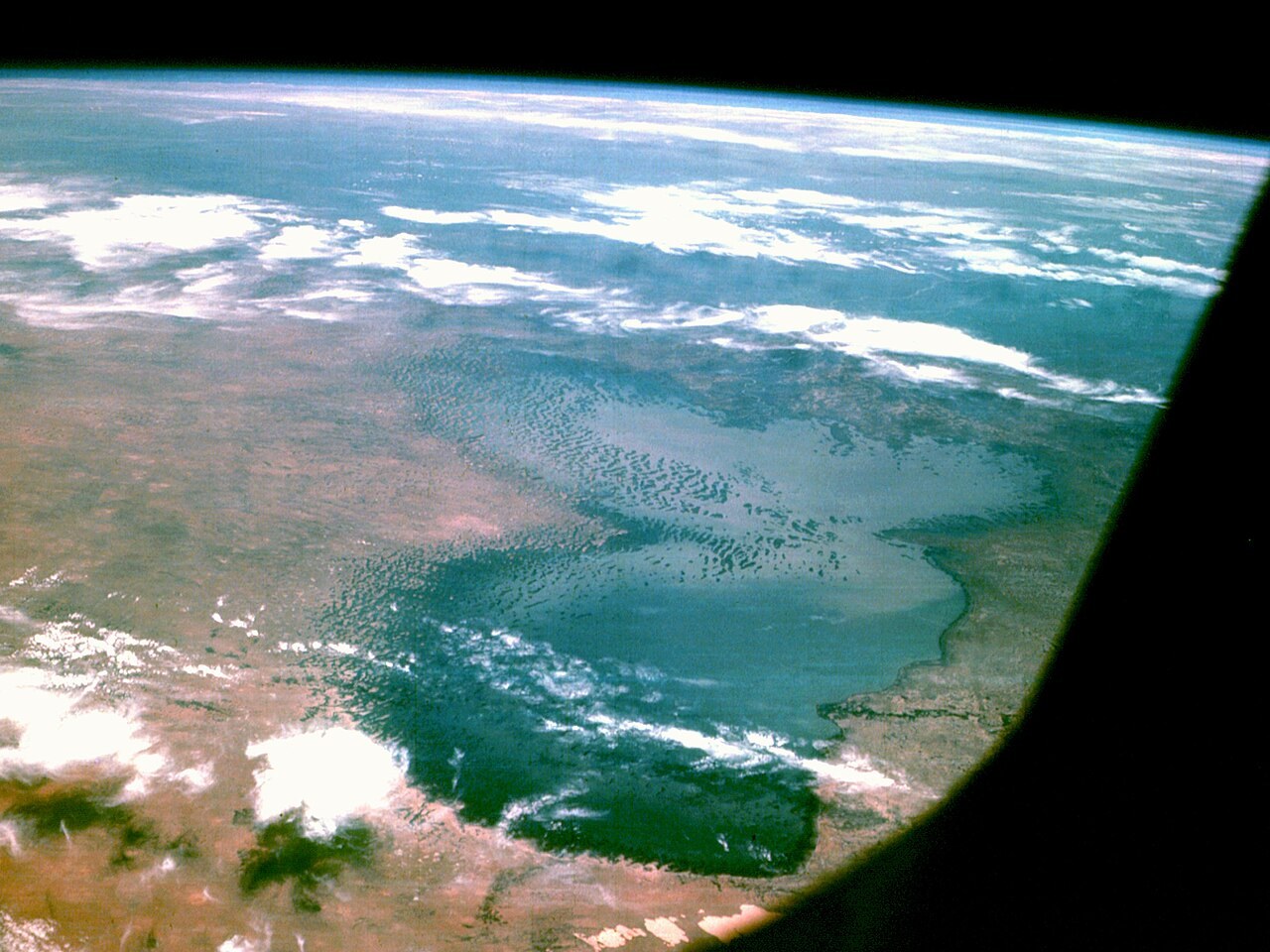
In the west and south-west, Chad meets three countries at once. Cameroon, Nigeria and Niger all touch Lake Chad, a shallow lake in the Sahel.
The World Bank names the drying of Lake Chad and desertification among the threats to Chad’s farming and fishing livelihoods. Agriculture accounts for roughly 40% of Chad’s economy, so a shrinking lake hits many households.
Nigeria is the giant of the group, with about 237.5 million people and an economy of about US$290.8 billion in 2025. Cameroon has about 29.9 million people and about US$58.9 billion, and Niger has about 27.9 million people and about US$21.6 billion.
Niger’s economy is almost exactly the size of Chad’s. Both countries are small economies facing the same dry climate.
People also cross these borders to seek safety. At the end of 2025 UNHCR counted 7,711 refugees from Cameroon and 867 from Niger in Chad, besides the 22,214 from Nigeria.
The Central African Republic to the South
South of Chad lies the Central African Republic, with about 5.5 million people and an economy of only about US$3.1 billion in 2025. It is the smallest of the six neighbours in both measures.
Refugees have crossed this border for years. In 2025 UNHCR counted 140,062 refugees and 4,834 asylum-seekers from the Central African Republic in Chad.
About 5,000 Chadian refugees were in the other direction. UNHCR recorded 5,013 at the end of 2025.
The two countries sit together in the regional bodies described below. The flow of people is far larger toward Chad than away from it.
Trade, Oil and a Landlocked Economy
The World Bank says oil supplies about 15% of Chad’s economy, 41% of government revenue and 76% of exports. Agriculture adds roughly 40% of output, and about 88% of jobs are informal.
Chad has no coastline, so everything it sells or buys must cross at least one neighbour. That makes friendly borders, working roads and honest customs posts part of the national budget.
Oil production fell in 2025, and the bank puts oil output growth at minus 0.7% for that year. It projects overall growth of 3.4% for 2025 and an average of 3.9% a year for 2026 and 2027.
Poverty is deep, with 44.8% of people below the national poverty line in 2022. The bank also warns that conflicts in neighbouring countries strain stability and public finances.
Regional Bodies Where Chad Sits
The Lake Chad Basin Commission was created on 22 May 1964 by Cameroon, Chad, Niger and Nigeria. The Central African Republic joined in 1996 and Libya in 2008, and its headquarters are in N’Djamena.
The commission says the basin covers 2.5 million square kilometres and is home to nearly 45 million people. On 28 October 2026 it launched a US$11.7 million climate project, paid for by the Adaptation Fund.
The commission also ran a regional workshop on stabilisation and recovery on 11 September 2026. Its Executive Secretary, Ambassador Ibrahim Babani, is also head of mission of the Multinational Joint Task Force, the basin’s regional security force.
That makes N’Djamena the seat of both a water body and a security effort. Chad is also one of six members of CEMAC, the Economic and Monetary Community of Central Africa, whose headquarters are in Bangui.
The other CEMAC members are Cameroon, the Central African Republic, Congo, Gabon and Equatorial Guinea. Two of Chad’s neighbours, Cameroon and the Central African Republic, therefore sit in the same bloc.
Where Chad Leads and Where It Follows
Chad leads in hosting. It carries a refugee population equal to about 7.5% of its own people, and its capital hosts the Lake Chad Basin Commission.
Chad follows in trade and money. Its oil is its main export, and it has no coast of its own.
Its economy is smaller than Cameroon’s and far smaller than Nigeria’s. Only Niger and the Central African Republic are similar or smaller.
In politics, the World Bank notes that Parliament approved constitutional changes on 3 October 2025. They extend presidential terms from five to seven years without a limit.
The opposition leader Succès Masra received a 20-year sentence after a post-election crisis.Neighbours watch these moves because stability in N’Djamena affects refugees, trade and security around the lake.The Chad neighbours are tied to the same few crises: war in Sudan, a shrinking lake and a landlocked economy.
What It Means for US Readers
For US readers, the Chad neighbours matter because the Sahel is a place where migration, armed groups and great-power competition meet. A crisis in one border state can raise aid needs, travel risks and security costs for the whole region.
Humanitarian groups work with refugees from Sudan in eastern Chad. Investors in oil or shipping should read Chad together with Cameroon, Nigeria and Niger.
What Is Not Known
The size of the Sudan refugee flow during 2026 is only partly known. UNHCR’s latest public count gives the total of 1,584,253 refugees but no split by country of origin.
Trade and migration across the northern desert are not measured in official statistics. The World Bank projects that extreme poverty in Chad will rise to 47.6% in 2027.
Frequently Asked Questions
Which countries border Chad?
Chad borders six countries. They are Libya to the north, Sudan to the east, the Central African Republic to the south, Cameroon and Nigeria to the south-west, and Niger to the west.
How many refugees are in Chad?
UNHCR lists 1,584,253 refugees in Chad as of 5 October 2026. At the end of 2025 it counted 1,330,950 refugees from Sudan alone.
Is Chad part of the Sahel?
Yes, Chad lies in the Sahel, the dry belt south of the Sahara. It shares Lake Chad with Cameroon, Niger and Nigeria.
What is the Lake Chad Basin Commission?
It is a six-nation body founded on 22 May 1964 and headquartered in N’Djamena. Its members are Cameroon, Chad, Niger, Nigeria, the Central African Republic and Libya.
Is Chad a landlocked country?
Yes, Chad has no coastline. Its trade must pass through a neighbouring country to reach the sea.
What does Chad export?
Oil supplies about 76% of Chad’s exports and 41% of government revenue, according to the World Bank. Agriculture contributes about 40% of the economy.
Sources: UNHCR, Operational Data Portal, Chad country page (refugees 1,584,253 on 5 October 2026; asylum-seekers 9,554 on 31 August 2026), 2026-10-05; UNHCR, Refugee Data Finder and population statistics API (year-end 2025, country of asylum Chad), 2026-11-01; World Bank, World Development Indicators (population SP.POP.TOTL and GDP NY.GDP.MKTP.CD, 2025), 2026-10-08; World Bank, Chad country overview, 2026-11-01; Lake Chad Basin Commission, official website (members, history, news of 11 September and 28 October 2026), 2026-10-28; CEMAC, official website (member states, headquarters), 2026-10-26; International Court of Justice, Territorial Dispute (Libya/Chad), judgment of 3 February 1994, 1994-02-03.
This article was produced by The Rio Times’ automated newsroom system. How we use AI · Report an error · Editorial responsibility: Matthias Camenzind, Editor-in-Chief
Brazil runoff date: Sunday, October 25, poll closing times and when results start · Brazil runoff polls: Flávio 51%, Lula 49% · Kalshi and Polymarket odds
Rotate for Best Experience
This report is optimized for landscape viewing. Rotate your phone for the full experience.
You've reached your free article limit
Subscribe to The Rio Times for unlimited access to our reporting from across Africa.
Keep reading for free
Your first article was on us. Register with your email address to read 6 free articles every month. You will also receive Africa Intelligence: African markets, politics and business, every weekday morning.