Brazil Poll: 31.5% of Voters May Switch Their Presidential Vote Before Sunday
POLITICS · BRAZIL
Key Facts
- —The country Brazil holds the first round of its presidential election on Sunday 4 October 2026. A runoff follows on 25 October if nobody wins a majority of valid votes.
- —What happened A Meio/Ideia poll released on 30 September found 31.5% of voters may still change their presidential choice before Sunday; 68.5% say they are decided.
- —The numbers Same poll, fieldwork 25–28 September: Lula 39.4%, Flávio Bolsonaro 38.4% in the first round, and 48.5% to 48% in a runoff. Margin of error: 2.2 points.
- —What it means for you The race remains a statistical tie. A runoff on 25 October would extend the campaign, and the policy uncertainty that comes with it, by three weeks.
- —Still open Whether late switchers move at all: a BTG/Nexus poll of 25–27 September found only 12% of voters with a candidate still open to changing.
Nearly a third of Brazil’s voters may switch their presidential choice before Sunday, according to a poll released on Wednesday 30 September. In the Meio/Ideia survey, 31.5% said they could still change their vote, while 68.5% said their mind was made up.
With Luiz Inácio Lula da Silva and Flávio Bolsonaro level, that group could decide whether the race ends on 4 October. The poll put the president, of the Workers’ Party (PT), on 39.4% and the Liberal Party (PL) senator on 38.4%.

What Would Make Voters Change Their Minds
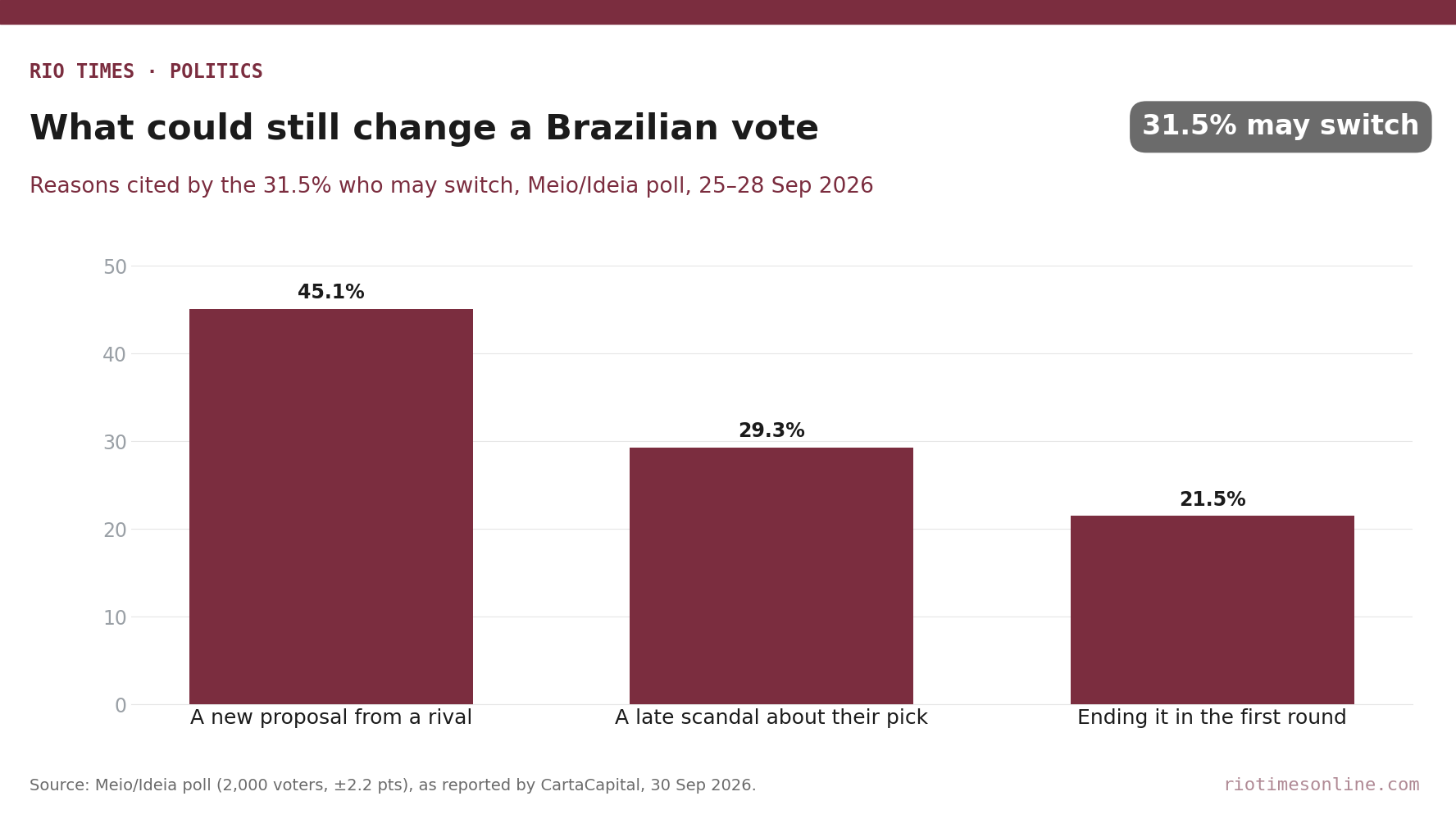
Among those open to switching, 45.1% said a new proposal from another candidate could move them. Another 29.3% cited a late corruption scandal involving their own candidate.
A further 21.5% said they might change simply to settle the election in the first round. CartaCapital, which reported the breakdown, noted that the evenly split race makes this group potentially decisive.
Canal Meio, a news outlet, commissioned the survey from the Ideia polling institute. Ideia interviewed 2,000 voters by telephone from 25 to 28 September, with a margin of error of 2.2 points.
The poll is registered with the Superior Electoral Court (TSE), which runs Brazil’s elections, as BR-08706/2026. Brazilian law requires every published poll to be registered there first.
A Statistical Tie in Both Rounds
Behind the two leaders, Augusto Cury of Avante had 6.7% and Renan Santos of Missão 4.5%. Ronaldo Caiado of the PSD had 4.4% and Romeu Zema of Novo 3.5%, Veja reported.
In a simulated runoff, Lula had 48.5% and Flávio 48%, again within the margin of error. In the previous Meio/Ideia round, released on 9 September, both men stood at 46%.
To win outright on Sunday, a candidate needs more than half of valid votes, which exclude blank and spoiled ballots. Otherwise the top two meet again on 25 October.
Other pollsters see a similar picture. The final AtlasIntel poll, published on Tuesday, had Lula ahead in the first round and the runoff a dead heat.
Another Poll Sees a More Settled Electorate
Not every survey finds so much movement. A BTG/Nexus poll interviewed 2,000 voters by phone from 25 to 27 September, with a margin of error of two points.
It found 87% of voters who had picked a candidate called the decision final, and only 12% might still change. Veja reported that this is the most settled reading in the Nexus series.
The two polls ask different questions, so the figures are not directly comparable. Nexus measures only voters who already name a candidate, while Ideia’s two figures cover its whole sample.
Ideia’s own series also shows volatility falling since April. In that round, 51.4% said they might change their vote, Banda B reported at the time.
Among Nexus’s possible switchers, second choices were scattered: Lula 18%, Cury and Flávio 17% each, Caiado 14%. Such a spread means late switching need not favour any one candidate.
What the Candidates Are Offering
Voters swayed by proposals have plenty to read. On Wednesday the news site g1 compiled the six leading candidates’ government plans, as filed with the TSE.
The plans cover public security, corruption, the minimum wage, pensions, interest rates and the Supreme Court (STF). g1 found the six converge on similar proposals in five areas.
Voters’ priorities point the same way. A Quaest poll released on 28 September found violence (29%), corruption (21%) and the economy (19%) the most cited concerns, g1 reported.
The STF became a campaign theme after new developments in the Banco Master case. Globo’s final televised debate, on Thursday 1 October, is the last large stage for fresh pitches.
What Is Not Yet Known
It is unclear how many voters may switch in practice. Saying one might change is not the same as doing so.
The two latest polls also differ on the gap: Nexus had Lula on 42% and Flávio on 37%, Ideia a one-point edge. Sunday’s count will show which reading was closer.
Frequently Asked Questions
When is Brazil’s presidential election?
The first round is on Sunday 4 October 2026. If no candidate wins more than half of valid votes, the top two meet in a runoff on 25 October.
What share of Brazil’s voters may switch?
A Meio/Ideia poll of 25–28 September put it at 31.5%. A BTG/Nexus poll of 25–27 September found 12% of voters with a candidate open to changing.
Who leads Brazil’s presidential race?
Nobody clearly. Meio/Ideia had Lula on 39.4% and Flávio Bolsonaro on 38.4% in the first round. In a runoff it was 48.5% to 48%, a statistical tie.
Sources: CartaCapital, 30 September 2026; Veja, 30 September 2026 (Meio/Ideia, TSE registration BR-08706/2026); Veja, 28 September 2026 (BTG/Nexus, BR-07557/2026); g1, 30 September 2026; Banda B, April 2026.
This article was produced by The Rio Times’ automated newsroom system. How we use AI · Report an error
Read More from The Rio Times