Brazil’s 4 Defeated Candidates Endorse No One in Runoff

ELECTIONS · BRAZIL
Runoff · Sunday, 25 October
Flávio Bolsonaro vs Lula: what happens next
First-round results, how the runoff works, the key dates and who backs whom, in one guide.
Key Facts
- —The country Brazil is Latin America’s largest economy and most populous nation. A president needs more than half of valid votes, so a close race goes to a second round.
- —Why it matters The four main eliminated candidates won about 9.1 million votes on 4 October. That is roughly four times Flávio Bolsonaro’s 2.2 million-vote lead over Lula (TSE).
- —Why now The runoff is on Sunday 25 October. Both camps are now courting these voters, with three weeks left (Metrópoles, 5 October).
- —What happened On the night of 4 October, Augusto Cury and Renan Santos refused to back anyone. Ronaldo Caiado deferred to his party, and Romeu Zema declared himself against the PT.
- —The numbers Cury 2.89%, Santos 2.24%, Caiado 2.18%, Zema 0.27% of valid votes. Flávio 47.03%, Lula 45.16% (TSE, 99.99% counted, reported 5 October).
- —What it means for you The winner sets Brazil’s line on trade, China and the United States from 2027. Without endorsements, turnout and the two campaigns decide the result.
- —Still open Whether Caiado endorses anyone after meeting PSD chair Gilberto Kassab. Zema’s Novo party plans to formalise its backing for Flávio this week (O Globo, 5 October).
- —Prediction markets Polymarket gives Flávio Bolsonaro an 84% chance of winning the presidency and Lula 16.5% (5 October, 12:29 p.m. ET). Polymarket puts Flávio Bolsonaro’s chance of winning at 83% and Kalshi at 82% (Lula: 18% and 18%), as of 5 October, 2:40 pm ET; prices are bets, not polls.
Brazil runoff endorsements, a staple of past campaigns, have not materialised after Sunday’s first round of the presidential election. None of the four best-placed eliminated candidates has formally backed either finalist.
Flávio Bolsonaro is a senator for Rio de Janeiro and son of former president Jair Bolsonaro. He runs for the conservative Liberal Party (PL), led by Valdemar Costa Neto. President Luiz Inácio Lula da Silva runs for the left-wing Workers’ Party (PT), led by Edinho Silva.
For Washington and US investors, the race for Latin America’s largest economy now rests on the two finalists alone. The four candidates won about 9.1 million votes, roughly four times the 2.2 million votes separating the leaders.
Cury and Santos Refuse to Pick a Side
Augusto Cury, the psychiatrist and best-selling author who ran for Avante, a small centrist party, finished third with 2.89% of valid votes. On Sunday night in Ribeirão Preto he said he would stay out of the runoff entirely.
“I fall completely silent about those who will be in the second round,” he said, according to g1. He added that no one was authorised to claim his support or that of his running mate, Júlio.
In a letter cited by Metrópoles, Cury congratulated both finalists without choosing one. “Whoever wins, I hope they govern thinking of a Brazil of hope,” he wrote.
CNN Brasil reported that Cury does not plan to continue in politics and ruled out a cabinet post. His campaign had attacked polarisation and criticised both main camps.
Renan Santos, co-founder of the Free Brazil Movement (MBL), ran for Missão, the new right-leaning party that grew out of the MBL. He came fourth with 2.24%. He said he would campaign neither for a candidate nor for a spoiled ballot.
“Do whatever you want, because it will make no difference,” he told supporters, as quoted by CNN Brasil. He predicted that Flávio had already won and said he would keep building his party.
Caiado Defers to a Neutral PSD
Ronaldo Caiado, a former governor of Goiás, placed fifth with 2.18%. He said he would announce nothing before meeting Gilberto Kassab, the national chair of his Social Democratic Party (PSD).
“I will keep my coherence,” Caiado told reporters, according to O Globo and Terra. “I did not win, but I fell standing,” he added.
The party moved first. In a note on Sunday night, Kassab, who was also Caiado’s running mate, declared the PSD neutral in the presidential runoff.
State branches, lawmakers and members “will have freedom to define their support,” the note said, per O Globo and CNN Brasil. Folha de S.Paulo noted that northern and north-eastern branches lean towards Lula. Those in the Centre-West, South and South-East lean towards Flávio.
Caiado has a record on the right. In 2022, after winning re-election in Goiás, he endorsed Jair Bolsonaro against Lula, Metrópoles recalled.
Zema Opposes the PT but Names No One
Romeu Zema, a former governor of Minas Gerais, ran for Novo, a pro-market party that favours a smaller state. He won only 0.27% but gave the clearest signal of the four, without a formal endorsement.
“Wherever the PT is in the second round, I will be against the PT,” he said in Belo Horizonte, according to g1 and Terra. He did not mention Flávio by name.
On social media he wrote “mission accomplished”, saying Novo had cleared the vote threshold that secures public party funding. He signed off “ALWAYS against the PT”.
Why Neutral Losers Still Matter
Flávio took 47.03% and Lula 45.16%, a gap of 1.87 points, according to TSE figures with 99.99% of polling stations counted. That margin is smaller than Cury’s share alone.
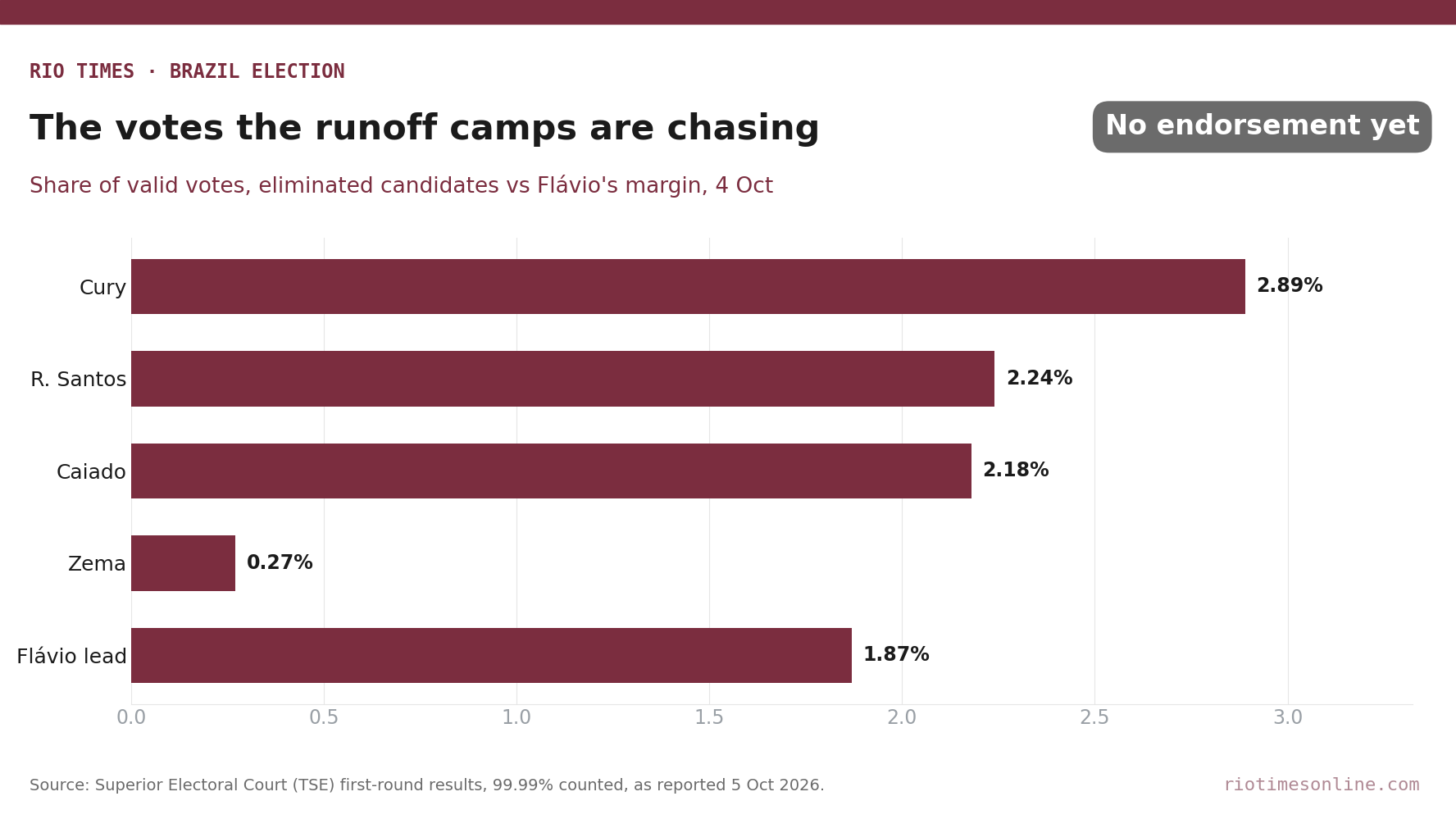
Brazil runoff endorsements rarely move whole blocs. An analyst quoted by InfoMoney said Zema’s and most of Caiado’s voters lean towards Flávio. Cury’s remaining voters look closer to Lula’s base.
Santos’s voters, the same analyst said, cast a protest vote and may split or stay home. Abstention already reached 21.08% in the first round, the highest since 1998.
The contrast with 2022 is clear. Then, Simone Tebet, the centrist senator who had finished third for the Brazilian Democratic Movement (MDB), backed Lula soon after the first round, and he won the runoff by 1.8 points.
Without Brazil runoff endorsements this year, both finalists must win over these voters directly. Our earlier report, Brazil Runoff: Flávio Hails ‘End of PT Era’, Lula Regroups, covers how both camps reset their strategy.
What It Means for You
For US investors, the runoff has no kingmaker. Holders of Brazilian ADRs such as Petrobras, Vale and Itaú Unibanco, and of the real, face three more weeks of a two-way race in which a 1.87-point gap can still close.
The bets below already price Flávio as a clear favourite, but bets are not votes. With abstention at 21.08% in the first round, turnout on 25 October may matter more than any loser’s blessing.
The winner sets Brazil’s line on trade, China and the United States from 2027. For travellers and residents, daily life is unchanged until the vote.
What Is Not Known
No date has been given for Caiado’s meeting with Kassab, the next test for Brazil runoff endorsements. Novo plans to meet its newly elected lawmakers on Tuesday or Wednesday, then formally back Flávio, O Globo reported on Monday.
The party has not announced it yet. Until it does, Zema’s stance remains a statement against the PT rather than an endorsement.
How many PSD state branches will back each finalist remains open. For the timetable of the vote, see Brazil Runoff on October 25, Flávio Bolsonaro vs Lula.
What Prediction Markets Say
On Polymarket, where about US$172 million has been bet on the “Brazil Presidential Election” market since it opened, Flávio traded at 84% and Lula at 16.5% at 12:29 p.m. ET on 5 October. That is a jump of about 22 points for Flávio in a day.
On Kalshi, which is regulated in the US by the Commodity Futures Trading Commission (CFTC), Flávio last traded at 83 cents and Lula at 18. A day earlier they stood at 64 and 37. These are bets, not polls.
Prediction markets · who wins the runoff
Implied chance of winning Brazil’s presidency on 25 October, from traders’ prices.
Polymarket
Flávio Bolsonaro 82.5% · Lula 17.5% (US$173 million traded)
Kalshi (regulated in the US by the CFTC)
Flávio Bolsonaro 82% · Lula 18%
As of 5 October, 2:40 pm ET (19:40 Lisbon), updated every 20 minutes. Prices are bets, not polls, and can move fast.
Why we show this: prediction markets turn real-money bets into a live probability that moves within minutes of the news, which is why investors, campaigns and newsrooms in the United States now follow them closely. We show them next to polls and official results, never instead of them.
Why we show this: prediction markets turn real-money bets into a live probability that moves within minutes of the news, which is why investors, campaigns and newsrooms in the United States now follow them closely. We show them next to polls and official results, never instead of them.
Has any eliminated candidate endorsed Flávio Bolsonaro or Lula?
Not formally, as of Monday afternoon, 5 October. Romeu Zema said he will be against the PT, which favours Flávio, but he did not name him. His Novo party plans a formal announcement this week.
What did Ronaldo Caiado’s party decide for the runoff?
PSD chair Gilberto Kassab declared the party neutral on 4 October. State branches, lawmakers and members are free to back either candidate.
When is Brazil’s presidential runoff?
Sunday 25 October 2026, between Flávio Bolsonaro of the Liberal Party (PL) and President Lula of the Workers’ Party (PT).
Sources: g1; CNN Brasil; CNN Brasil (Renan Santos); O Globo; Folha de S.Paulo; Metrópoles; Terra; InfoMoney; O Globo (Novo); Agência Brasil; Superior Electoral Court (TSE) results; Polymarket and Kalshi market data, 5 October 2026.
This article was produced by The Rio Times’ automated newsroom system. How we use AI · Report an error · Editorial responsibility: Matthias Camenzind, Editor-in-Chief