Brazil’s First Presidential Debate Is Off as Both Front-Runners Stay Silent
Key Facts
Runoff · Sunday, 25 October
Brazil Runoff 2026: Lula vs Flávio
Date, polls, debates, odds and how the runoff works, updated every day.
Read our Brazil election 2026 runoff guide →
Brazil election 2026 · Brazil election polls · Who will win: Brazil election odds · Brazil runoff date and results start · Brazil election results · Brazil election poll data (CSV) · All election stories
Prediction markets · who wins the runoff
Implied chance of winning Brazil’s presidency on 25 October, from traders’ prices.
Polymarket
Flávio Bolsonaro 83.7% · Lula 16.5% (US$196 million traded)
Kalshi (regulated in the US by the CFTC)
Flávio Bolsonaro 83% · Lula 18%
As of 24 October, 8:40 pm ET (01:40 Lisbon), updated every 20 minutes. Prices are bets, not polls, and can move fast.
Why we show this: prediction markets turn real-money bets into a live probability that moves within minutes of the news, which is why investors, campaigns and newsrooms in the United States now follow them closely. We show them next to polls and official results, never instead of them.
Brazil’s presidential race is heading for another close finish between Lula and the Bolsonaro family. A debate staged by eleven broadcasters was cancelled after both front-runners let the deadline pass in silence.
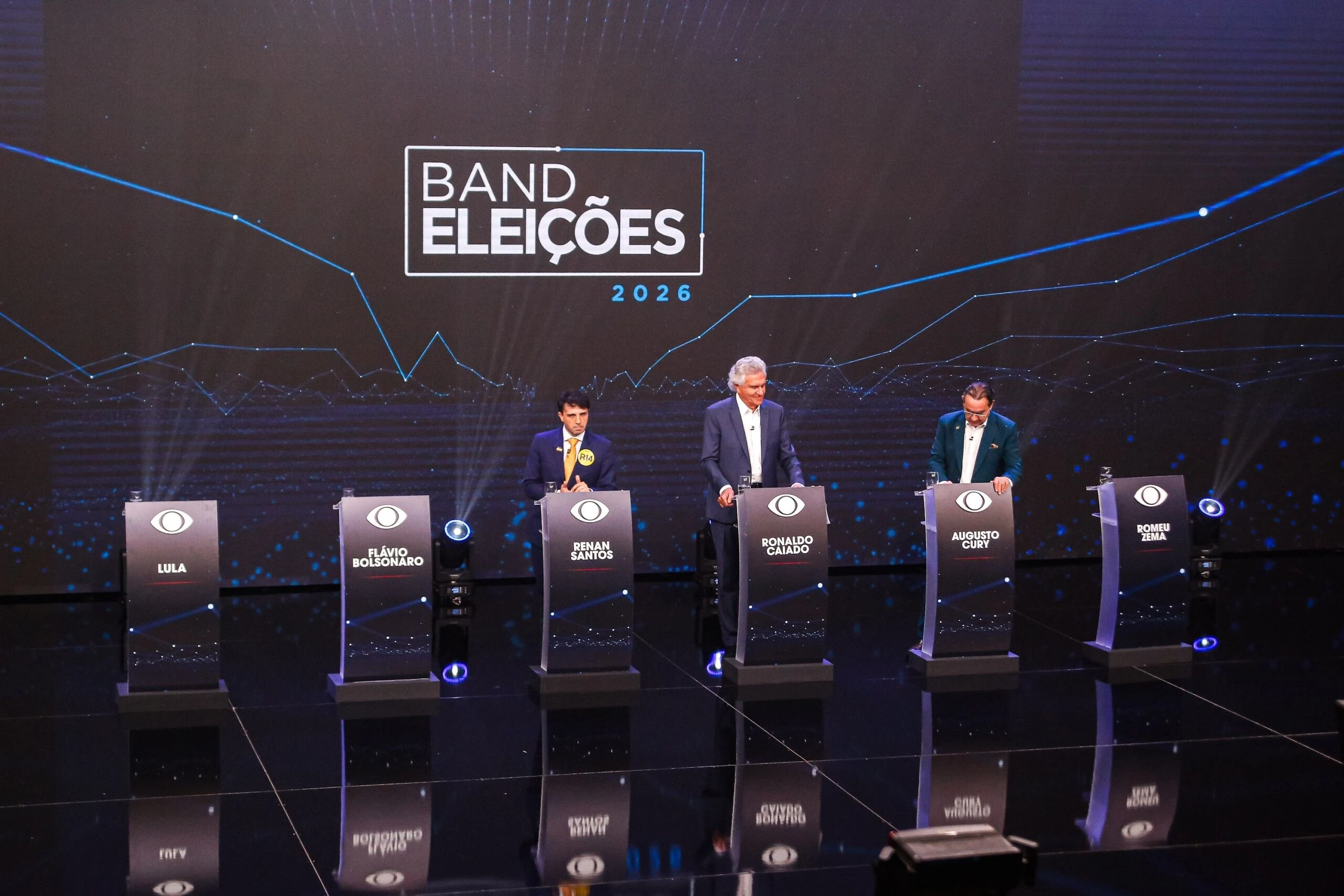
A pool of eleven media outlets announced on 8 September 2026 that it had cancelled its presidential debate set for 14 September. President Luiz Inácio Lula da Silva and Senator Flávio Bolsonaro, the two poll leaders, did not confirm by the 7 September deadline.
Why This Matters
Brazil is the largest economy in Latin America, and this is the region’s most consequential election this year. Voting is compulsory for literate citizens aged 18 to 69, and the whole country votes electronically.
The first round is on Sunday 4 October, and a runoff follows on 25 October if nobody wins outright. The last race was the closest in Brazil’s history, with Lula beating Jair Bolsonaro by 50.9% to 49.1% in 2022.
This time Lula’s main rival is Flávio Bolsonaro, the former president’s son and a senator. A cancelled debate removes the only scheduled moment where the two would have faced each other before voting starts.
For investors, the result will set economic policy in Latin America’s biggest market. For voters, televised debates are one of the few unscripted tests of the candidates.
What Was Cancelled
Eleven outlets had joined to stage the debate under the banner The Moment of Decision. They include CNN Brasil, the broadcasters SBT and RedeTV!, the magazines Exame and VEJA, and news sites Metrópoles and Terra.
Rádio Itatiaia, a radio network based in Minas Gerais, was also part of the pool. Pools of this kind returned in 2022 for the first time since the 1989 presidential election.
The debate was set for 14 September, and the deadline for candidates to confirm was 7 September. The cancellation was announced on 8 September, the day after the deadline passed.
A São Paulo governor’s debate scheduled for 18 September was cancelled too. There too, the incumbent governor failed to confirm his participation.
Nobody Actually Said No
President Lula, seeking a fourth term, did not confirm, and Senator Flávio Bolsonaro did not confirm either. Neither campaign issued a statement, declined in terms or gave a reason.
That distinction matters for how this is reported, because silence is not a refusal, though the effect is the same. Four candidates did confirm, namely Ronaldo Caiado, Romeu Zema, Augusto Cury and Renan Santos.
Caiado, the governor of Goiás state, called the cancellation a blow to Brazilian democracy. Zema is the governor of Minas Gerais, a large state in Brazil’s southeast.
Who the Front-Runners Are
Lula is seeking a fourth term for the left-wing Workers’ Party, known as PT, with Geraldo Alckmin as his running mate. Flávio Bolsonaro is a senator for Rio de Janeiro and the son of former president Jair Bolsonaro.
He announced his candidacy in December 2025, after visiting his father in custody. His running mate is a federal deputy from Alagoas, a state in Brazil’s northeast.
Jair Bolsonaro is not a candidate, because he was convicted of attempting a coup and sentenced to 27 years and three months. He is serving that sentence under house arrest in Brasília, with visits restricted to doctors and lawyers.
Flávio is barred from visiting him under a Supreme Court restriction. The same court is now embroiled in a public dispute among its own justices.
Where the Race Stands
Quaest, a leading pollster, surveyed 2,004 people between 3 and 6 September for a Globo company. The poll has a margin of error of two percentage points.
In the first round it puts Lula on 36% and Flávio Bolsonaro on 29%. Augusto Cury follows on 8%, then Ronaldo Caiado and Renan Santos on 3% each, and Romeu Zema on 2%.
In a runoff the same poll has the two front-runners level at 41% each. Other polls this week point the same way or slightly the other, with one showing Flávio ahead 46 to 45.
Another has them tied at 44, so the first round has a leader and the second round does not. Neither campaign has said whether the risk of a debate stumble played any part in its silence.
The State Races Under It
Brazilians also elect state governors on 4 October, and Quaest polled five of those races from 4 to 7 September. In São Paulo, incumbent governor Tarcísio de Freitas leads Lula ally Fernando Haddad by 42% to 27%.
In Rio de Janeiro, Eduardo Paes, a long-serving Rio mayor, leads on 39%, with Douglas Ruas on 18%. Celina Leão leads the Federal District, home to Brasília, on 35%, and Cleitinho leads Minas Gerais on 32%.
Pernambuco is the close one, with incumbent governor Raquel Lyra on 43% to João Campos’s 37%. The pollster calls that a tie at the edge of the margin, so a six-point gap is not a clear lead.
Two Legal Actions Running in Parallel
On 8 September, Flávio Bolsonaro’s campaign asked the electoral court, known as TSE, to cancel the Lula ticket’s registration. It alleges abuse of power over a February Carnival parade at Rio’s sambadrome that honoured Lula.
The filing alleges public money was used and seeks eight years of ineligibility, and there has been no ruling. The same day, the court accepted a case filed by Lula’s coalition against Flávio Bolsonaro and his running mate.
It concerns campaigning from the main stage of a rodeo festival in Barretos in late August, before around 60,000 people. The allegation is indirect corporate campaign funding, because private companies paid for the stage.
Flávio has five days to answer, and no court has found wrongdoing by either side. Both actions seek the same remedy against the other side, and neither has produced a decision.
What It Means If You Follow Brazil
For voters, the cancellation means fewer chances to compare the two main candidates side by side. For investors and analysts, it means less clarity on economic plans before a vote that polls call a toss-up in a runoff.
Watch whether other broadcasters schedule debates, and whether the front-runners accept those invitations. Also watch the electoral court, because its rulings on the two legal actions could reshape the ballot.
What Is Not Yet Known
Neither the Lula nor the Flávio Bolsonaro campaign has explained why it did not answer the invitation. It is not known whether the pool will try to reschedule the debate.
The electoral court has not ruled on either of the two cases. It is not yet clear whether any debate will bring Lula and Flávio Bolsonaro onto the same stage.
Frequently Asked Questions
Why does the cancelled debate matter?
It removes the only scheduled meeting of the two front-runners before a very close vote. Lula won in 2022 by less than two points.
Did the candidates refuse to attend?
Not in terms. Neither campaign issued a statement or gave a reason, and the debate fell through on non-response rather than refusal.
Who is leading the race?
Quaest has Lula on 36% and Flávio Bolsonaro on 29% in the first round. The two are level at 41% each in a runoff.
When does Brazil vote?
The first round is on 4 October 2026. A runoff follows on 25 October if nobody wins more than half the valid votes.
Sources: CartaCapital, the cancellation, Metrópoles, Caiado’s reaction, Gazeta do Povo, the Quaest presidential poll, Gazeta do Povo, the Quaest state polls, Poder360, the Federal District race, Poder360, the action against the Lula ticket, CNN Brasil, the action over the Barretos festival, Correio Braziliense, on Flávio Bolsonaro’s running mate, Wikipedia, the 2022 Brazilian presidential election, Wikipedia, elections and compulsory voting in Brazil
This article was drafted with automated assistance and reviewed before publication. How we use AI · Report an error · Editorial responsibility: Matthias Camenzind, Editor-in-Chief