Brazil Oil Output Hits Record for a Third Straight Month
BRAZIL · ENERGY
Key Facts
—The record. Brazil produced 4.34 million barrels of oil per day in April, a third consecutive monthly record.
—The growth. Oil output rose about 19.5% from a year earlier and 2.2% from March, according to the regulator.
—Counting gas. Combined oil and gas reached a record 5.640 million barrels of oil equivalent per day, with gas up 23% on the year.
—The engine. Deepwater pre-salt fields supplied 81.8% of total output; fields operated by Petrobras accounted for nearly 89%.
—Top field. Búzios in the Santos Basin led oil production at 910,100 barrels per day.
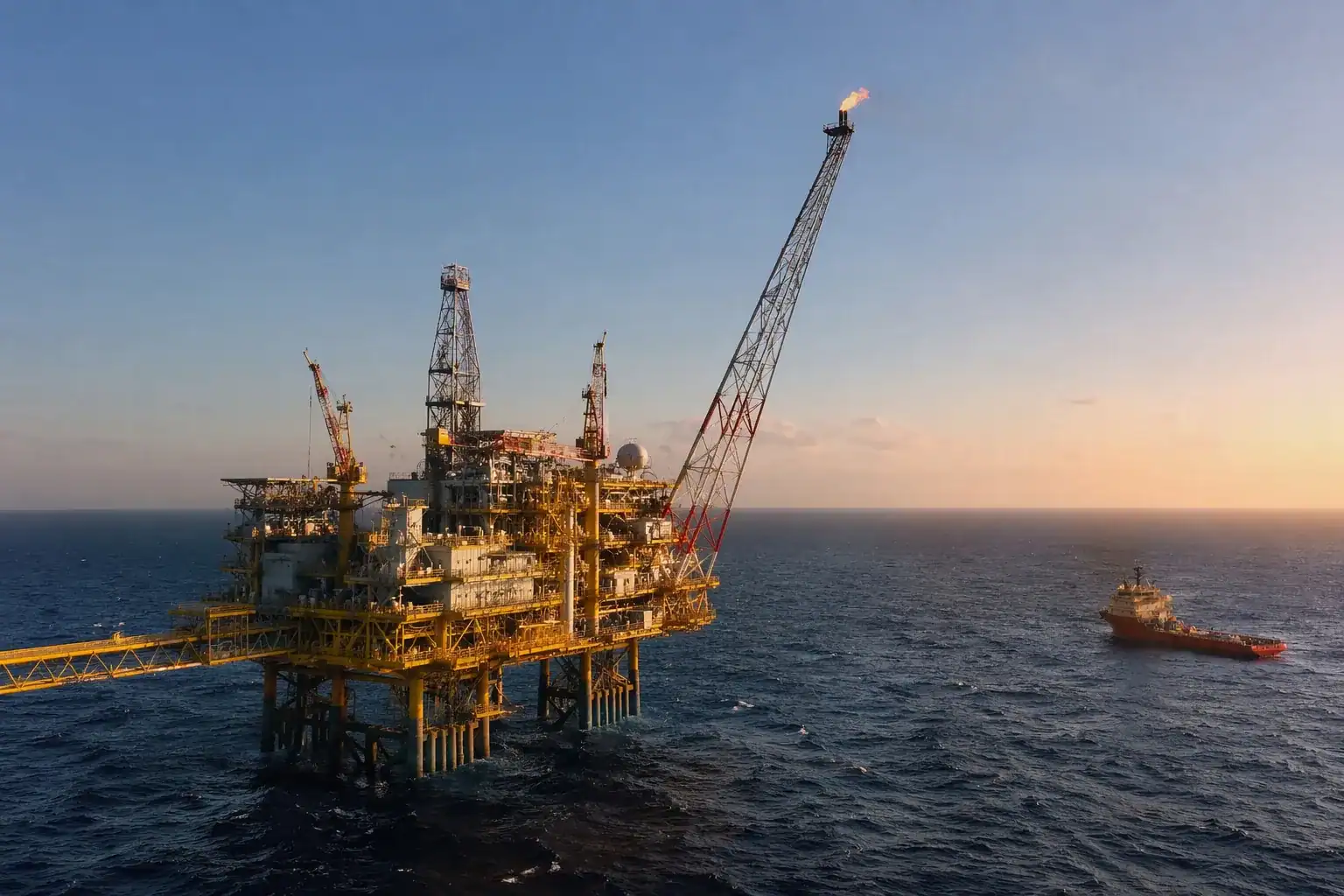
Brazil’s oil production keeps setting records, and April marked the third month in a row. The latest figures show an industry still accelerating, driven almost entirely by the ultra-deep fields off the southeastern coast.
A third record month for oil output
Brazil extracted 4.34 million barrels of oil per day in April, the National Agency of Petroleum, Natural Gas and Biofuels, the regulator known as the ANP, reported on June 2. The figure was up roughly 19.5% from the same month a year earlier and 2.2% from March, marking the third consecutive month in which national oil production set a record.
Counting natural gas alongside crude, total hydrocarbon output reached an all-time high of 5.640 million barrels of oil equivalent per day, surpassing the previous record of 5.531 million set in March. Natural gas production came to 206.7 million cubic meters per day, a 23% jump from a year earlier and a further sign that the gains are broad rather than confined to crude.
The pre-salt does the heavy lifting
As in recent months, the record rests on the pre-salt, the formations lying beneath thousands of meters of ocean, sediment and a thick layer of salt in the Santos Basin. Pre-salt wells supplied 4.614 million barrels of oil equivalent per day in April, or 81.8% of the national total, itself a record for that segment.
Offshore fields accounted for 98.1% of the country’s oil and 88% of its gas. The Búzios field remained the largest single oil producer at 910,100 barrels per day, while the Mero field led on gas. The most productive individual installation was the floating production vessel Almirante Tamandaré, stationed at Búzios.
Petrobras at the center
Fields operated by the state-controlled Petrobras, alone or in consortium with other companies, were responsible for 88.98% of everything Brazil produced in April. That concentration underscores how central the company remains to national output even as foreign majors such as Shell and TotalEnergies hold stakes in the offshore fields.
The run of records is the output of a long capital cycle. Pre-salt reserves were discovered in 2006, and the multi-year investment in floating platforms is now reaching peak production as new vessels come online, lifting volumes month after month.
More: Brazil news in English, every day from The Rio Times.
Why it matters
Rising output strengthens Brazil’s trade balance and its standing among global producers, and it hands the federal government a growing stream of royalties and taxes. The earnings are also a political asset in an election year, financing public spending while the production curve climbs.
The gains are not without tension. Much of the future growth depends on frontier drilling, including environmentally sensitive areas near the mouth of the Amazon River, where resource ambitions collide with conservation concerns. For now, though, the monthly data tell a consistent story of an industry expanding faster than almost anyone expected a decade ago.
Frequently Asked Questions
How much oil did Brazil produce in April?
4.34 million barrels per day, up about 19.5% from a year earlier and 2.2% from March, a third consecutive monthly record, according to the regulator ANP. With gas included, total output hit 5.640 million barrels of oil equivalent per day.
What is driving the records?
The deepwater pre-salt fields in the Santos Basin, which supplied 81.8% of output, as new floating production vessels reach peak capacity. The cycle traces back to the 2006 pre-salt discovery.
Which field produces the most?
Búzios, in the Santos Basin, was the largest oil producer at 910,100 barrels per day. The Almirante Tamandaré vessel there was the single most productive installation in the country.
How big a role does Petrobras play?
Fields operated by Petrobras, alone or in consortium, accounted for nearly 89% of national production in April, keeping the state-controlled company central to Brazil’s oil industry.
Connected Coverage
For more on Brazil’s energy sector, see Brazil’s first power-battery auction and how World Cup games cut power demand.
This article was drafted with automated assistance and reviewed before publication. How we use AI · Report an error
Read More from The Rio Times