Brazil Eyes 20 More Swedish Gripen Jets, Skipping Rafale
Brazil · Defense
Key Facts
—The signal. Sweden says Brazil could order around 20 more Saab Gripen fighters, on top of the 36 already contracted.
—Not the Rafale. Brazil is favouring more Gripens rather than adding France’s Dassault Rafale, avoiding the cost of running two fighter types.
—The milestone. Brazil’s F-39, its locally assembled Gripen E, flew its first multinational exercise abroad, at Salitre 2026 in Chile.
—What it replaces. The new jets would retire Brazil’s ageing American-built F-5 fighters, in service for decades.
—The bet. The move deepens a Sweden–Brazil industrial partnership built on technology transfer and local production.
Brazil is preparing to widen one of Latin America’s largest defence deals. Sweden has signalled that a follow-on Brazil Gripen order of around 20 additional fighters is on the table, extending a partnership that is already reshaping the country’s air force.
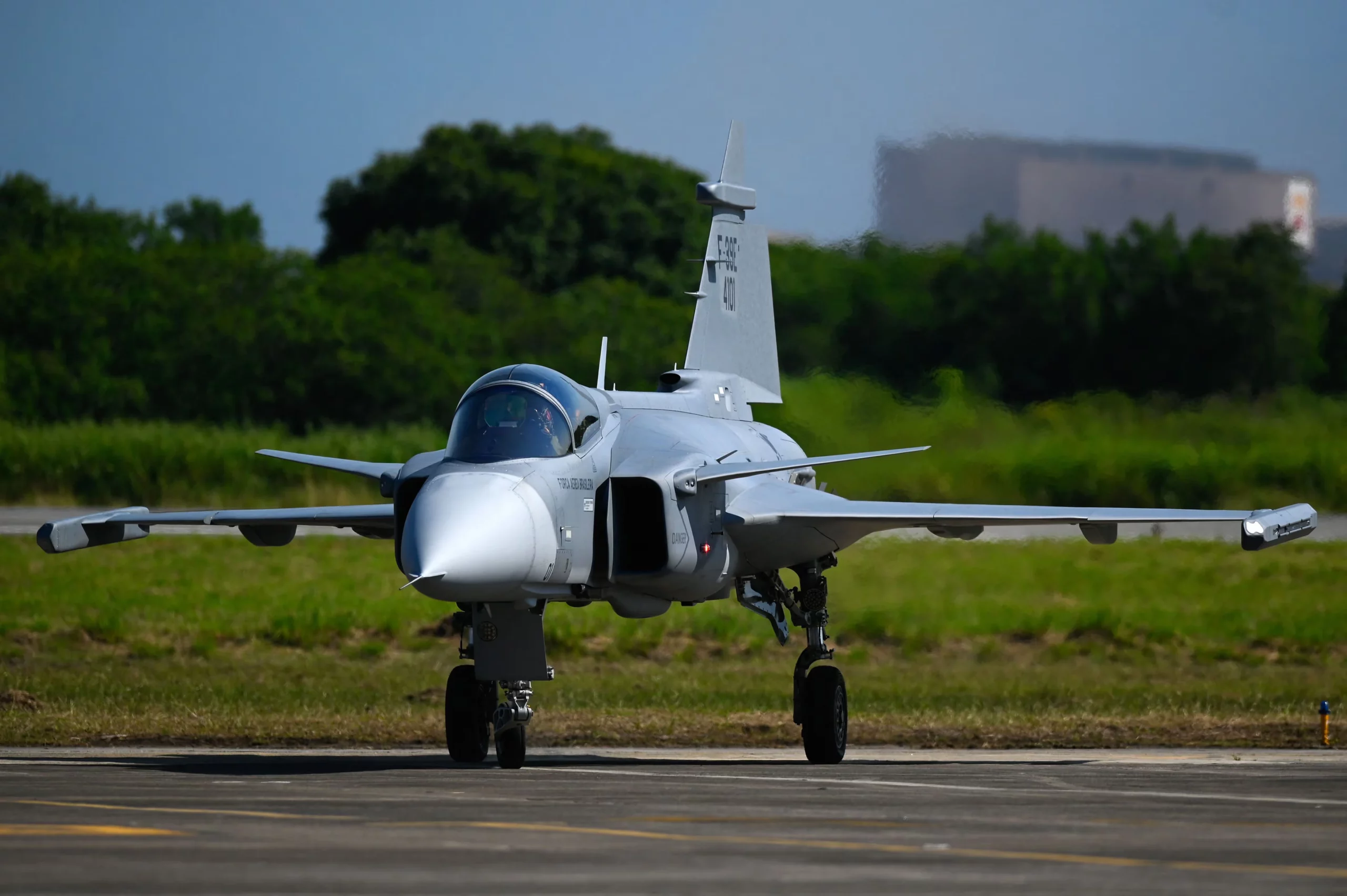
The indication came on the sidelines of a meeting in Stockholm, where the Swedish and Brazilian defence ministers signed an agreement to deepen technological cooperation, according to AeroTime. Brazil has so far contracted 36 Gripen E/F jets; the new tranche would push the fleet toward 56.
Why Brazil chose more Gripens over the Rafale
France’s Dassault had offered Brazil its Rafale, but Brasília has leaned toward buying more of what it already flies. Running a single fighter type keeps one logistics chain, one training pipeline and one maintenance base, rather than splitting the force across two aircraft.
There is also the sunk investment to protect. Brazil has spent years building the local infrastructure and skills to assemble and support the Gripen, Army Recognition reports, and adding a second platform would dilute that return. The extra jets are intended to replace the air force’s ageing F-5s.
For a foreign reader, the choice between a single fleet and a mixed fleet is a classic air-force calculation. Every fighter type demands its own spare parts, specialist tools, ground equipment and a dedicated team of mechanics and pilots qualified on that specific aircraft.
A second type essentially doubles that overhead, which is why many medium-sized air forces try to avoid it unless a strategic need forces their hand.
The Rafale is a twin-engine, carrier-capable fighter that has won orders in India, Egypt and elsewhere. It is a capable aircraft, but introducing it would mean Brazil would have to stand up a separate supply line from France while still paying for the Gripen ecosystem it has already built with Saab.
That math rarely favours the newcomer.
The F-39 makes its debut abroad
The procurement news coincides with an operational first. Six F-39E Gripens, the Brazilian designation for the locally assembled Gripen E, took part in Salitre 2026 in Chile, the jet’s first multinational exercise outside Brazil, Saab said.
Flying from Cerro Moreno Air Base in Antofagasta, the aircraft ran air-defence, escort and patrol missions alongside jets from Chile, Argentina, Colombia, the United States and Paraguay. For an air force that has waited years to field a modern supersonic fighter of its own, deploying it abroad is a statement of readiness.
Multinational exercises like Salitre serve a purpose beyond the flying itself. They let crews practise communicating across language barriers, test how their jets perform in unfamiliar airspace and weather, and build the personal relationships that matter when real crises unfold.
For Brazil, showing that a locally assembled fighter can hold its own alongside US. and regional partners is a quiet but important validation of the Gripen programme.
Why it matters for the region
A larger Gripen fleet consolidates Brazil as the region’s most ambitious air power and cements Sweden as its partner of choice over the traditional American and French suppliers. The technology-transfer model, building jets on Brazilian soil, is also what Brasília wants to sell to neighbours weighing their own fleets.
The follow-on order is not yet signed, and deals of this size move slowly from intent to contract. But the direction is set: Brazil is building its air force around one Swedish fighter, at home.
The broader significance stretches beyond the cockpit. A defence partnership built on technology transfer, rather than a simple off-the-shelf sale, gives the buyer something it can use long after the assembly line stops: a domestic workforce that knows how to upgrade, repair and eventually modify the aircraft.
That is a model Brazil has championed in other sectors, and it is now applying it to its fighter fleet.
What to watch next is whether the follow-on contract materialises on the timeline Sweden has hinted at, and at what price. Defence budgets in Brazil face competing demands, and a formal signature will depend on fiscal room as much as strategic intent.
Another open question is whether any neighbouring country, watching Brazil’s experience with local assembly, decides to pursue a similar arrangement for its own ageing fighters.
More: Brazil news in English, every day from The Rio Times.
Frequently Asked Questions
How many Gripen fighters will Brazil have?
Brazil has contracted 36 Saab Gripen E/F jets. Sweden has signalled a possible follow-on order of about 20 more, which would take the fleet toward 56 aircraft.
What is the F-39?
F-39 is Brazil’s designation for the Saab Gripen E, assembled locally under a technology-transfer deal. It is the country’s first domestically produced supersonic fighter, and it recently flew its first exercise abroad at Salitre 2026 in Chile.
Did Brazil reject France’s Rafale?
Brazil has favoured buying more Gripens over adding Dassault’s Rafale. Officials point to the cost of operating two fighter types and the investment already made in Gripen production and support in Brazil.
This article was produced by The Rio Times’ automated newsroom system. How we use AI · Report an error · Editorial responsibility: Matthias Camenzind, Editor-in-Chief
Brazil runoff, Sunday, October 25: Brazil runoff: date, poll closing times and when results start. Latest: Brazil runoff polls, Flávio 51%, Lula 49%.