Embraer Bets on India for 500 Regional Jets Over Two Decades
Brazil
Key Facts
—Market Target. Embraer estimates India will need at least 500 aircraft in the 80–146 seat segment over the next 20 years.
—Local Assembly. A final assembly line for the E175 jet is planned with Adani Defence, contingent on securing 200 firm orders from Indian carriers.
—Regulatory Green Light. India’s DGCA granted type certification to the E190, E195, and E195-E2 in early July 2026, unlocking the commercial pathway.
—Defence Angle. A parallel partnership with Mahindra targets India’s Medium Transport Aircraft programme with the C-390 Millennium.
—Policy Support. India has allocated ₹28,840 crore (US$3.5 billion) over a decade to its UDAN regional connectivity scheme, which favours smaller jets.
Embraer is positioning itself to capture a 500-aircraft market in India, leveraging new regulatory approvals and a proposed local assembly line to challenge the Airbus-Boeing duopoly in the world’s fastest-growing aviation market.
The 500-Aircraft Vision Takes Shape
Brazil’s Embraer has publicly stated that India will require at least 500 aircraft in the 80–146 seat segment over roughly two decades. Executives, including CEO Francisco Gomes Neto, have used even more aggressive timelines in interviews, suggesting that 300 to 500 regional jets could be absorbed by the Indian market within the next ten years alone.
The product focus centres on the E175, with 76 to 88 seats, and the next-generation E195-E2, which can carry up to 146 passengers. Embraer pitches these jets as the ideal gap-filler between turboprops and large narrowbodies, perfectly sized for connecting India’s smaller cities to major hubs.
A Regulatory Breakthrough Unlocks the Market
In early July 2026, India’s Directorate General of Civil Aviation (DGCA) granted type certification to Embraer’s E190, E195, and E195-E2 aircraft. This regulatory milestone formally opened a market that Embraer had been courting for years, removing the final bureaucratic barrier to commercial operations.
Senior Vice President Raul Villaron explicitly linked the certification to India’s UDAN regional connectivity scheme, which subsidises flights to underserved airports. Embraer has already identified more than 1,800 Indian routes that could be profitably served by its E175 jets, though no firm commercial orders have yet been signed.
Live Company IntelligenceEmbraer SA ADR — the full investor dossier
Wall Street view
Valuation & profitability
Price & risk
$56.8452-wk high
$66.87
Revenue trend · 6y
Ownership
Dividend
The Adani Partnership and Make in India
On 27 January 2026, Embraer and Adani Defence & Aerospace signed a Memorandum of Understanding in New Delhi to create a final assembly line (FAL) for the E175 regional jet. The deal is explicitly aligned with India’s Aatmanirbhar Bharat self-reliance policy and aims to phase up indigenisation of components and systems over time.
However, Embraer’s CEO has made it clear that firm orders for at least 200 E175 jets are necessary to justify the investment in an Indian assembly line. The company is primarily courting IndiGo and Air India, the two carriers with the financial heft to place orders of 100 aircraft or more, as anchor customers for the project.
Defence Deals and Strategic Depth
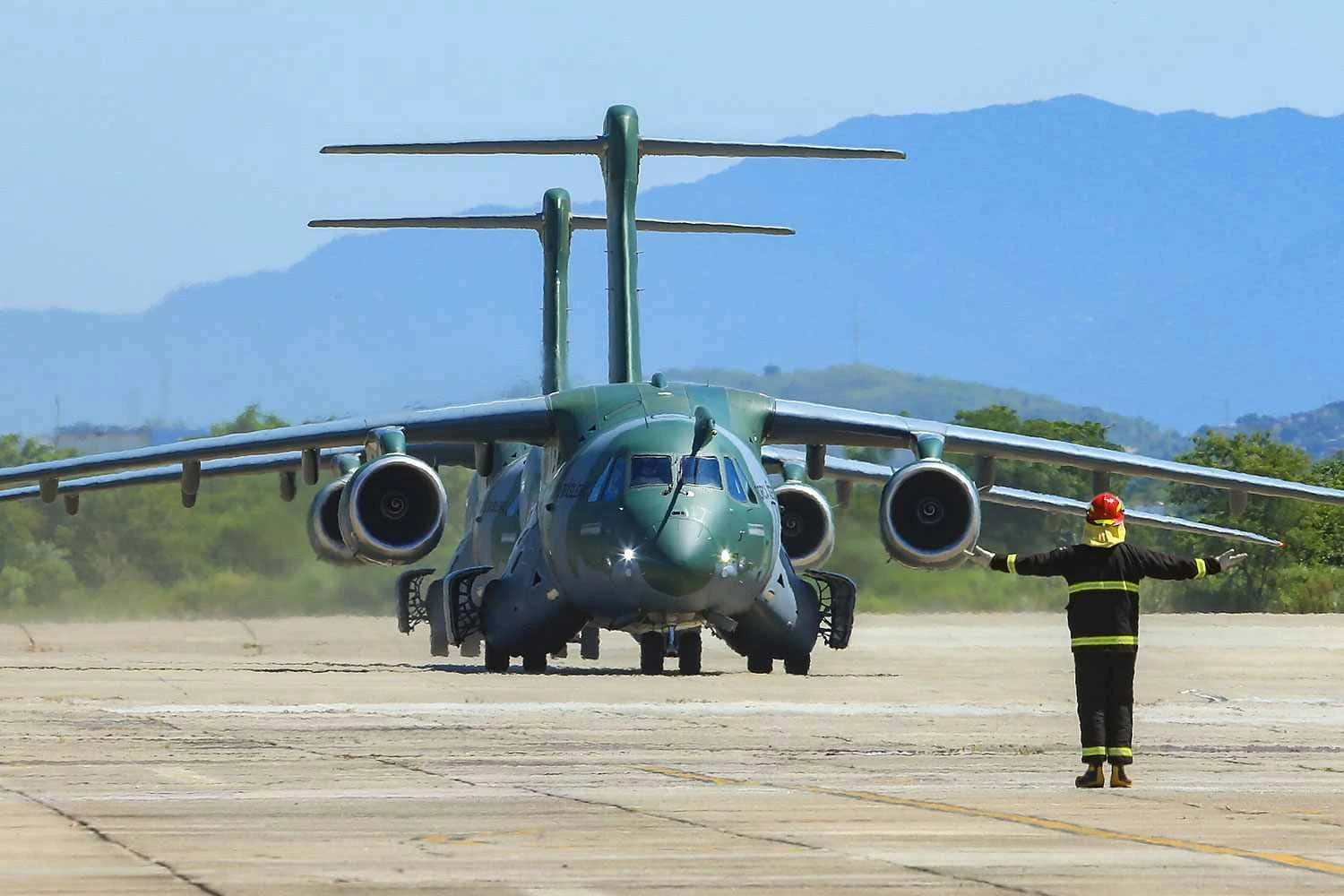
Embraer’s India push is not limited to commercial aviation. A parallel partnership with Mahindra targets India’s Medium Transport Aircraft programme with the C-390 Millennium.
This dual-use strategy deepens Embraer’s political capital in New Delhi. The company already supports three EMB-145 AEW “Netra” airborne early warning aircraft and five VIP jets in Indian government service, giving it an established footprint to build upon as it pursues larger strategic roles.
Geopolitics and the BRICS Connection
Embraer executives explicitly highlight that India and Brazil are both BRICS members with significant potential to grow bilateral trade. The Adani-Embraer deal is framed in both Brazilian and Indian media as strengthening strategic relations and deepening South-South cooperation between the two large Global South economies.
For India, hosting Brazilian aircraft manufacturing fits a broader strategy of diversifying civil aviation and defence suppliers beyond Western incumbents. For Brazil, securing a production base in India increases Embraer’s bargaining power in global supply chains and hedges against domestic political or economic disruptions.
What Investors and Expats Should Watch
The financial stakes extend well beyond aircraft sales. Embraer is attempting to lock in long-term services and maintenance, repair, and overhaul (MRO) revenue tied to Indian aviation hubs, while also positioning itself as an alternative to the Airbus A220 and Boeing 737 MAX on thinner routes across Asia-Pacific.
The key risk is that Embraer’s 500-aircraft vision currently has no firm commercial orders. Success will depend on Indian carriers’ willingness to diversify away from an all-A320 and 737 model, access to competitive financing in a low-yield market, and continued government support through the UDAN scheme and infrastructure rollout.
More: Brazil news in English, every day from The Rio Times.
Frequently Asked Questions
Why is Embraer targeting a 500-aircraft market in India specifically?
India is the world’s fastest-growing major aviation market, with airlines holding orders for more than 1,800 aircraft, mostly larger Airbus and Boeing types. Embraer sees a gap in the 80–146 seat segment for connecting smaller cities, a need amplified by the government’s UDAN regional connectivity scheme and rapid airport expansion across tier-II and tier-III cities.
When could Embraer start building jets in India?
If Embraer secures the required 200 firm orders from Indian carriers around 2026, the company projects that a final assembly line could be operational and delivering E175 jets by 2028. The timeline depends entirely on anchor orders from major carriers like IndiGo or Air India, which have not yet materialised.
What does the Adani-Embraer deal mean for Brazil-India trade relations?
The partnership is a form of industrial diplomacy that deepens economic ties between two BRICS members whose bilateral trade remains relatively modest. By anchoring manufacturing in India and committing to technology transfer, Embraer is building political capital while positioning itself as a non-Western supplier in a market traditionally dominated by Airbus and Boeing.
Connected Coverage
Brazil Fuels an Ocean Ship With Ethanol for the First Time
Banco Master’s Collapse Keeps Draining Brazil’s Bank Safety Net
This article was produced by The Rio Times’ automated newsroom system. How we use AI · Report an error · Editorial responsibility: Matthias Camenzind, Editor-in-Chief
LatAm Markets: Live Signals → — real-time movers, turnover leaders and FX across Latin America.