Weather Whiplash: La Niña Shakes Up Latin America’s Climate and Economy
Imagine a world where weather determines economies, a scenario close to reality in Latin America today.
The region is transitioning from the hot El Niño to the cooler La Niña.
Early rains from April to May herald her arrival, signaling relief and challenges.
The Australian Bureau of Meteorology BOM noted a significant Pacific Ocean cooling.
From April to June, the World Meteorological Organization predicts La Niña will bring substantial rains, reshaping agriculture.
La Niña’s Economic Torrent
Consider Brazil’s Rio Grande do Sul, recently transitioning from heatwaves to floods.
These floods have disrupted agriculture and industry, resulting in over 150 deaths.
The El Niño Southern Oscillation (ENSO) cycle influences global weather, alternating between droughts, floods, heatwaves, and cold spells.
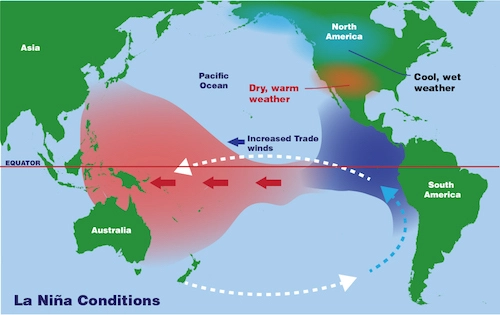
These conditions severely affect crops and livestock, impacting food security and economies.
Between 2022 and 2023, severe droughts struck central South America, affecting Uruguay, Argentina, Paraguay, Chile, and southern Brazil.
Swiss Re, one of the world’s largest reinsurers, categorizes these events as rare, occurring every 20 to 50 years.
La Niña Shakes Up Latin America’s Climate and Economy
As La Niña reduces crop yields and drives up food prices, the demand for agricultural insurance surges.
In Brazil, agricultural insurance claims increased by 47% in 2022.
Despite improvements since 2016, Latin America’s crop resilience still trails the global average, with a $6 billion deficit in crop protection.
That is why Swiss Re advocates for stronger insurance adoption.
Resilience indices in Brazil and Mexico are substantially below those in advanced economies, emphasizing the need for better insurance coverage and policy support.
Looking Ahead
From 2020 to 2023, the world experienced its first three-year La Niña of the century.
This period saw massive floods in Australia, devastating droughts in Africa, and extensive fires in South America.
These events are key to understanding global climate dynamics. Typically, a warm water pool in the Pacific drives these weather patterns.
During La Niña, this pool shifts westward, reversing usual conditions and affecting lives globally.
It’s crucial to understand and prepare for these changes.
As La Niña returns, the focus extends beyond weather to protecting economies and communities from nature’s unpredictable swings.
More: Latin America news in English, every day from The Rio Times.
This article was drafted with automated assistance and reviewed before publication. How we use AI · Report an error
Read More from The Rio Times