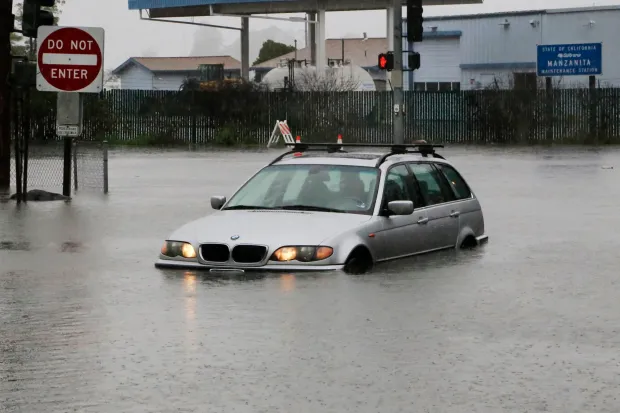
In January 2023, California experienced its wettest three-week period on record, with some areas receiving over 600% of their normal rainfall.
Streets turned into rivers, homes were flooded, and agricultural fields were submerged. This extreme weather event is becoming more common as climate change makes rainfall patterns increasingly unpredictable worldwide.
It creates a cascade of consequences that ripple through agriculture, migration, and economic stability.
Researchers from the Chinese Academy of Sciences and the Met Office Hadley Center analyzed data from 1900 to 2020.
They found that precipitation variability has increased by 1.2% per decade, closely tracking global temperature rises.
This means larger wet-dry swings, causing both floods and droughts. As the climate warms, the atmosphere holds more moisture, leading to extreme precipitation events that disrupt lives and livelihoods.
Impact on Food Security
In the United States, nine of the top ten years for extreme one-day precipitation events have occurred since 1995.
In 2019, excessive rainfall led to a 19% decrease in corn yields in the Midwest. Erratic monsoon patterns in 2022 caused a 5.6% drop in rice production, affecting 12 million hectares of farmland in India,
In Kenya, climate variability has reduced tea production by up to 30% in some years. Zimbabwe faces a projected 30% drop in maize yields by 2030 due to changing rainfall patterns.
Climate-Forced Migration
The World Bank predicts that by 2050, 216 million people could be forced to move within their countries due to climate change.
In Bangladesh, sea-level rise and changing monsoon patterns could displace up to 13.3 million people.
In Central America’s Dry Corridor, prolonged droughts have forced thousands to migrate. Between 2010 and 2015, an estimated 3.5 million people were displaced due to climate-related events in this region.
Economic Development Challenges
Climate change complicates economic development, particularly in poorer countries. Increased precipitation variability can reduce economic growth by up to 12% for every 1°C rise in temperature.
The World Bank estimates that climate change could push an additional 132 million people into poverty by 2030.
In Sub-Saharan Africa, GDP per capita could be reduced by up to 3% by 2050 due to climate-related shocks.
In Southeast Asia, the Asian Development Bank projects that climate change could reduce the region’s GDP by up to 11% by 2100 if left unchecked.
Geopolitical Implications
The Middle East and North Africa (MENA) region, already water-stressed, faces severe challenges.
By 2050, 14 of the 33 most water-stressed countries will likely be in the MENA region, potentially exacerbating existing conflicts.
In Europe, the 2021 floods in Germany and Belgium caused over €40 billion in damages, highlighting the continent’s vulnerability to extreme weather events.
The Fate of Brazil and Latin America
Latin America, particularly Brazil, faces a complex future. The region’s vast agricultural sector makes it highly vulnerable to changes in rainfall patterns.
In 2023, southeastern Brazil experienced wetter-than-average conditions, leading to floods, while the Amazon basin suffered severe droughts and wildfires.
In Argentina, a severe drought in 2022–2023 led to a 50% reduction in wheat production and a 43% drop in corn yields.
Conclusion
These examples underscore the urgent need for global action on climate change. As rainfall patterns become increasingly unpredictable, the consequences for food security, migration, and economic stability will be profound and far-reaching.
Developing countries, especially those in conflict zones or vulnerable to food price shocks, will suffer the most. Meanwhile, nations capable of adapting to these changes may gain a strategic advantage.
The global community must prioritize climate action and support vulnerable regions to mitigate these impacts and promote sustainable development.
More: Kenya news in English, every day from The Rio Times.
This article was produced by The Rio Times’ automated newsroom system. How we use AI · Report an error
Read More from The Rio Times