What Is Safaricom? Kenya’s M-Pesa Giant, Who Owns It and Why It Matters
COMPANIES · KENYA
Key Facts
- —What it is Kenya’s largest telecom operator and the owner of M-Pesa, the mobile-money service launched in 2007.
- —Size Revenue of about US$3.3 billion in the year to March 2026, with M-Pesa its biggest earner.
- —Market power It held 69.8 percent of Kenya’s mobile lines and 88.8 percent of mobile money in mid-2026.
- —The catch A Kenyan court voided the state’s stake sale to Vodacom in September 2026, and appeals are pending.
Safaricom is less a phone company than the payments system of Kenya, built around its M-Pesa money service. This guide explains how it earns money, who owns it and what could go wrong.
Millions of Kenyans pay bills and market traders by phone, and almost nine in ten mobile-money accounts sit with Safaricom. As of September 2026 the company is also at the centre of a court fight over who should control it.
What Safaricom Is
Safaricom is a Kenyan mobile operator founded in 1997 and listed on the Nairobi Securities Exchange, the country’s stock market, since 2008. It sells voice calls and mobile data, but its best-known product is M-Pesa.
Kenya is an East African country of about 53 million people on the Indian Ocean coast. It borders Ethiopia, Somalia and Tanzania, uses the Kenyan shilling and is led by President William Ruto.
The Central Bank of Kenya quoted the shilling at 129.48 per US dollar on 24 September 2026. All dollar figures in this guide use that rate unless stated otherwise.
It is Nairobi’s largest stock, valued at about KSh 1.36 trillion (about US$10.5 billion) at the price Vodacom paid in 2026. Peter Ndegwa, chief executive since April 2020, runs the company from Nairobi.
How M-Pesa Works
M-Pesa launched in March 2007 as a joint project of Safaricom and Vodafone, the British mobile group. Its start-up money came partly from a challenge fund of the UK Department for International Development, the British aid ministry.
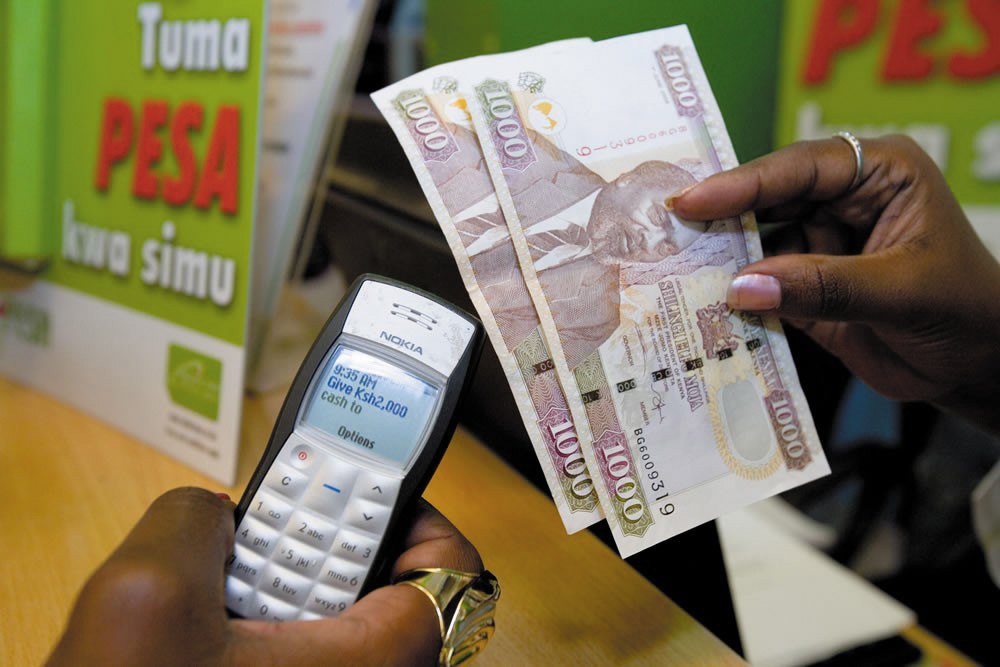
Customers load cash onto their phone at an agent, often a small shop, and then send it to anyone by text message. The receiver can pay bills with it or turn it back into cash at another agent.
From transfers to loans and savings
Over time M-Pesa added savings and credit on top of simple transfers. M-Shwari adds an interest-bearing savings account, and Fuliza, launched in 2019, lets users overdraw when their balance runs short.
Kenya’s Communications Authority, the telecom regulator, counted 568,463 mobile-money agents in the quarter to June 2026. Each agent is a place to turn digital money into cash and back again.
A widely cited 2016 study found that M-Pesa lifted about 194,000 Kenyan households, or 2 percent, out of poverty. Other researchers have questioned the study’s methods, so the exact effect remains debated.
How Safaricom Makes Money
Safaricom reports on a financial year that ends on 31 March, and it published its 2026 results on 7 May 2026. Total revenue rose 10.0 percent to KSh 427.6 billion (about US$3.30 billion).
M-Pesa brought in KSh 182.7 billion (about US$1.41 billion), up 13.4 percent. That made it 45.6 percent of Kenyan service revenue, the money earned from calls, data and payments rather than handset sales.
M-Pesa earns mainly from fees on transfers, cash withdrawals, merchant payments and loans. Mobile data and voice calls make up most of the remaining service revenue.
The Kenyan business alone made a net profit of KSh 119.1 billion (about US$920 million). Group profit is lower because of heavy losses in Ethiopia, where Safaricom is still building its network.
Shareholders received a total dividend of KSh 2.00 per share (about US$0.015) for the year, up two-thirds on the year before. For the next year it guided to operating profit of KSh 180-187 billion (about US$1.39-1.44 billion).
Peter Ndegwa called it a landmark year that marked 25 years of the company. Dilip Pal, the group’s chief financial officer, presented the figures alongside him.
Size and Market Power
Kenya had 88.0 million active mobile subscriptions in the quarter to June 2026, according to the Communications Authority. Safaricom held 69.8 percent of them, far ahead of rivals such as Airtel Kenya.
In mobile money its lead is even larger, at 88.8 percent of 54.0 million subscriptions. In March 2026 Safaricom counted 57.9 million Kenyan customers active within 90 days, and 71.6 million group-wide.
Who Owns Safaricom
Until mid-2026 the Kenyan government owned 35 percent of Safaricom and Vodacom, the South African operator, owned a similar stake. Vodafone held a further 5 percent, and the public owned the remaining 25 percent through the stock market.
Vodacom agreed to buy 15 percent from the Kenyan Treasury and Vodafone’s 5 percent, lifting its stake to 55 percent. It completed the US$2.1 billion purchase on 30 June 2026, The Rio Times reported in its coverage of the Vodacom deal.
The Treasury priced its 6.01 billion shares at KSh 34 each (about US$0.26), for KSh 204.3 billion (about US$1.58 billion). It also secured a dividend top-up of KSh 40.2 billion (about US$310 million) tied to its remaining 20 percent.
The deal faced legal challenges from the start, and the High Court froze it for a time in 2026. The Court of Appeal then lifted the freeze only days before Vodacom completed it.
On 15 September 2026 three High Court judges in Nairobi ruled the sale unconstitutional and ordered the shares returned to the state. The Rio Times detailed how the court voided the stake sale.
The judges found no meaningful public participation, no competitive search for a buyer and no Competition Authority approval. The petitioners were broadcaster Tony Gachoka and economist Fredrick Ogola, and opposition Wiper party leader Kalonzo Musyoka appeared in the case.
Treasury Cabinet Secretary John Mbadi said the government would pursue its appeal vigorously, and Vodacom said it would also appeal. As of mid-September 2026 no court had suspended the ruling, so control of Safaricom is legally contested.
If the ruling stands, the government would again hold 35 percent and Vodacom would lose its majority. If the appeal succeeds, Vodacom keeps 55 percent and full control of M-Pesa’s direction.
The Ethiopia Bet
Safaricom won a licence to operate in Ethiopia in 2021 and switched on its network there in 2022. The Ethiopian business is its only operating unit outside Kenya and its biggest growth bet.
The licence alone cost US$850 million, and the separate M-Pesa licence another US$150 million. M-Pesa Ethiopia launched in August 2023 under a licence from the National Bank of Ethiopia.
By June 2026 it had 14.7 million customers active over 90 days, The Rio Times reported. Total funding put into the venture had reached US$2.6 billion by March 2026.
The Ethiopian unit lost KSh 47.1 billion (about US$364 million) after tax in the 2026 financial year. Safaricom’s own share was KSh 21.2 billion (about US$164 million), 41.2 percent less than a year earlier.
Finance chief Dilip Pal said “it shows that we are geared for positive EBITDA breakeven in FY27”, the year to March 2027. EBITDA means earnings before interest, tax, depreciation and amortisation, so the unit can still post an operating loss.
Safaricom guided to an Ethiopian operating loss of KSh 12-15 billion (about US$93-116 million) for that year. In the 2026 financial year that operating loss was KSh 37.7 billion (about US$291 million).
Controversies and Criticism
During the June 2024 protests against tax increases, Kenyan users reported internet disruption. More than ten influencers and artists accused Safaricom of blocking communications, and several ended their partnerships with it.
Ndegwa denied any deliberate disruption and blamed an outage on two undersea cables. The internet monitor NetBlocks said it found no physical damage to subsea cables, so the dispute was never fully settled.
On 29 October 2024 the Daily Nation newspaper alleged Safaricom had long given police access to customer data to track suspects. Safaricom denied sharing customer data unlawfully and issued a public statement on 31 October 2024.
Two rights groups, the Kenya Human Rights Commission and Muslims for Human Rights, said the statement ignored the key findings. Their letter, signed by commission director Davis Malombe, asked how Safaricom would stop unlawful use of its data.
Safaricom then suspended advertising with the newspaper’s owner, Nation Media Group, the tech site TechCabal reported, citing two of the group’s executives. A week after the story, Safaricom ran privacy adverts in rival papers The Standard and The Star.
TechCabal noted that Safaricom had withheld advertising after critical coverage before but never publicly admitted it. As of September 2026, no court has ruled that the company shared data unlawfully.
What It Means for Foreigners and Investors
For visitors and expats, M-Pesa is the most common way to pay in Kenya, from taxis to market stalls. With more than half a million agents, cash is rarely far away for anyone with an account.
For investors, Safaricom is the biggest stock on the Nairobi exchange and pays a rising dividend. It combines a near-monopoly in payments with steady Kenyan cash, set against losses in Ethiopia.
The risks are political, legal and regulatory. A company this central attracts pressure from governments, courts, regulators and the public, as the Vodacom dispute shows.
Currency is the other risk for foreign holders, because profits and dividends are earned in shillings. A weaker shilling cuts the dollar value of returns even when the business grows.
What to Watch
The first test is the appeal against the September 2026 ruling. The outcome will decide whether Vodacom controls Safaricom or whether the state regains a blocking stake.
The second is whether Ethiopia reaches breakeven in the year to March 2027 as promised. A miss would raise new doubts about the US$2.6 billion already spent there.
Regulation is a third factor, because M-Pesa fees and Fuliza overdrafts sit at the heart of profits. Any cap on fees or order to share agents with rivals would hit the most profitable part of the business.
Finally, watch how Safaricom handles data and privacy questions after the 2024 allegations. Trust is the asset that turned a phone network into a national payments system.
Frequently Asked Questions
What is Safaricom?
Safaricom is Kenya’s largest mobile operator and the company behind M-Pesa, the country’s dominant mobile-money service. It is listed on the Nairobi Securities Exchange and also operates in Ethiopia.
Who owns Safaricom?
Vodacom completed a deal on 30 June 2026 that lifted its stake to 55 percent, leaving the Kenyan state with 20 percent. A High Court ruling of 15 September 2026 voided the state’s sale, and appeals are pending.
How does Safaricom make money?
It earns from mobile data, voice calls and above all M-Pesa fees on transfers, withdrawals, payments and loans. M-Pesa made up 45.6 percent of Kenyan service revenue in the year to March 2026.
Is M-Pesa a bank?
No, M-Pesa is a mobile-money service in which customers hold electronic money on their phone. Savings and overdraft products such as M-Shwari and Fuliza are built on top of it.
Is Safaricom profitable in Ethiopia?
Not yet, as the Ethiopian unit lost about US$364 million after tax in the year to March 2026. The company expects earnings before interest, tax, depreciation and amortisation to turn positive in the year to March 2027.
This article was produced by The Rio Times’ automated newsroom system. How we use AI · Report an error
LatAm Markets: Live Signals → — real-time movers, turnover leaders and FX across Latin America.
Read More from The Rio Times