UNITAS 2026 Opens in Peru: 24 Navies Launch the Americas’ Largest Multinational Drill
PERU · SECURITY
Key Facts
- —The opening UNITAS 2026 (UNITAS LXVII), the 67th edition of the world’s longest-running multinational naval exercise, opened this week at the Callao Naval Base, hosted and directed by the Peruvian Navy.
- —The scale More than 5,300 personnel from 24 countries of the Americas, Europe, Asia and Africa, with 26 surface ships, three submarines, 21 aircraft and at least six unmanned systems.
- —The calendar The operational phase runs 10–24 September, with actions in Callao, Ancón, Salinas, Junín and Iquitos — from the Pacific coast to the Amazon.
- —The hardware Spain’s AEGIS frigate Álvaro de Bazán, Argentina’s destroyer ARA Almirante Brown, the US littoral combat ship USS Minneapolis-Saint Paul and P-8A Poseidon patrol aircraft are among the foreign units.
- —The backdrop Peru confirmed its entry into the US-promoted “Shield of the Americas” security initiative this week, as Washington courts South America’s Pacific navies.
The Pacific off Lima is crowded with warships this week: Peru has opened UNITAS 2026, bringing two dozen navies together for the largest multinational naval exercise in the Americas — and one of the biggest military gatherings hosted by any Latin American country this year.
UNITAS 2026 is underway. The Peruvian Navy opened the 67th edition of the multinational exercise at the Callao Naval Base this week, with state news agency Andina broadcasting the inauguration of drills that bring together more than 5,300 military personnel from 24 countries.
The operational phase runs from 10 to 24 September, concentrated on the Pacific hub of Callao but extending to Ancón and Salinas on the coast, Junín in the Andes and Iquitos in the Amazon — a geography that lets the exercise train maritime, riverine, amphibious and even lake operations alongside cyber-defense scenarios, according to the Peruvian Navy.
Two Dozen Navies, One Command Structure
Opening-day coverage counted 23 participating navies; the Peruvian Navy’s final planning conference in June registered delegations from 24 countries, which signed a memorandum of understanding formalizing the commitments. Either way, it is the broadest multilateral military footprint on the region’s calendar this year.
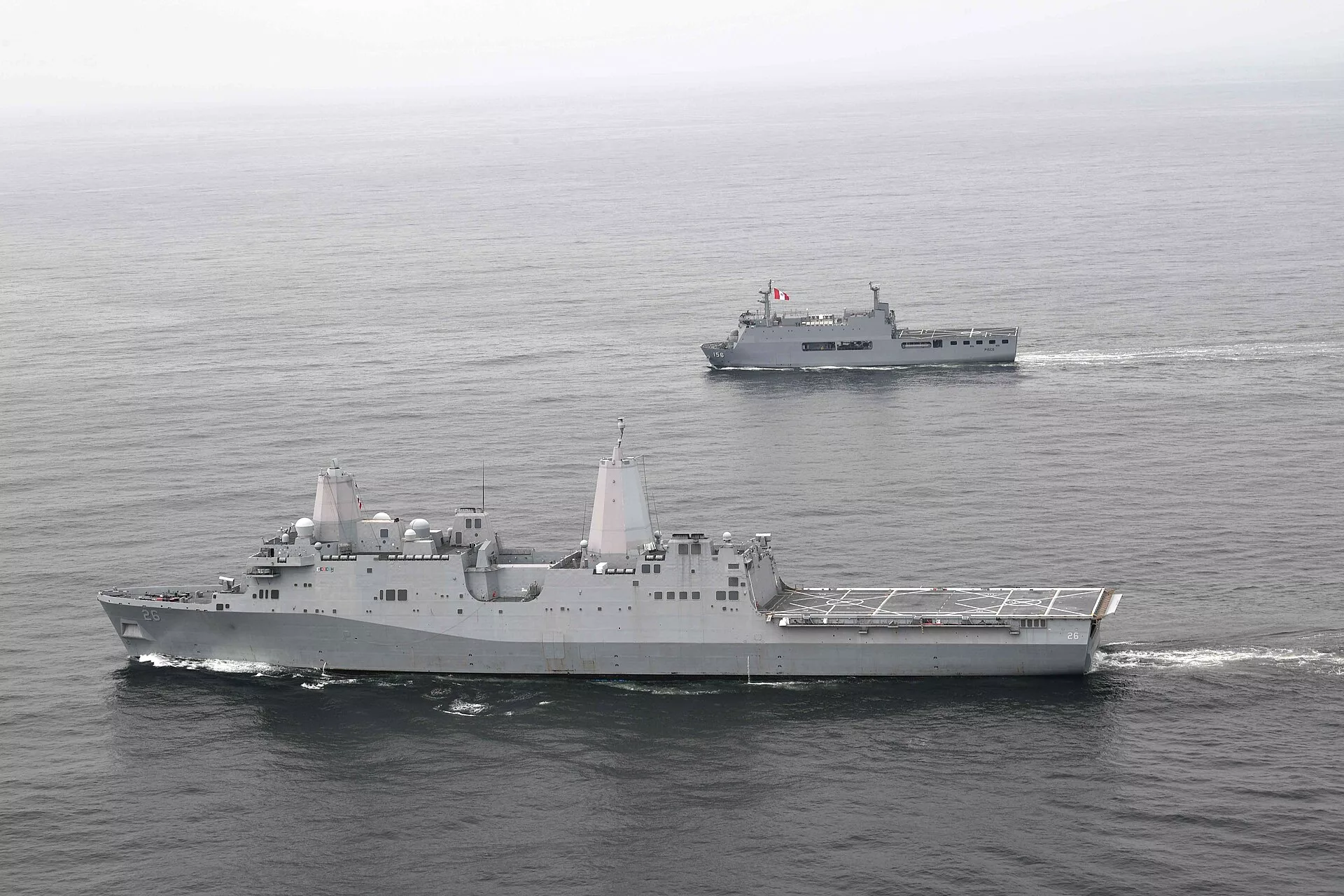
The combined force includes 26 surface ships, three submarines, 21 aircraft and more than six unmanned aerial, surface and subsurface systems, according to Escenario Mundial. Peru is fielding its Pisco-class amphibious assault ships — built at the state SIMA shipyards — while foreign contingents include Argentina’s guided-missile destroyer ARA Almirante Brown with its embarked Fennec helicopter, Spain’s AEGIS-equipped frigate Álvaro de Bazán (F-101), the US littoral combat ship USS Minneapolis-Saint Paul and US Navy P-8A Poseidon maritime patrol aircraft.
Chile sent the offshore patrol vessel Cabo Odger, a marine infantry platoon, cyber-operations specialists and staff officers for the exercise’s Maritime Operations Center, the Chilean Navy confirmed. Colombia contributes a frigate of the Almirante Padilla class and an HH-65 Dauphin helicopter, Ecuador the missile corvette BAE Manabí, according to the Peruvian Congress’s authorizations for foreign forces published in El Peruano. The Rio Times reported Chile’s participation when it was first confirmed in July.
Submarines First: SIFOREX Set the Stage
The opening was preceded by SIFOREX XIV (Silent Force Exercise), the anti-submarine warfare phase run from 6 to 9 September off Callao, according to Zona Militar, in which allied ships and aircraft hunted Peruvian diesel-electric submarines to standardize detection and interdiction tactics. Argentina’s Almirante Brown took part with its embarked Fennec helicopter — the first time Argentina has joined SIFOREX with a ship, Zona Militar reported.
That sequence matters: diesel submarines are the Pacific coast’s quietest threat, and Peru operates one of the region’s most experienced conventional submarine forces, making it the natural host for this kind of training.
Sixty-Seven Editions and Counting
UNITAS — Latin for “unity” — was conceived at the first Inter-American Naval Conference in 1959 and has run annually since 1960, making it the world’s oldest multinational naval exercise still active. Peru last hosted in 2021, when UNITAS LXII brought 29 vessels, four submarines and 20 aircraft to Lima, according to the US Fourth Fleet. The 2025 edition was hosted by the United States at Camp Lejeune, North Carolina.
For the Peruvian Navy, hosting is a statement of institutional weight: it acts as “organizing and conducting country”, in its own words, running the combined command structure from its tactical training center in Callao. Rear Admiral Alfredo Osorio Bromberg, commander of the Surface Force, closed the June planning conference by calling the agreement a milestone for regional maritime security.
The Diplomacy Underneath
The exercise lands in a week of conspicuous alignment between Lima and Washington. On Thursday Peru confirmed its incorporation into the “Shield of the Americas” (Escudo de las Américas), the US-promoted coalition for coordinating intelligence and counter-narcotics efforts — the same initiative Colombia joined days earlier, as Escenario Mundial reported.
None of this is framed officially as directed at any power, and the Peruvian Navy’s language stays with interoperability and cooperation. But the optics — two dozen flags, US patrol aircraft on Peruvian tarmacs, a Spanish AEGIS frigate in Callao — speak for themselves at a moment when Washington and Beijing are openly competing for influence over South America’s Pacific ports.
What It Means for Foreigners in Peru
For expats, ship-watchers and anyone doing business through Callao — Peru’s main port and the country’s key foreign-trade gateway — the practical impact is modest: port calls, a visible uniformed presence around the bay and restricted waters during live phases through 24 September. The strategic takeaway is larger: Peru is positioning itself as the Pacific anchor of US-aligned maritime cooperation in the region, and its navy as the one force in South America that can convene two dozen others under its own command.
More: Peru news in English, every day from The Rio Times.
Background: Brazil Focus Survey Shows Weaker Growth, Sticky Inflation.
Background: Brazil Election Results 2026: Live Updates, Vote Count and Runoff Scenarios.
Background: BRICS Just Got Bigger — Who’s In, Who’s Still Out, and Why It Matters.
This article was produced by The Rio Times’ automated newsroom system. How we use AI · Report an error · Editorial responsibility: Matthias Camenzind, Editor-in-Chief