Seized Drugs Worth US$249 Million Burned in Trinidad and Tobago as Police Vow Crackdown
SECURITY · TRINIDAD AND TOBAGO
Key Facts
- —The country Trinidad and Tobago, a twin-island Caribbean state of about 1.4 million people off Venezuela’s coast, sits on a cocaine route to North America and Europe.
- —What happened On Tuesday 29 September 2026 police burned seized drugs valued at TT$1.68 billion (about US$249 million) at the Caroni Cremation Site, the police commissioner said.
- —Who is involved Prime Minister Kamla Persad-Bissessar, Police Commissioner Allister Guevarro and Homeland Security Minister Roger Alexander. The opposition PNM says most seizures happened under its government.
- —What it means for you Officials say the public burn is meant to prove seized exhibits are not recycled onto the street. Police also promise more asset-confiscation cases against traffickers.
- —Still open No official breakdown by drug type or weight was released. The Express put the total at more than 8.3 tonnes; that figure is not independently confirmed.
Police in Trinidad and Tobago burned seized drugs worth an estimated TT$1.68 billion (about US$249 million) on Tuesday 29 September. The exercise took place at the Caroni Cremation Site in central Trinidad, Guardian Media and the Trinidad Express reported.
Prime Minister Kamla Persad-Bissessar said the haul equalled about one percent of annual GDP. She promised the “local drug mafia” would face pressure on shipments, money and corrupt insiders.

Why the figure is in local dollars
Local reports gave the value only as “$1.68 billion”, without naming a currency. The context shows it is Trinidad and Tobago dollars, not US dollars.
At 6.76 TT dollars to the US dollar on 30 September 2026, the sum is about US$249 million. World Bank data put 2025 GDP near US$25.9 billion, so that matches the prime minister’s one percent.
A US-dollar reading would have meant US$1.68 billion, or six to seven percent of GDP. The Express reported a street value of “over $1.6 billion”, in line with the lower figure.
What was burned, and why now
Officers of the Special Investigations Unit (SIU), a police unit, carried the drugs in two truckloads, supervised by Commissioner Allister Guevarro. He said the load held marijuana, cocaine and synthetic drugs such as ecstasy; the Express also listed heroin.
Some exhibits dated back to a 2005 cocaine case on Monos Island, the Express reported. Guevarro said seized drugs stay in custody for years while trials run, and can decay into powder or dust.
He framed the burn as a test of trust. Officials once blamed rats for missing exhibits; “rats didn’t eat these,” he told reporters.
More seizures, and a push to follow the money
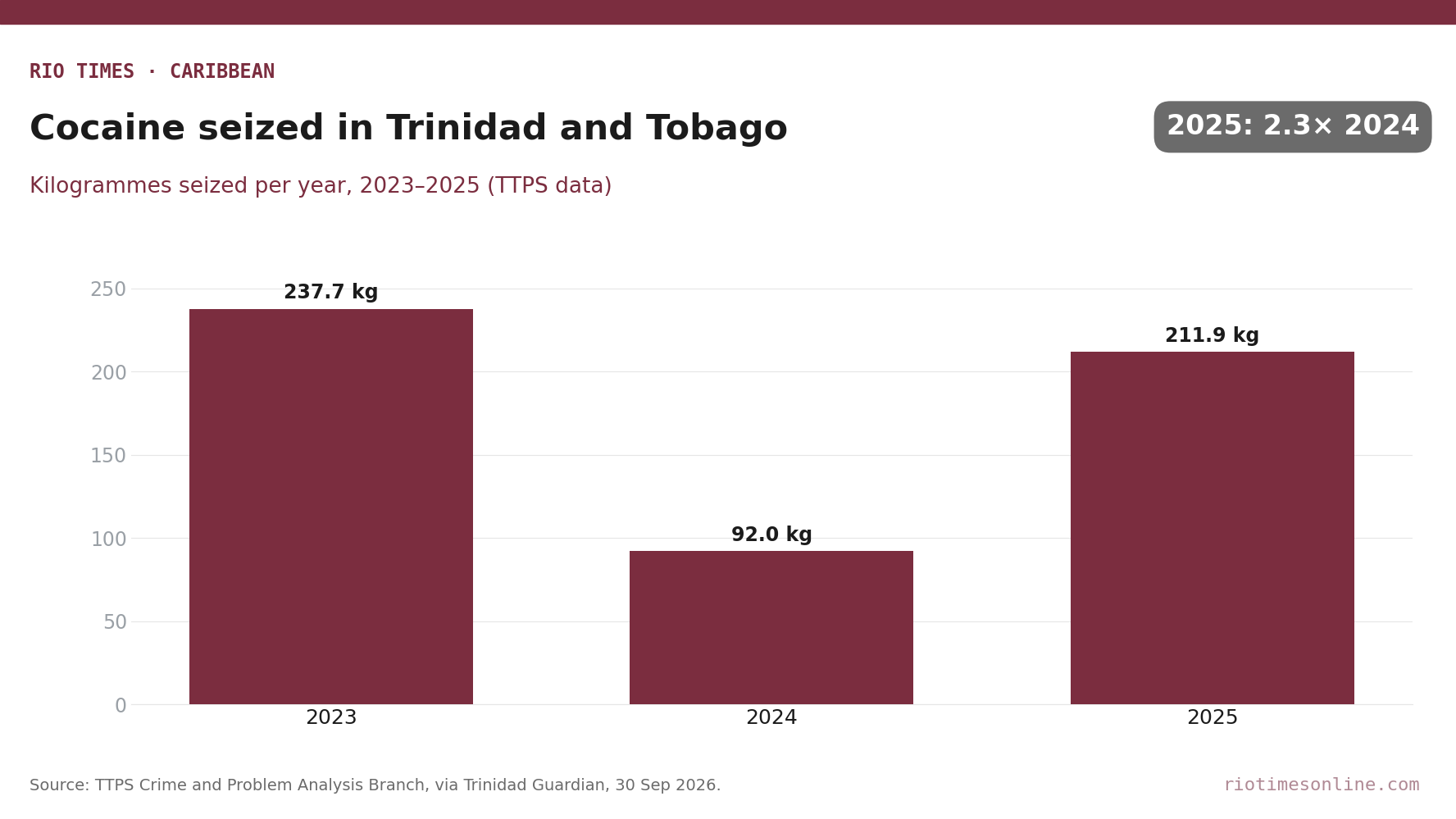
Police data show 211.87 kilogrammes of cocaine seized in 2025, up from 92 kilogrammes in 2024. The 2023 total was 237.67 kilogrammes, according to the TTPS Crime and Problem Analysis Branch.
Guevarro read the rise as a sign that operations are working. He said a recent Coast Guard interdiction would produce another batch for destruction soon.
Assistant Commissioner Kerwin Francis said financial investigations aim at confiscation orders and restrained property. Forfeitures from 1 January to 17 September 2025 totalled TT$5.68 million (about US$840,000), police data showed.
That figure is small beside the value of the drugs burned. It suggests the money trail remains the harder part of the campaign.
Politics around the pyre
Persad-Bissessar, of the governing United National Congress (UNC), said traffickers had run “rampant” under the People’s National Movement (PNM). Homeland Security Minister Roger Alexander called the effort a “war” backed by international allies.
PNM chairman Marvin Gonzales called her claim a “satanic lie”. He said most of the drugs were seized between 2005 and April 2025, when his party governed.
The burn follows the end of Trinidad’s 199 days of emergency rule. It also follows the Special Operations Bill passing the House.
What Is Not Yet Known
Police have not published a breakdown by drug type, weight or case. The Express figure of more than 8.3 tonnes was not confirmed by a second outlet.
Reports of prison terms “up to 30 years” refer to a separate bill, not to trafficking. Guardian Media reported that the Miscellaneous Provisions Bill 2026 proposes them for offences such as selling cannabis to under-25s.
That bill also raises the drinking age to 21 and the cannabis age to 25. It remains a government proposal, and its final penalties could still change.
Sources: CNC3, 29 Sep 2026; Trinidad Guardian, 30 Sep 2026; Trinidad Express, 30 Sep 2026; Trinidad Guardian (penalties bill), 30 Sep 2026; World Bank GDP data; exchange rate open.er-api, 30 Sep 2026.
This article was produced by The Rio Times’ automated newsroom system. How we use AI · Report an error
Read More from The Rio Times