Latin America Steel Tariffs Hit Chinese Imports, Lift ETF
Key Facts
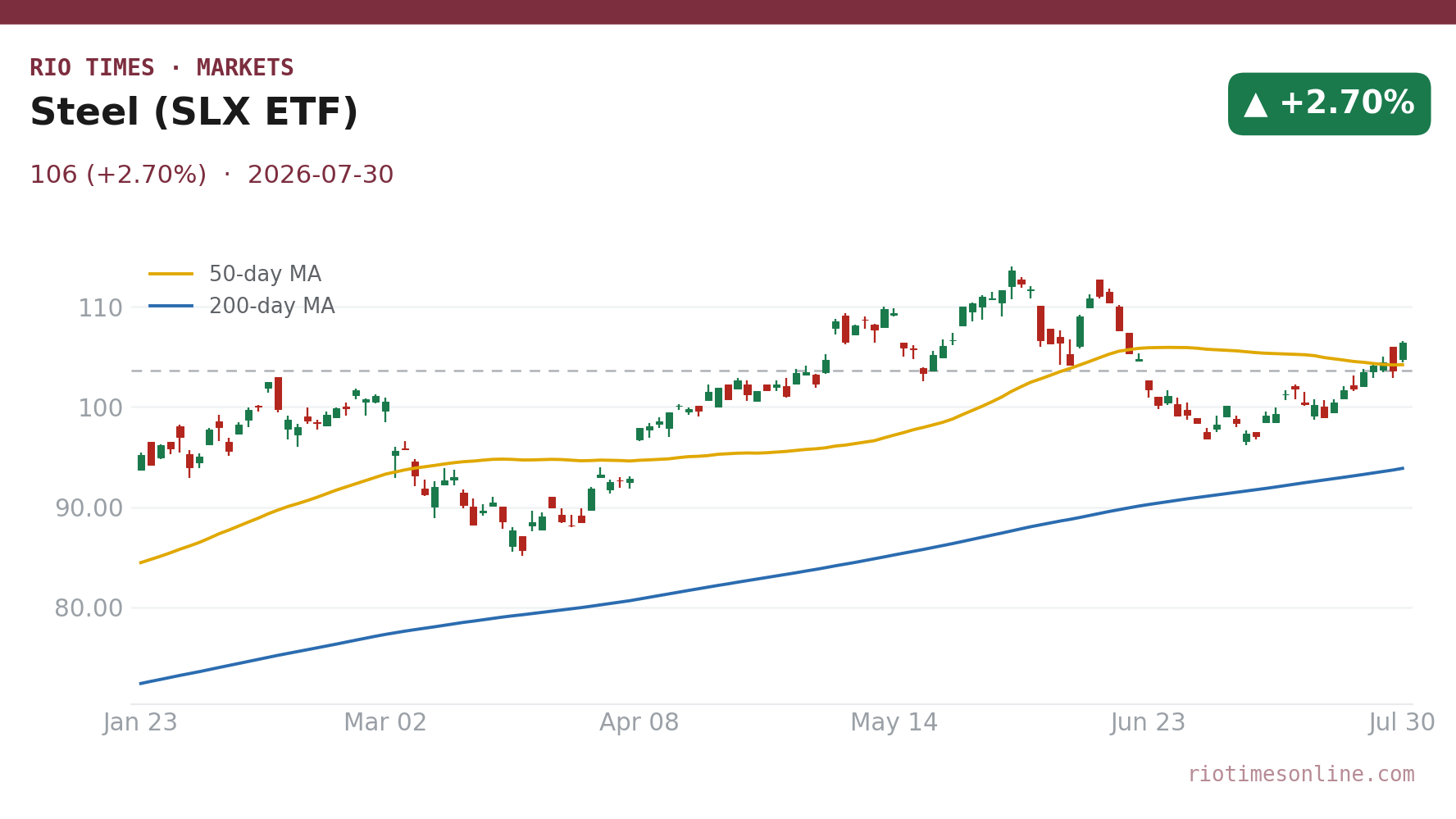
- SLX steel ETF closed at US$106.43 a 2.70 per cent daily gain that captured global optimism on construction and vehicle demand for listed producers.
- Gerdau ADR rose 2.06 per cent to US$4.96 as foreign investors bet on Brazilian long-steel demand tied to infrastructure and housing credit programmes.
- CSN’s New York ADR fell 1.94 per cent to US$1.01 under pressure from a weak domestic flat-steel spread and a 7.59 per cent negative net margin in its latest quarter.
- Ternium ADR added 2.18 per cent at US$49.11 reflecting the Mexican flat-steel champion’s exposure to nearshoring-fuelled construction and auto supply chains.
- Brazil and Mexico periodically impose anti-dumping duties on Chinese steel shielding local mills when Chinese export prices undercut production costs, and any tariff tightening instantly lifts mill margins.
- Gerdau’s annual revenue in 2024 was 67.03 billion reais a 2.74 per cent decline that illustrates margin pressure from lower prices and competition for Brazil’s construction bellwether.
Today’s Focus
Latin American steel producer shares split on Friday, with Mexican flat-steel group Ternium and Brazilian long-steel heavyweight Gerdau climbing while Brazil’s CSN fell, as investors reassessed the interplay between cheap Chinese imports, local tariff shields and patchy construction and auto demand. The VanEck Steel ETF SLX, a global basket of listed steelmakers that includes Latin American names and serves as a liquid proxy for foreign investors, settled at US$106.43, a 2.70 per cent day-to-day gain that signalled broad-based buying of steel equities.
Gerdau’s New York-traded ADR rose 2.06 per cent to US$4.96, buoyed by expectations that Brazilian housing credit programmes and infrastructure works will lift long-steel orders even as the company digests a 37.8 per cent drop in net income reported for 2024. Ternium’s ADR closed at US$49.11, up 2.18 per cent, on confidence that Mexican nearshoring investment and steady US auto demand will keep its flat-steel mills busy.
CSN bucked the trend, its ADR dropping 1.94 per cent to US$1.01, punished by a recent quarterly loss of 840.34 million reais and a negative net margin of 7.59 per cent that exposed how lower steel spreads and soft Brazilian appliance and auto demand have hit profitability. The move underscored a divide between producers leveraged to construction rebar and those most exposed to flat products where Chinese competition is fiercest.
Cheap Chinese steel exports to Latin America remain the single most important policy variable for these stocks: any tightening of anti-dumping duties on hot-rolled coil, cold-rolled sheet or rebar immediately widens mill margins, while an easing lets Chinese material undercut local prices again. For foreign readers, the SLX ETF’s 2.70 per cent pop offers a one-click exposure to this tariff-driven dynamic, bundling Gerdau and Ternium with global peers that also benefit from more muscular trade intervention.
What matters today. Latin American steel stocks are trading as a pure play on whether governments tighten anti-dumping tariffs on Chinese imports fast enough to offset tepid domestic construction and auto demand.

” alt=”Steel daily market wrap.” />
01 The session in one read
Latin American steel equities gave foreign investors a mixed close on Friday, with the global SLX steel ETF rising 2.70 per cent to US$106.43, a powerful daily gain that pulled Gerdau and Ternium higher even as CSN retreated. The split reflects a market that is actively discriminating between companies with robust tariff protection on construction-grade steel and those still wrestling with low-priced Chinese flat products.
Brazilian construction-steel bellwether Gerdau moved its ADR to US$4.96, up 2.06 per cent, while Mexican flat-steel group Ternium closed at US$49.11 with a 2.18 per cent gain. CSN’s ADR fell 1.94 per cent to US$1.01, penalised by domestic earnings weakness that a relatively strong iron-ore export arm could not fully offset.
Investors are pricing Latin American steel equities primarily off the probability of stricter anti-dumping duties on Chinese steel, rather than organic construction or auto growth, because domestic demand remains mixed in Brazil while Mexican nearshoring is a slow-burning story. Friday’s split session, with Gerdau and Ternium up and CSN down, tells you that the tariff umbrella is uneven: long-steel names benefit more readily from import barriers on rebar, while integrated flat-steel producers such as CSN remain exposed to global oversupply in sheet products that local duties only partly block. The variable to watch over the next fortnight is any announcement from Brasília or Mexico City on new safeguard measures against Chinese cold-rolled and galvanised steel.
02 The board
The SLX ETF, which bundles global listed steel producers including Latin American names and gives foreign investors a liquid steel proxy, settled at US$106.43 for a 2.70 per cent daily advance. That move was echoed in two of the three Latin American ADRs: Gerdau gained 2.06 per cent to US$4.96 and Ternium added 2.18 per cent to US$49.11, signalling that buyers favoured companies with leverage to construction rebar and nearshoring-driven Mexican industrial demand.
CSN defied the positive tone, its ADR down 1.94 per cent to US$1.01. The drop aligns with the company’s reported 840.34 million reais quarterly net loss and the market’s concern that its flat-steel business remains acutely exposed to cheap Chinese cold-rolled and galvanised sheet that leaks into Brazil’s auto and appliance supply chains.
| Asset | Level | Change |
|---|---|---|
| Steel (SLX ETF) | US$106.43 | +2.70% |
| Gerdau | US$4.96 | +2.06% |
| CSN | US$1.01 | -1.94% |
| Ternium | US$49.11 | +2.18% |
Source: RT close, 2026-07-30. Where a commodity has no spot feed, an exchange-traded tracker or leading producer is shown as a labelled proxy.
Live Market IntelligenceThe live market board
Rio Times · Live Market Intelligence
Latin America — Cross-Market Board
| Instrument | Last | Change | YoY | Prev. | High | Low | Volume |
|---|---|---|---|---|---|---|---|
| IBOV | 185,229.17 | -0.41% | +21.85% | 185,992.03 | 168,310 | 167,142 | — |
| IPSA | 11,381.18 | +1.30% | — | 11,235.60 | 11,210 | 10,984 | 1,513,213,483 |
| IPC MEX | 63,873.32 | +0.58% | +12.17% | 63,507.11 | 66,121 | 65,405 | 108,886,187 |
| MERVAL | 3,021,926 | -1.29% | +30.51% | 3,022,485 | 3,042,365 | 2,991,150 | — |
| COLCAP | 2,548.22 | +1.05% | — | 9.04 | 9.05 | 9.02 | 4,133 |
| BVL PERÚ | 60,023.65 | -1.13% | — | — | — | — | — |
| USD/BRL | 5.16 | +0.01% | -5.13% | 5.16 | 5.18 | 5.14 | — |
| EUR/BRL | 5.95 | +1.01% | -5.83% | 5.89 | 5.98 | 5.94 | — |
| USD/MXN | 17.06 | -0.24% | -8.58% | 17.10 | 17.08 | 17.01 | — |
| USD/CLP | 913.98 | +0.04% | -5.67% | 913.65 | 915.11 | 906.68 | — |
| USD/COP | 3,140 | +0.03% | -22.04% | 3,139 | 3,141 | 3,105 | — |
| USD/PEN | 3.36 | -0.66% | -4.82% | 3.38 | 3.38 | 3.35 | — |
| USD/ARS | 1,493 | +0.10% | +12.96% | 1,491 | 1,494 | 1,480 | — |
| USD/UYU | 40.27 | +1.24% | +1.80% | 39.77 | 40.27 | 40.23 | — |
| USD/PYG | 5,939 | +1.68% | -19.54% | 5,841 | 5,939 | 5,925 | — |
| USD/BOB | 11.64 | -0.76% | +72.04% | 11.73 | 11.72 | 11.64 | — |
| USD/DOP | 58.34 | +1.25% | -3.44% | 57.62 | 58.34 | 58.04 | — |
| USD/CRC | 445.92 | +0.89% | -9.71% | 441.97 | 448.50 | 445.92 | — |
Live Company IntelligenceGerdau S.A — the full investor dossier
Valuation & profitability
Price & risk
$15.9852-wk high
$26.44
Revenue trend · 6y
Ownership
Dividend
03 What moved it
Fears and hopes around Chinese steel exports were the dominant piston. China, the world’s largest steel exporter, has been pushing semi-finished and finished steel into Latin America at prices that Gerdau, CSN and Ternium have repeatedly called below production cost, a dynamic that shortens mill margins whenever local tariff shields weaken.
Brazil and Mexico have periodically imposed anti-dumping duties on Chinese hot-rolled coil, cold-rolled sheet and rebar, and the market is currently pricing an expectation of tighter enforcement ahead of new quarterly decisions. Gerdau and Ternium benefit directly from that tariff narrative because their product mixes lean into rebar and construction flat products where import substitution is politically sensitive.
On the demand side, Brazilian long-steel consumption is tied to housing credit programmes and public infrastructure budgets, both of which have been inching forward but remain below the levels that would fuel a self-sustaining recovery absent import protection. Mexico’s construction story is stronger thanks to nearshoring investment that fills Ternium’s order books for industrial parks, logistics centres and residential projects linked to US supply chains.
04 The Latin American read
For an investor sitting outside the region, these stocks are not simply plays on GDP growth. Gerdau’s US$7.76 billion market capitalisation and 67.03 billion reais in 2024 revenue—a 2.74 per cent annual decline—tell you that the Brazilian long-steel giant is fighting margin compression with cost discipline and geographic diversification into North American special steel, not just waiting for a construction boom.
Ternium’s US$17.649 billion revenue base, split between Mexico and the Southern Region, makes it a barometer for two distinct forces: the industrial vigour of Mexican auto and appliance exports to the United States, and Argentina’s volatile construction cycle. CSN, meanwhile, carries the double-edged sword of iron-ore exports via CSN Mineração alongside a domestic flat-steel unit that posted a negative 7.59 per cent net margin, leaving its New York ADR at US$1.01 clearly pricing more pain before any tariff relief arrives.
05 The names to watch
Gerdau’s ADR at US$4.96 is the purest listed vehicle for Brazilian construction steel, heavily levered to rebar demand for housing and infrastructure and to automotive special steel orders. Any announcement on new Brazilian anti-dumping duties on Chinese long products would move this name first.
CSN, priced at US$1.01, couples a challenged flat-steel business with iron-ore export exposure that attracts a different kind of foreign investor—one willing to tolerate steel losses for the optionality of Asian ore demand. Its trajectory depends on whether Brasília tightens sheet steel tariffs and on Chinese iron-ore restocking patterns.
Ternium, at US$49.11, is a Mexican and regional champion that effectively tracks US auto cycles and nearshoring construction, with an overlay of Argentine macro uncertainty. Foreign investors use Ternium as a liquid proxy for the proposition that Mexico will keep industrialising inside the US–Mexico–Canada trade architecture.
06 The outlook
The near-term direction for Latin American steel stocks hinges on a binary event: the next round of Brazilian and Mexican anti-dumping determinations on Chinese steel. If tariffs are widened or toughened, Gerdau, Ternium and eventually CSN will rally as domestic price relief flows directly to margins. If authorities delay or dilute measures, the cheap Chinese import valve reopens and the SLX ETF’s 2.70 per cent Friday gain will look like a head-fake rather than the start of a durable regional rerating. Foreign investors should also watch Mexican auto production data and Brazilian housing credit figures, but only as secondary checks—in this market, the policy lever is everything.
07 What to watch
- Brazil anti-dumping announcements: New duties on Chinese rebar, hot-rolled coil or cold-rolled sheet would directly lift Gerdau and CSN mill margins and are the single most potent price catalyst.
- Mexico near-term tariff decisions: Any safeguard action by Mexico City on Chinese flat steel would bolster Ternium’s pricing power in its core market and support its ADR at US$49.11.
- Chinese steel export offer prices: Rising export quotes curtail the pricing pressure on Latin American mills, while falling offers test the effectiveness of local tariff walls.
- SLX ETF fund flows: The SLX ETF at US$106.43 is a real-time barometer of foreign sentiment toward global steel producers; sustained inflows would amplify buying in included Latin American names.
Frequently Asked Questions
What is the SLX ETF and why does it matter for Latin America?
The SLX ETF is a VanEck fund that tracks a global basket of listed steel producers, including Brazil’s Gerdau and Mexico’s Ternium, giving foreign investors a liquid one-click vehicle to trade regional steel demand and tariff policy.
Why did CSN fall while Gerdau and Ternium rose?
CSN’s ADR fell 1.94 per cent to US$1.01 because its flat-steel business posted a negative net margin and remains highly exposed to cheap Chinese cold-rolled sheet, whereas Gerdau and Ternium benefit from construction-heavy product mixes and stronger tariff protection.
How do Chinese steel exports affect Latin American producers?
Chinese mills export semi-finished and finished steel into Brazil and Mexico at prices that local companies say are below production cost, prompting governments to impose anti-dumping duties that directly set mill profitability for regional champions.
What drives demand for steel in Brazil and Mexico?
Brazilian steel demand hinges on housing credit, infrastructure budgets and automotive output, while Mexican demand is tightly linked to car exports to the United States and nearshoring-driven construction of industrial parks and logistics hubs.
This article was produced by The Rio Times’ automated newsroom system. How we use AI · Report an error
LatAm Markets: Live Signals → — real-time movers, turnover leaders and FX across Latin America.
Read More from The Rio Times