SAINT LUCIA · COUNTRY GUIDE
Key Facts
- —What it is A small English-speaking island state in the eastern Caribbean, governed as a constitutional monarchy with a parliamentary democracy.
- —Why it matters Tourism, construction and services drive a small open economy that is highly exposed to global demand, fuel prices and climate events.
- —The numbers Unemployment stood at 10.1% in the second quarter of 2026, with 99,528 people employed, according to the Central Statistical Office.
- —The catch Mountainous terrain makes travel slow, and the island remains vulnerable to hurricanes, landslides and imported inflation.
- —What it means for you A newcomer should expect English in formal settings, Kwéyòl in daily life, and an economy centred on Castries and the western coast.
Saint Lucia explained in one read: a volcanic Caribbean island where Westminster politics, Afro-Caribbean culture and a tourism-led economy meet. For a foreigner, it is compact, English-speaking and welcoming, but shaped by terrain, climate risk and a small domestic market.
Saint Lucia sits between Martinique and Saint Vincent in the Lesser Antilles, facing the Atlantic on one side and the Caribbean Sea on the other. This guide explains how the country works, who runs it, what the economy looks like in 2026 and what a newcomer should know before arriving or investing.
Geography: a volcanic island with two distinct coasts
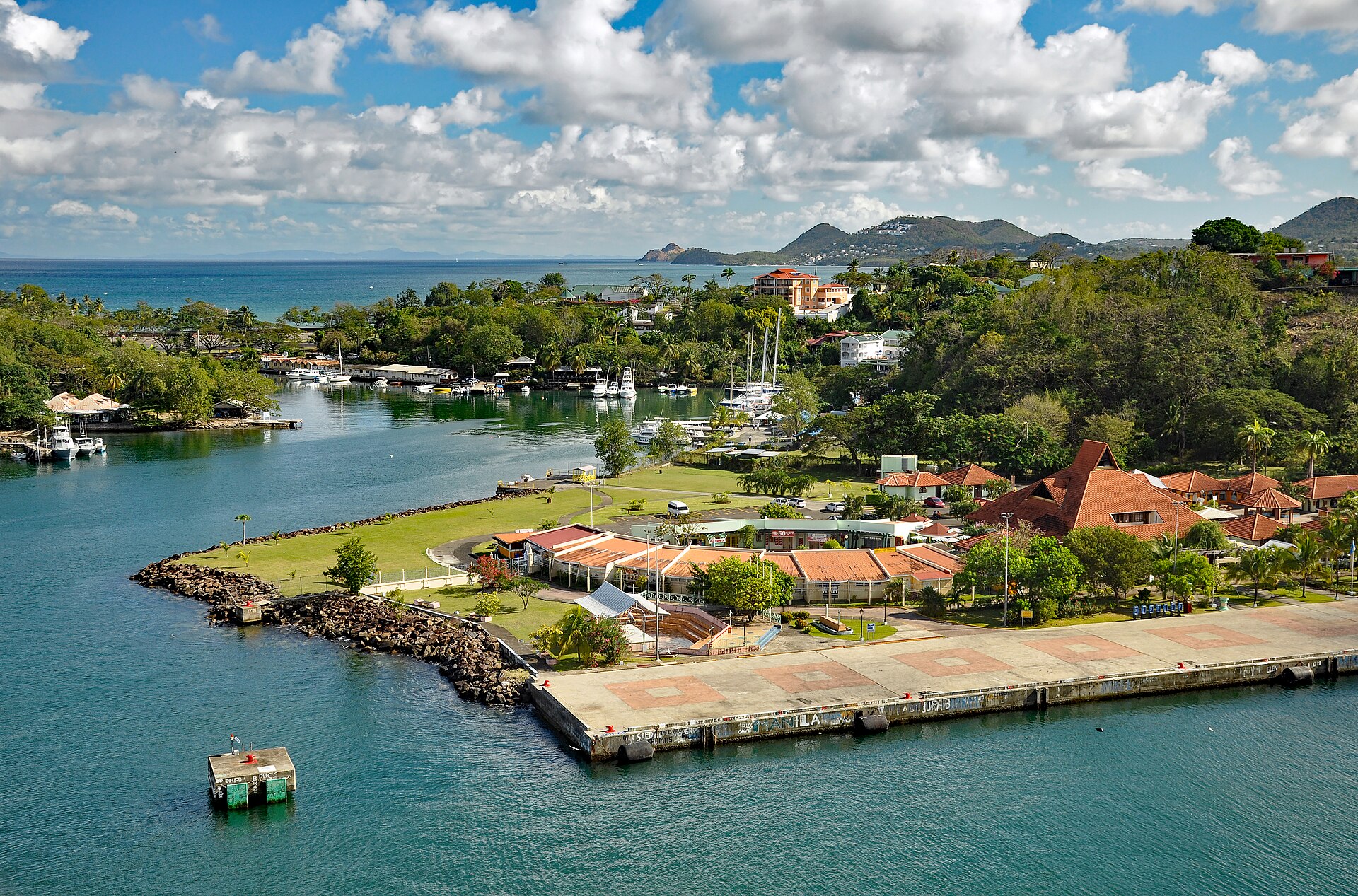
Saint Lucia is not a flat beach destination. It is a volcanic, mountainous island with rainforest, steep valleys, rivers and hot springs. The most recognisable landmarks are the Pitons, two volcanic spires at Soufrière that form part of a UNESCO World Heritage site.
The western coast faces the Caribbean Sea and has sheltered bays, beaches and most of the resort development. The eastern coast faces the Atlantic Ocean and has rougher seas and greater exposure to weather systems. Castries, the capital, is the main administrative, commercial and transport centre.
This geography shapes daily life. Roads are winding, and travel times are longer than distances on a map suggest. Outside Castries and the main towns, settlements are dispersed through valleys, hillsides and coastal communities. Hurricane and storm exposure, coastal erosion, landslides and water security remain important policy concerns.
People, language and identity
Saint Lucian society is predominantly Afro-Caribbean, with smaller communities of mixed, European, Indian, Lebanese and other ancestry. The cultural identity reflects African heritage, French influence and British constitutional institutions. French place names, Catholic traditions and African-derived cultural practices coexist with British legal and administrative structures.
English is the official language and the language of government, education and business. Kwéyòl, a French-lexified Creole, is widely used in informal and cultural settings. A newcomer can function in English but will hear Kwéyòl in markets, buses and community life.
Family, church, community groups, schools, sports clubs and cultural associations remain influential. The population is concentrated around the northwest and central-western parts of the island, particularly the Castries area. A substantial diaspora lives in the United Kingdom, Canada, the United States and other Caribbean states, and remittances and return migration are part of the national economic landscape.
Political system and constitutional structure
Saint Lucia is a constitutional monarchy and a parliamentary democracy. The Governor-General represents the head of state, while executive political authority is exercised by the Prime Minister and Cabinet. The Governor-General’s functions are mainly ceremonial, including opening the House of Assembly with the Throne Speech and assenting to legislation.
The Governor-General appoints as Prime Minister the member of the House of Assembly who appears most likely to command majority support. In practice, this is normally the leader of the party controlling the majority of seats. The national legislature is the House of Assembly, consisting of elected representatives and appointed senators.
Current officeholders in 2026
Prime Minister Philip J. Pierre leads the government and also holds the finance portfolio. Felix Finisterre has been Acting Governor-General, the King’s representative, since 1 August 2026, after Sir Errol Charles stepped down on 31 July 2026.
Other verified ministers include Emma Hippolyte, responsible for equity, social justice, gender, older persons, labour, cooperatives and consumer affairs; Wayne Girard, Minister for Economic Development; Shawn Edward, Minister for Infrastructure, Ports Services and Energy; and Stephenson King, responsible for public utilities. Ministerial portfolios can change, and the available sources do not provide a complete Cabinet list.
Politics is traditionally competitive between the Saint Lucia Labour Party and the United Workers Party, although smaller parties and independents may influence parliamentary dynamics. Voters focus on employment, prices, public services, crime, housing, infrastructure, healthcare, education and the cost of living.
The economy: tourism-led, services-heavy and exposed
Saint Lucia has a small, open economy. Tourism is its most visible international industry, but the broader economy includes construction, wholesale and retail trade, transportation, accommodation and food services, public administration, education, healthcare, agriculture and financial services.
The economy is exposed to international tourism demand, airline capacity, global food and fuel prices, imported inflation, climate events, construction cycles, public debt and the limits of a small domestic market. Accommodation and food services were the largest employing industry in the second quarter of 2026, accounting for 16.4% of total employment, followed by wholesale and retail trade at 14.2% and construction at 9.4%.
| Labour market indicator | Q2 2025 | Q1 2026 | Q2 2026 |
|---|---|---|---|
| Unemployment rate | 13.4% | 12.1% | 10.1% |
| Youth unemployment | 24.1% | — | 15.5% |
| Total employment | — | — | 99,528 |
The labour market improved during 2026. According to Central Statistical Office figures cited by the government, unemployment fell from 13.4% in the second quarter of 2025 to 10.1% in the second quarter of 2026. Construction employment increased by 14% in the quarter, while administrative and support services increased by 35.1%.
These figures indicate improvement, but unemployment remains high by the standards of many advanced economies, and youth employment remains a major concern. Agriculture, once associated with bananas, remains important for food security and rural livelihoods but is no longer the dominant export engine.
Government finances and the 2026/27 Budget
The government presented a 2026/27 Budget of EC$2.18 billion, described as the largest in Saint Lucia’s history. The theme was “Consolidating Our Gains: Prospering in Uncertain Times.” The government said it would introduce no new taxes while continuing measures aimed at families, businesses and vulnerable groups.
Announced measures included government payment for five CSEC subjects, a one-time EC$1,000 payment to expectant mothers, expansion of the School Feeding Programme, a one-time EC$700 payment to pensioners, a one-time EC$200 payment to Public Assistance Programme clients, increased disability support, housing assistance, educational grants, small-business support and extension of a tax-amnesty programme. The government also said penalties and interest on overdue taxes would fall from 12.5% to 6%.
The government reported that outstanding payables had fallen from more than EC$160 million in 2022 to approximately EC$20 million by December 2025. These are government-reported budget claims and should be read alongside underlying estimates, audited accounts and debt reports.
Social protection and daily life
The 2026/27 social policy agenda included increased support for people with disabilities, a proposed National Disability Registry, support for elderly-care institutions, completion of the Soufrière Home for the Elderly, development of a “Silver Economy” framework, training for healthcare workers dealing with dementia and Alzheimer’s disease, and expanded youth and sports programmes.
For residents, these policies matter because social support, healthcare access and community programmes shape daily life beyond the tourism economy.
Daily life for a newcomer involves practical adjustments. The currency is the Eastern Caribbean dollar, issued within the Eastern Caribbean Currency Union. English works in formal settings, but Kwéyòl is common informally. Roads are winding, and services are concentrated around Castries and the western coast. Utilities, healthcare and education are available, but the small-island context means that specialised services may require travel or external arrangements.
What it means for foreigners, investors and expats
For a foreigner, Saint Lucia offers an English-speaking legal and administrative system, a familiar Westminster political structure and a well-established tourism economy. The island is compact, culturally rich and relatively accessible from North America and Europe, with a diaspora that keeps family and business ties active.
For investors, the main opportunities are generally connected to hospitality and tourism infrastructure, real estate and approved development projects, renewable energy and climate resilience, agro-processing and food production, digital services, transportation and logistics, and small and medium-sized enterprises. The investment environment must be assessed with attention to land title, planning approvals, environmental rules, work permits, taxation, foreign-exchange arrangements, local participation requirements and the practical limits of a small island market.
The risks are real. The economy is exposed to external shocks, climate events and public debt pressures. Unemployment, while improving, remains high. Infrastructure can be strained by terrain and weather. A newcomer should plan for slower travel times, higher imported costs and the need for local professional advice on legal and regulatory matters.
What to watch
Several issues will shape Saint Lucia in the coming years. The first is the labour market. The fall in unemployment from 13.4% in the second quarter of 2025 to 10.1% in the second quarter of 2026 is significant, but youth unemployment at 15.5% remains a policy challenge. Watch whether construction and services employment continue to grow.
The second is fiscal policy. The record EC$2.18 billion budget and the reduction in outstanding payables suggest a government focused on spending and social support. The question is whether revenue growth can sustain that spending without new taxes or rising debt.
The third is climate resilience. Hurricane exposure, coastal erosion, landslides and water security are not abstract concerns. Infrastructure investment, renewable energy and disaster preparedness will affect property values, insurance costs and daily life.
Finally, watch the political calendar. The government was described in 2026 official and local reporting as having been re-elected, but Saint Lucian politics remains competitive. Changes in Cabinet portfolios or policy direction can affect investment approvals, social programmes and the business environment.
Frequently Asked Questions
Is Saint Lucia an independent country?
Yes. Saint Lucia is an independent state and a constitutional monarchy with a parliamentary democracy. The Governor-General represents the head of state, while the Prime Minister and Cabinet exercise executive authority.
What language do people speak in Saint Lucia?
English is the official language and is used in government, education and business. Kwéyòl, a French-lexified Creole, is widely spoken in informal and cultural settings.
What currency does Saint Lucia use?
Saint Lucia uses the Eastern Caribbean dollar, or EC$, issued within the Eastern Caribbean Currency Union. It is not the United States dollar.
Who is the Prime Minister of Saint Lucia in 2026?
Philip J. Pierre is the Prime Minister and also holds the finance portfolio, according to official government sources available as of October 2026.
What is the unemployment rate in Saint Lucia?
Unemployment stood at 10.1% in the second quarter of 2026, down from 12.1% in the first quarter and 13.4% in the second quarter of 2025, according to Central Statistical Office figures cited by the government.
Is Saint Lucia a good place for foreign investment?
Saint Lucia offers opportunities in tourism, real estate, renewable energy, agro-processing and digital services. However, investors must assess land title, planning approvals, work permits, taxation and the limits of a small island market.
Sources: govt.lc, govt.lc, news.mbcslu.com, govt.lc, npc.govt.lc, govt.lc. Retrieved 2 October 2026.
This article was produced by The Rio Times’ automated newsroom system. How we use AI · Report an error · Editorial responsibility: Matthias Camenzind, Editor-in-Chief
Read More from The Rio Times