Puigdemont’s Return: Catalyzing Catalonia’s Independence Debate
Carles Puigdemont, the exiled former leader of Catalonia’s separatist movement, has made a bold return to Spain after seven years abroad.
This return comes despite an active arrest warrant against him for his involvement in the controversial 2017 Catalan independence referendum, deemed illegal by Spanish courts.
Accused of embezzlement, Puigdemont asserts the legitimacy of the referendum and refutes the charges against him.
The story of Puigdemont is a vivid chapter in Catalonia‘s recent history. In 2017, as the President of Catalonia, he spearheaded an unsanctioned independence referendum.
The result—a declaration of independence—was quickly annulled by the Spanish government, which then took direct control of the region.
Facing severe charges, Puigdemont escaped to Belgium and later to France, continuing his advocacy for Catalan independence from there.
His role as a member of the European Parliament offered him some protection from extradition, allowing him to maintain a voice in European politics.
A Dramatic Homecoming
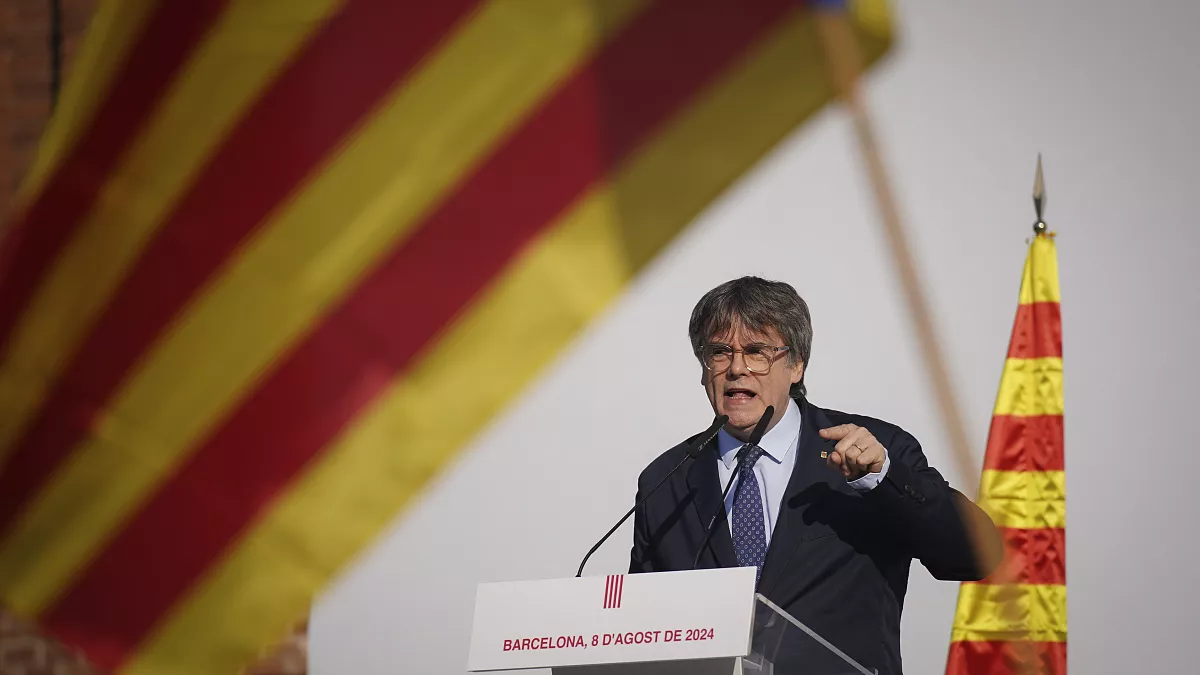
Puigdemont’s recent reappearance in Spain was marked by a rally in Barcelona, drawing thousands of supporters.
He spoke of Catalonia’s ongoing fight for self-determination and critiqued the Spanish government’s opposition to their cause.
His arrival initiated a significant police response, with roadblocks attempting to prevent his movement within Barcelona.
This homecoming aligns with pivotal political changes in Catalonia, where the regional parliament is set to elect a new leader. Puigdemont planned to attend the vote but ultimately had to exit the rally covertly due to arrest risks.
Broader Political Stakes
His return injects complexity into the delicate political dance between the Spanish government and Catalan separatist parties.
Spanish Prime Minister Pedro Sánchez has attempted to ease tensions by passing an amnesty law covering participants in the 2017 secession attempt, although it doesn’t protect Puigdemont from his embezzlement charges.
This law aims to garner the support of Catalan parties essential to sustaining Sánchez’s minority government.
However, it has also stirred discontent among right-wing groups and caused rifts within Sánchez’s own Socialist party.
Reflections on a Divisive Figure
Puigdemont’s actions resonate far beyond Catalonia, impacting Spanish politics at large. His presence revitalizes the independence debate, complicating the Spanish government’s efforts to stabilize its rule while respecting regional desires.
As he re-engages with his supporters and detractors alike, the story of Catalonia’s push for independence continues to unfold.
This article was drafted with automated assistance and reviewed before publication. How we use AI · Report an error
Read More from The Rio Times