Strong Guaraní Worries Paraguay Industry as Minister Defends Central Bank Restraint
ECONOMY · PARAGUAY
Key Facts
- —The country Paraguay, a landlocked farm and energy exporter whose currency is the guaraní (G.). Its central bank, the Banco Central del Paraguay (BCP), targets inflation.
- —What happened On 1 October 2026 Industry and Commerce Minister Marco Riquelme told radio 780 AM “we are super worried” about the falling dollar, citing pressure from business, La Nación and El Trueno reported.
- —The numbers The BCP reference rate fell from G. 5,917.80 per dollar in mid-September to G. 5,873.44 on 25 September; interbank trades hit G. 5,847 on 29 September (ABC Color). April 2025 peak: G. 8,006 (Última Hora).
- —What it means for you Imports and dollar debts get cheaper for people paid in guaraníes. Exporters and factories competing with imports receive fewer guaraníes per dollar earned.
- —Still open Whether the BCP will buy more dollars for reserves, and whether the US$1 billion in announced investment pledges actually arrives as cash.
A strong guaraní is squeezing Paraguay’s factories and exporters, and the government says it hears them. Industry and Commerce Minister Marco Riquelme said on 1 October 2026 that “we are super worried” about the cheaper dollar.
He did not, however, ask the central bank to step in. According to La Nación, Riquelme defended the bank’s hands-off stance and called the currency’s strength “the growing pains” of a fast-expanding economy.

How Far the Dollar Has Fallen
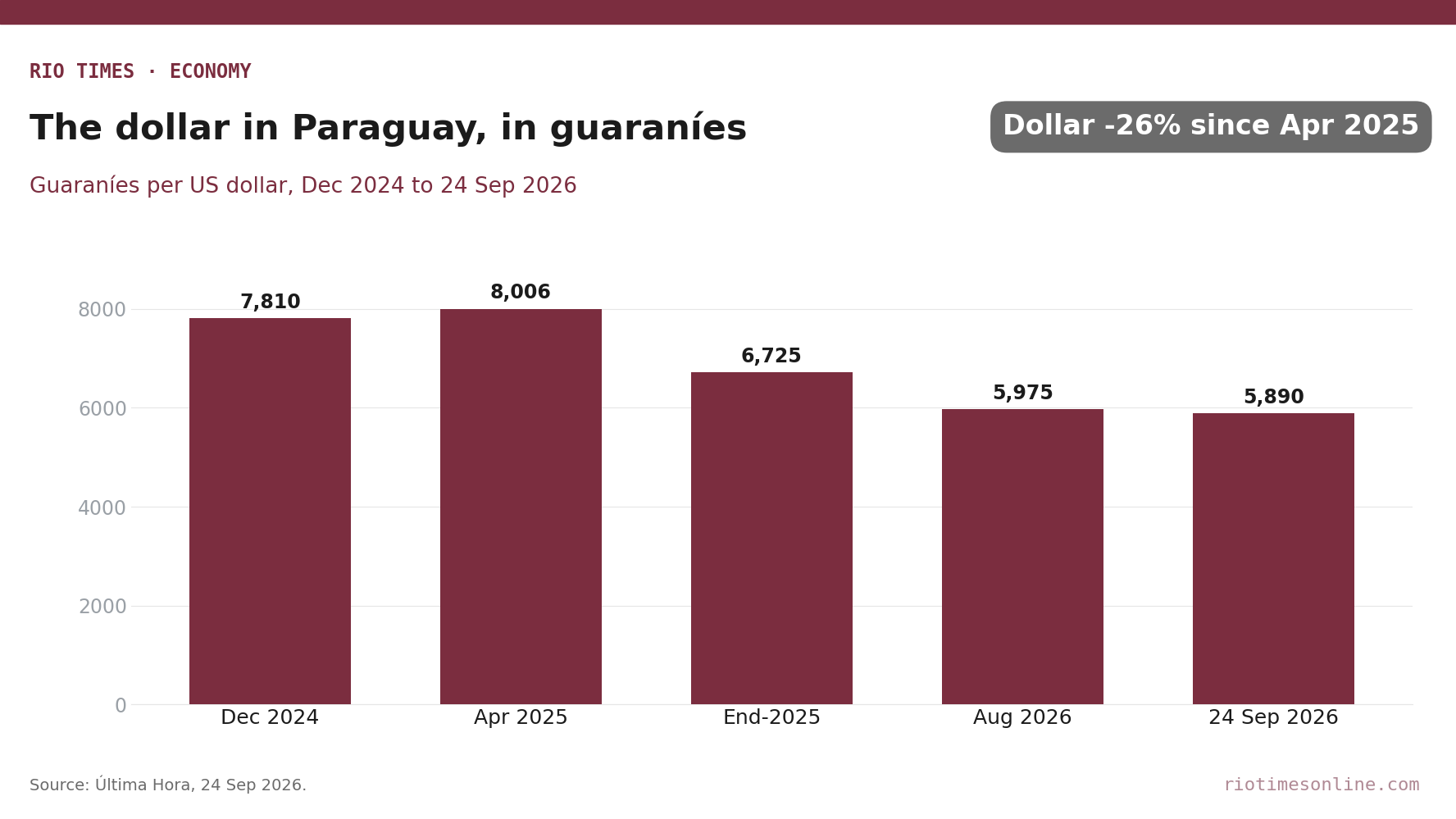
The dollar bought G. 5,890 on 24 September, Última Hora reported, close to its late-2018 averages. It peaked at G. 8,006 in April 2025, then fell to G. 6,725 by end-2025 and G. 5,975 in August 2026.
That makes it a strong guaraní by any recent measure, with the dollar down about 26 percent from its peak. ABC Color reported a new interbank low of G. 5,847 on 29 September, extending the slide.
The slide continued even after the US Federal Reserve raised its rate to 4 percent on 16 September. Economist Arnold Benítez told ABC Color that local dollar supply and investment inflows outweighed that pull.
The first signs came in late August, when the guaraní hit its strongest level against the dollar since 2018. The economy itself kept expanding, as the 4 percent second-quarter growth figure showed.
What the Industry Minister Said
Riquelme told 780 AM that the issue comes up regularly at his ministry’s business council. That body brings together the heads of 25 leading trade associations every month.
He said manufacturing exports were up 11 percent and maquila exports up 35 percent, with record foreign direct investment. Maquila plants assemble goods for export under a special tax regime.
In his view, new capital and rising exports will keep the strong guaraní in place, or push the dollar lower. The task for government, he said, is to use the moment to improve competitiveness and ease financial pressure on firms.
The Central Bank’s Position
Riquelme said the BCP president attended the council about three weeks ago and gave a technical explanation. According to the minister, the bank told business leaders the guaraní’s strength reflects economic growth.
He added that the bank’s main goal is controlling inflation, not managing the exchange rate. It intervenes only when markets are distorted, he said, citing the jump from G. 7,500 to G. 8,000.
ABC Color noted that the BCP’s June report said it had neither bought nor sold dollars with banks through May. It had, however, built up dollars received from the public sector.
Who Gains and Who Loses
A strong guaraní lowers the cost of imported goods and of dollar loans for households earning guaraníes. That helps hold down inflation, which is the BCP’s mandate.
Benítez warned that exporters paying wages in guaraníes now earn less per dollar. “Exporting more does not guarantee earning more,” he told ABC Color, and local producers also face cheaper imports.
He suggested the BCP explain more clearly when it would buy dollars to build reserves. He cited Colombia, which announced a programme in July to accumulate up to US$4 billion.
What Is Not Yet Known
The BCP did not issue a new public statement on the exchange rate on 1 October; its stance here comes from the minister and earlier bank reports. Riquelme’s remarks were carried by La Nación and El Trueno, both citing his 780 AM interview.
Benítez said announced investment commitments may exceed US$1 billion, but not all of that money will arrive soon. How much is converted into guaraníes will decide the next move in the rate.
Sources: La Nación (Paraguay), interview of Industry and Commerce Minister Marco Riquelme with 780 AM, 1 October 2026; Última Hora, exchange rate report, 24 September 2026; ABC Color, interview with economist Arnold Benítez, 27 September 2026; ABC Color, market report, 29 September 2026; El Trueno, 1 October 2026.
LatAm Markets: Live Signals → — real-time movers, turnover leaders and FX across Latin America.
Read More from The Rio Times