Key Facts
- Brent rose: the expiring November contract settled up 91 cents, or 0.9%, at US$103.50 a barrel, and the more active December contract gained US$1.87, or 1.9%, to US$98.03.
- WTI recovered US$1.04, or 1.2%, to US$90.42 a barrel, after Tuesday’s 3.5% fall.
- Iran talks stalled: President Donald Trump denied reports that he was ready to offer Iran sanctions relief.
- US fuel stocks fell: gasoline inventories dropped 1.7 million barrels and distillates 2.3 million barrels, while crude stocks rose 922,000 barrels.
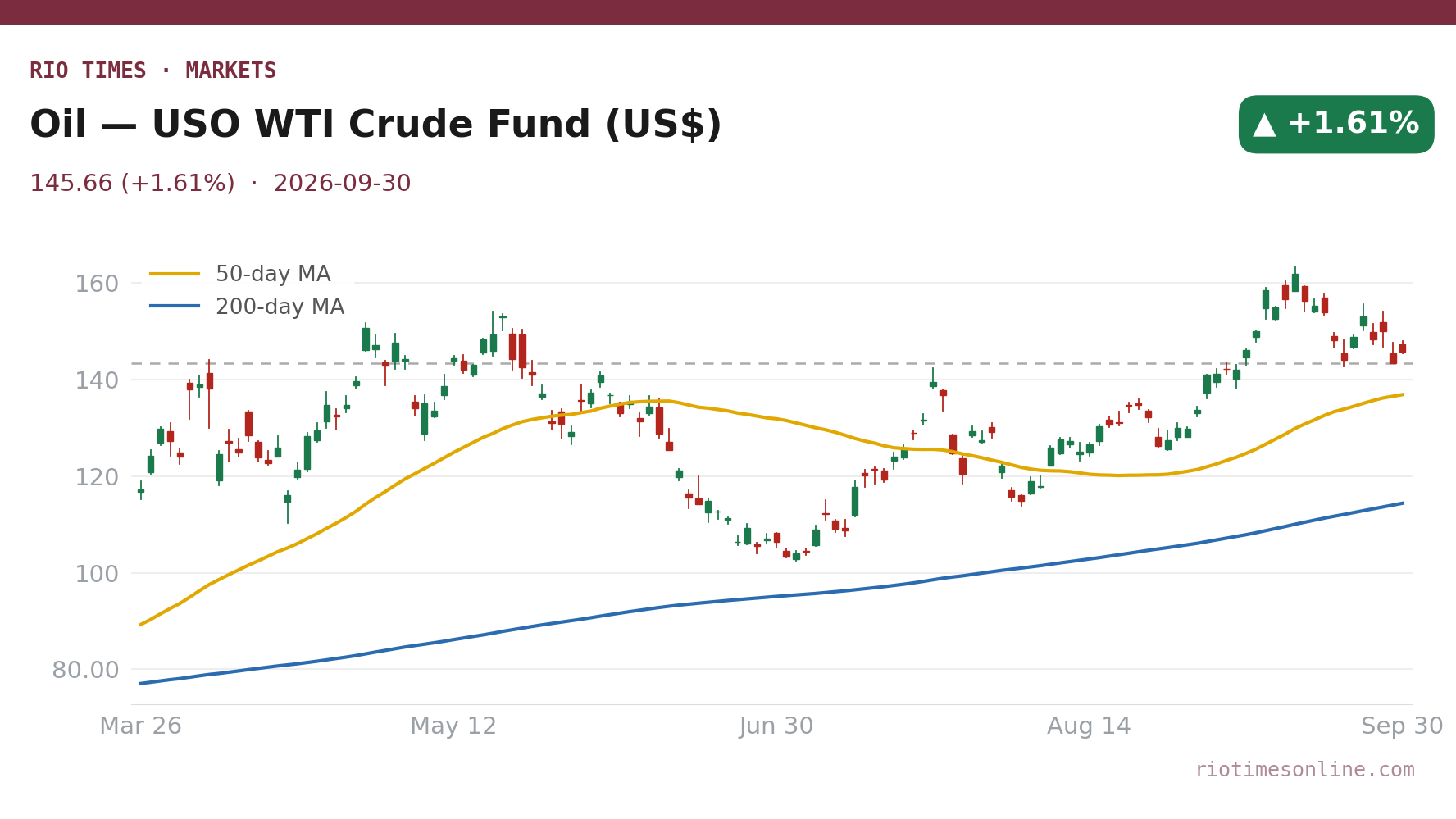
- Petrobras gained 1.07% to US$20.87 in New York, and the USO fund tracking WTI rose 1.61% to US$145.66.
- Argentine producers lagged: YPF slipped 0.36% to US$50.13 and Vista Energy fell 2.04% to US$65.35.
Today’s Focus
Oil rebounded on Wednesday, 30 September 2026, after Tuesday’s slide. Brent’s expiring November contract settled up 0.9% at US$103.50 a barrel, while the more active December contract rose 1.9% to US$98.03. WTI gained 1.2% to US$90.42.
Two forces lifted prices. US-Iran peace talks looked stalled after President Donald Trump denied reports that he was ready to offer Tehran sanctions relief. And US fuel stocks fell sharply: gasoline inventories dropped 1.7 million barrels and distillates 2.3 million barrels, government data showed.
A surprise 922,000-barrel rise in US crude stocks and recovering Gulf exports limited the gains.
Latin American producers did not move together. Petrobras’ New York shares rose 1.07% to US$20.87, but Argentina’s YPF slipped 0.36% and Vista Energy fell 2.04%.
What matters today. Diplomacy, more than barrels, is setting the price. If the Iran talks stay stuck, the war premium stays; if they restart, Tuesday’s selling could return.
01 The session in one read
Oil prices recovered part of Tuesday’s losses on Wednesday, 30 September 2026. WTI settled at US$90.42 a barrel, up US$1.04, after a 3.5% fall on Tuesday. Brent’s November contract expired at US$103.50, up 91 cents, and the December contract, now the benchmark, rose US$1.87 to US$98.03.
The gap of about US$5.50 between the two Brent contracts shows how tight nearby supply remains: buyers still pay a large premium for oil delivered sooner.
Wednesday’s rise came from politics and refined products, not crude. Trump’s denial of a sanctions-relief offer to Iran pushed back hopes that more Iranian oil would reach the market soon, and falling US gasoline and diesel stocks showed tight fuel markets. Physical supply is still improving: Saudi Arabia has resumed tanker loadings at its Red Sea port of Yanbu after restarting its East-West pipeline. Watch Sunday’s OPEC+ meeting and any news from the Iran talks.
02 The board
The USO fund, which tracks WTI futures, rose 1.61% to US$145.66. The BNO fund, which tracks Brent, gained 2.28% to US$60.09.
Petrobras’ New York shares gained 1.07% to US$20.87. In São Paulo, its preferred shares were almost flat, up 0.04% at R$49.12 (about US$9.49), as the real firmed 0.53% to 5.1743 per US dollar. Prio, the independent producer, fell 1.14% to R$60.90 (about US$11.77).
Ecopetrol’s US shares slipped 0.24% to US$16.48. In Bogotá, its shares fell 1.28% to COP 2,705 (about US$0.82) on the day Colombia’s central bank surprised with a rate hike. Argentina’s YPF lost 0.36% to US$50.13 and Vista Energy fell 2.04% to US$65.35.
| Asset | Level | Change |
|---|---|---|
| WTI crude (USO) | US$145.66 | +1.61% |
| Petrobras | US$20.87 | +1.07% |
| Ecopetrol | US$16.48 | -0.24% |
| YPF | US$50.13 | -0.36% |
Source: RT close, 2026-09-30. Where a commodity has no spot feed, an exchange-traded tracker or leading producer is shown as a labelled proxy.
Live Market IntelligenceThe live market board
Rio Times · Live Market Intelligence
Latin America — Cross-Market Board
| Instrument | Last | Change | YoY | Prev. | High | Low | Volume |
|---|---|---|---|---|---|---|---|
| IBOV | 186,340.46 | +1.37% | +21.85% | 183,827.59 | 168,310 | 167,142 | — |
| IPSA | 10,969.49 | -0.78% | — | 11,055.94 | 11,210 | 10,984 | 1,513,213,483 |
| IPC MEX | 64,951.10 | -0.24% | +12.17% | 65,110.57 | 66,121 | 65,405 | 108,886,187 |
| MERVAL | 2,819,323 | +1.32% | +30.51% | 3,022,485 | 3,042,365 | 2,991,150 | — |
| COLCAP | 2,549.16 | -0.38% | — | 9.04 | 9.05 | 9.02 | 4,133 |
| BVL PERÚ | 60,410.88 | -0.96% | — | — | — | — | — |
| USD/BRL | 5.16 | +0.01% | -5.13% | 5.16 | 5.18 | 5.14 | — |
| EUR/BRL | 5.95 | +1.01% | -5.83% | 5.89 | 5.98 | 5.94 | — |
| USD/MXN | 17.06 | -0.24% | -8.58% | 17.10 | 17.08 | 17.01 | — |
| USD/CLP | 913.98 | +0.04% | -5.67% | 913.65 | 915.11 | 906.68 | — |
| USD/COP | 3,140 | +0.03% | -22.04% | 3,139 | 3,141 | 3,105 | — |
| USD/PEN | 3.36 | -0.66% | -4.82% | 3.38 | 3.38 | 3.35 | — |
| USD/ARS | 1,493 | +0.10% | +12.96% | 1,491 | 1,494 | 1,480 | — |
| USD/UYU | 40.27 | +1.24% | +1.80% | 39.77 | 40.27 | 40.23 | — |
| USD/PYG | 5,939 | +1.68% | -19.54% | 5,841 | 5,939 | 5,925 | — |
| USD/BOB | 11.64 | -0.76% | +72.04% | 11.73 | 11.72 | 11.64 | — |
| USD/DOP | 58.34 | +1.25% | -3.44% | 57.62 | 58.34 | 58.04 | — |
| USD/CRC | 445.92 | +0.89% | -9.71% | 441.97 | 448.50 | 445.92 | — |
03 What moved it
Diplomacy was the first driver. Trump denied media reports, by Axios and CNN, that he was prepared to offer Iran sanctions relief and the release of frozen funds in exchange for nuclear concessions, Reuters reported. That pushed back expectations of a quick return of Iranian barrels.
US fuel data was the second. In the week to 25 September, gasoline stocks fell 1.7 million barrels to 204.4 million and distillate stocks, which include diesel, dropped 2.3 million barrels to 105.2 million, the Energy Information Administration (EIA) said. Crude stocks rose 922,000 barrels to 427.3 million, against a forecast draw of about 300,000 barrels.
Supply recovery is the counterweight. Saudi Arabia has resumed tanker loadings at Yanbu after restarting its East-West pipeline, and Goldman Sachs estimates Gulf oil exports have recovered to 23.3 million barrels a day. Analysts in a Reuters poll published on Wednesday still raised their 2026 Brent forecast to an average of US$89.05 a barrel, from US$85.08 a month earlier, citing the prolonged Gulf disruption.
04 Wednesday’s data, one by one
Tuesday’s edition promised five oil markers for Wednesday. Here is what happened.
US government oil inventories (EIA, week to 25 September): crude up, fuels down. Crude stocks rose 922,000 barrels, against a forecast draw of about 300,000 barrels, after the industry group API had reported a 1.02-million-barrel build. Gasoline fell 1.7 million barrels and distillates 2.3 million barrels; stocks at the Cushing, Oklahoma, hub rose 553,000 barrels. The fuel draws outweighed the crude build, and prices rose.
US-Iran talks: stalled. Trump denied he was ready to offer Iran sanctions relief and frozen funds, and the talks looked stuck, Reuters reported. No progress on Iran’s Hormuz proposal was announced. Brent rose.
US data: firmer jobs and factories, softer inflation. ADP private payrolls rose by 90,000 in September, above the 70,000 forecast. Core PCE inflation held at 3.0% a year in August, below the 3.3% forecast, and headline PCE inflation was 3.4%, below 3.7% expected. The Chicago PMI jumped to 58.8 from 47.1, far above the 51.2 forecast. The dollar index edged up 0.08% to 101.45.
Colombia’s central bank: a surprise hike. Banco de la República raised its policy rate by 25 basis points to 12.25%, when a hold at 12% was expected. Four board members backed the hike, two wanted a hold and one a 50-point rise. Ecopetrol fell 1.28% in Bogotá, and the peso firmed 0.68% to 3,307.50 per US dollar.
Brazil fiscal data (August): a wider deficit. The consolidated public sector ran a primary deficit of R$10.0 billion (about US$1.93 billion), and gross government debt rose to 82.9% of GDP from 82.5%, the central bank said. The real still firmed 0.53%, and Petrobras’ São Paulo shares held flat.
05 The Latin American read
Brazil remains the region’s steadiest oil story. Petrobras’ pre-salt fields, deep offshore beneath thick layers of salt, are among the lowest-cost barrels in the region, and its New York shares rose with crude. Brazilians vote in the first round of the general election on Sunday, 4 October, which adds political risk to the state-controlled company this week.
Argentina’s producers lagged. YPF and Vista, the two main Vaca Muerta shale names, fell even as crude rose, so the oil rebound did not reach Argentine shale stocks on Wednesday.
Guyana keeps adding supply outside the Gulf. The ExxonMobil-operated Stabroek block produces about 900,000 barrels a day, supply that competes with Middle Eastern crude for refiners in Europe and Asia.
06 The names to watch
Ecopetrol: a firmer peso trims the peso value of its dollar oil sales, and Wednesday’s rate hike raises local funding costs. Its Bogotá shares fell more than its US shares.
Venezuela: the White House said on 31 August that North American Blue Energy Partners had won concessions on 17 Venezuelan oil fields, with the Pentagon’s Office of Strategic Capital taking a 35% stake in the company’s parent. Venezuelan officials have disputed the 100-year term the White House described.
Petrobras: the firmer real flattered its New York shares, while its São Paulo preferred shares barely moved. Sunday’s election is the next test for the state-controlled company.
07 The outlook
The near term depends on one meeting and one negotiation. OPEC+ meets on Sunday, 4 October, and is likely to keep November output targets steady, Reuters reported. The US-Iran talks will decide whether the war premium shrinks further.
Brent’s benchmark is now the December contract, at about US$98 a barrel, below the US$100 mark the expired contract held. For Latin America, pre-salt and Guyana offer low-cost barrels, while Argentina’s shale names remain the most sensitive to price swings.
08 What to watch
- US-Iran talks: any sign of movement on sanctions or Iran’s Hormuz proposal would weigh on prices; a breakdown would lift them.
- US data, 9.30 am BRT (12.30 UTC) and 11 am BRT (14.00 UTC): weekly jobless claims (forecast 200,000) and the ISM manufacturing index (forecast 55.0 after 54.6).
- US natural gas storage, 11.30 am BRT (14.30 UTC): the EIA weekly report, with a build of 63 billion cubic feet forecast.
- Brazil manufacturing PMI, 10 am BRT (13.00 UTC): S&P Global’s September reading, forecast 46.5 after 46.3.
- OPEC+ meeting, Sunday 4 October: producers are expected to keep November output targets unchanged; Brazil votes the same day.
- China Golden Week: mainland markets, including Shanghai crude futures, are closed from 1 to 7 October.
Frequently Asked Questions
Why did oil rise on Wednesday?
US-Iran talks looked stalled after President Donald Trump denied he was ready to offer Iran sanctions relief, and US gasoline and distillate stocks fell sharply. WTI settled up 1.2% at US$90.42 a barrel.
Why are there two Brent prices?
The November Brent contract expired on Wednesday at US$103.50 a barrel, up 0.9%. The December contract, now the benchmark, settled up 1.9% at US$98.03.
What did the US inventory report show?
In the week to 25 September, US crude stocks rose 922,000 barrels to 427.3 million, while gasoline stocks fell 1.7 million barrels and distillates 2.3 million barrels, the Energy Information Administration said.
How did Latin American oil stocks perform?
Petrobras’ New York shares rose 1.07% to US$20.87. Argentina’s YPF slipped 0.36% to US$50.13, and Ecopetrol fell 1.28% in Bogotá after Colombia’s surprise rate hike.
Source: RT live market data, close of Wednesday 30 September 2026.
This article was produced by The Rio Times’ automated newsroom system. How we use AI · Report an error
LatAm Markets: Live Signals → — real-time movers, turnover leaders and FX across Latin America.
Read More from The Rio Times