GLOBAL BACKDROP · POLITICS & DISASTER
Key Facts
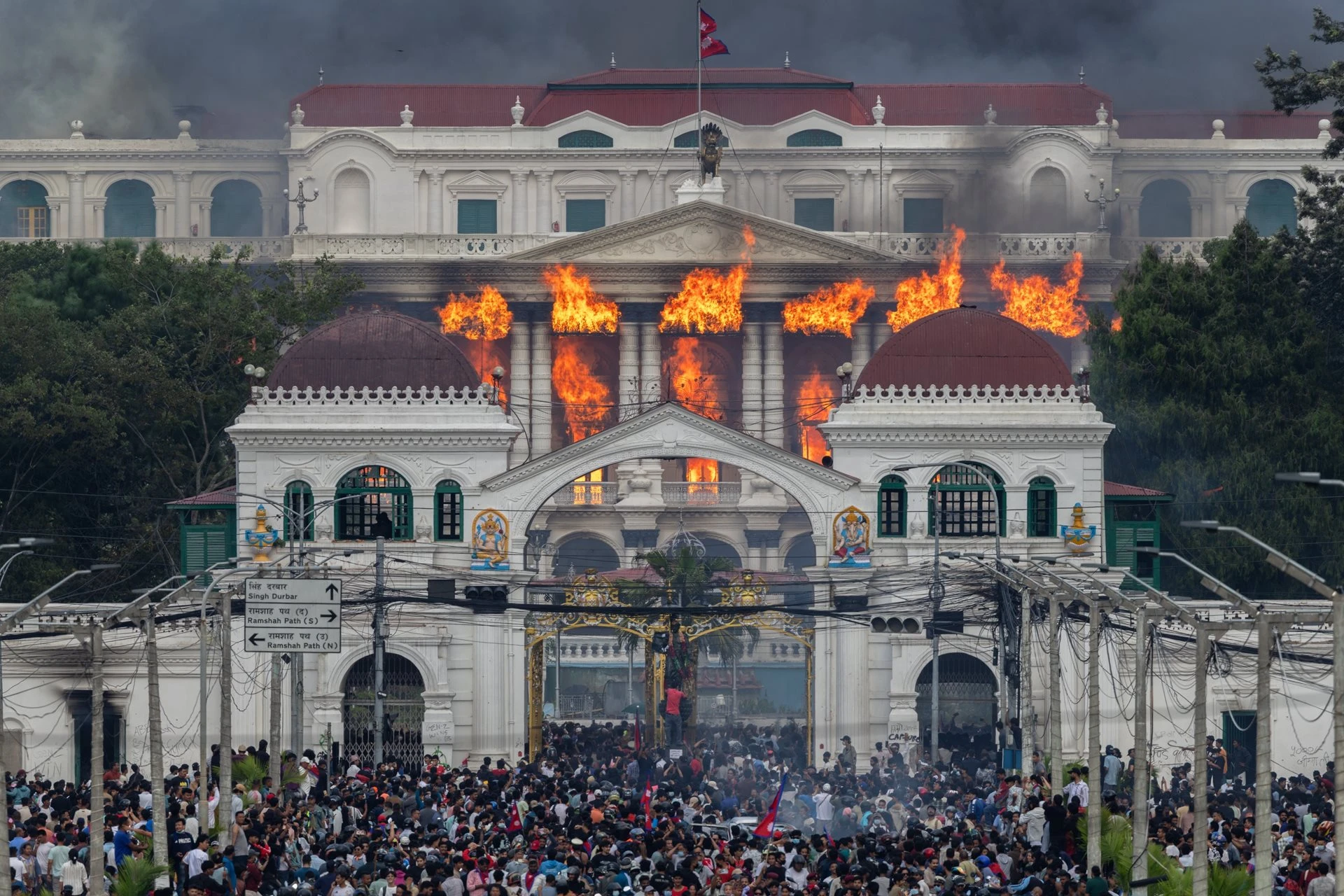
The anniversary: One year ago this week, Gen Z protests burned part of Singha Durbar and forced out a prime minister. Seventy-six people were killed.
The mandate: Balen Shah, a 35-year-old former rapper, was sworn in on 27 March 2026 with 182 of 275 seats.
The test: A glacier collapsed on 26 August. The flood has killed at least 1,385 people across Nepal and Tibet, with more than 5,400 still missing.
The hesitation: Nepal initially held back foreign rescue teams. An industry body says approval came too late.
The pledge: The governing party banned nepotism at its June convention. Its own appointments have tested that within weeks.
The detainees: More than 900 people arrested during last year’s protests are still held on arson-related charges.
Nepal replaced its political class and kept its state. A glacier has since tested the difference, and Latin America has run this experiment three times already.
A mandate without a method
Balen Shah took the prime minister’s oath on 27 March 2026. His Rastriya Swatantra Party holds 182 of the 275 seats in the House of Representatives.
The 5 March election drew more than 800,000 first-time voters on turnout of around 60 percent. Shah is a rapper turned civil engineer turned Kathmandu mayor, and at 35 the youngest prime minister Nepal has had.
A majority is an instrument, not a diagnosis. Nepal’s Gen Z movement never specified which institutions were supposed to change.
Sushila Karki, the former chief justice who ran the country as interim prime minister before handing it to Shah, made the gap explicit on the anniversary. “Even a two-thirds majority in Parliament cannot provide stability if there is no good governance,” she said on 8 September.
Bishnu Raj Upreti of the Nepal Centre for Contemporary Research told Al Jazeera that “leadership change has started. It is good, but not enough.” He added that structural change has to begin with changing laws and writing new ones.
Professor Dinesh Paudel was blunter. “The fundamental concerns and issues raised by the young protestor last year are still the same, and there are no governance style changes even after the new elected government.”
The pledge and the appointments
Within days of the swearing-in, the government appointed Kumar Byanjankar, known as Kumar Ben, as the prime minister’s chief advisor. Shah considers his father, Narsingh Byanjankar, his political mentor.
Kumar’s brother Siddhi Byanjankar became chief advisor to Education Minister Sasmit Pokharel on 1 April. On his first day in office Shah moved his entire Kathmandu city secretariat into the Prime Minister’s Office.
Only in June, at its Chitwan convention, did the Rastriya Swatantra Party pass a resolution banning nepotism and favouritism outright. The vocabulary was the movement’s own.
The appointments that followed came within weeks of that pledge. Kumar’s sister Siddhi Laxmi Byanjankar joined the Calendar Determination Development Committee in early July, and a 68-year-old ally, Kishore Thapa, was named to chair the Tribhuvan University Service Commission without a competitive process.
None of this is illegal, and little of it is unusual in Nepali coalition politics. It is unusual only in whose signature is on it.
Governing by ordinance
The government did move on paper. It published a hundred-point agenda for its first hundred days and set up a commission to investigate former officials’ assets.
It abolished civil-service trade unions. It removed more than 1,500 political appointees through ordinance, without individual legal review.
The method is what critics have seized on. Courts have since released several of the government’s headline detainees, a pattern one Nepali assessment said risked “creating the impression of politically dramatic but legally fragile enforcement”.
More than 900 people arrested during the 2025 protests remain in custody on arson-related charges, with unofficial estimates running past 1,600. A government born of a street uprising is still the jailer of the people who put it there.
Two further episodes never reached the official scorecard. A prime ministerial comment appeared to question Nepal’s border with India and was walked back, and riverbank settlements were cleared in Kathmandu.
Water finds the old cracks
On 26 August 2026 roughly 0.2 square kilometres of ice and rock broke off the Langtang Lirung glacier and fell about 1.2 kilometres. The United States Geological Survey attributed the seismic signal to the collapse itself, not to any earthquake before it.
The impact melted enough ice to send a flood down the Trishuli river system. It destroyed the Gyirong Port border crossing in Tibet within seven minutes.
Nepal’s upstream monitoring stations were swept away before they could send an alert. Debris travelled up to a hundred kilometres downstream.
Five districts lie along the flood path: Rasuwa, Nuwakot, Dhading, Gorkha and Chitwan. The worst destruction was upstream, in Rasuwa and Nuwakot.
In Chitwan, some 160 kilometres downstream, more than 250 bodies washed ashore. Only nine could be readily identified.
A toll that keeps climbing
The United Nations reported roughly 900 dead and 4,247 missing on 31 August. By 4 September Nepali authorities were citing 1,287 dead inside the country.
By 6 September the combined figure had reached at least 1,385 dead, 1,342 in Nepal and 43 in Tibet, with more than 5,400 still missing.
Among the missing are 583 foreign nationals from 39 countries in Nepal, and 261 more from 23 countries in Tibet. At least 17 further bodies have been recovered from rivers in India and are not in the official count.
South Korea sent a response team and one million dollars in aid. Nine of its nationals are missing at a hydropower construction site in Rasuwa.
The hesitation that cost time
Nepal has mobilised some 21,465 security personnel and declared a three-month disaster zone. Relief funds passed 7.77 billion rupees by 3 September, up from 5.44 billion five days earlier.
On paper that is a far better organised response than 2015. In practice the government initially held foreign help at arm’s length.
Finance Minister Swarnim Wagle said aid was accepted “according to the needs on the ground”. Bhim Gautam of the Independent Power Producers Association said the government lacked “enough technology, equipment and expertise”.
Gautam added that late in the week the government approved rescue teams from China, India and Australia. “But it is so late now,” he said.
The analyst Chandradev Bhatta traced the hesitation to 2015, when China and India competed openly for reconstruction influence and China “managed to gain a geopolitical foothold in the country”. A state that spent a decade guarding against foreign leverage built the delay that cost it time in a different emergency.
What this means from Latin America
Rio Times readers have watched this experiment run to its conclusion twice on their own continent.
Chile’s October 2019 estallido social produced an elected Constitutional Convention and a new president in Gabriel Boric. The rewrite the plazas demanded was rejected twice, by 61.87 percent in September 2022 and 55.76 percent in December 2023.
The amended Pinochet-era charter is still in force. The faces changed and the operating system did not.
Peru offers the harsher version. After Pedro Castillo’s December 2022 self-coup collapsed and Dina Boluarte took office, protests demanding early elections were met with force that killed 49 people, including eight children, between December 2022 and February 2023.
Congress rejected every attempt to bring the vote forward. Peru ran the calendar out to 2026 under the same political class the protesters had tried to remove.
Colombia sits between the two. The April 2021 paro nacional forced President Iván Duque to withdraw a tax reform within days, and the disillusionment fed into Gustavo Petro’s election the following year.
Nepal has so far delivered the Chilean pattern rather than the Colombian one. New faces, an unrewritten state, and a flood asking the question a ballot box usually asks first.
More: World news in English, every day from The Rio Times.
Frequently Asked Questions
How old is Balen Shah?
He was born on 27 April 1990. He was 32 when Kathmandu elected him mayor in May 2022 and 35 when he was sworn in as prime minister on 27 March 2026.
What caused the August 2026 floods?
About 0.2 square kilometres of the Langtang Lirung glacier collapsed on 26 August and fell some 1.2 kilometres. The impact melted enough ice to send a flood down the Trishuli river system.
How many people have died?
At least 1,385 as of 6 September, 1,342 in Nepal and 43 in Tibet, with more than 5,400 still missing. The count is still rising.
What sparked the 2025 protests?
Anger at corruption combined with a ban on major social media platforms, since reversed. The demonstrations killed 76 people and forced Prime Minister K.P. Sharma Oli to resign within days.
Has the government kept its anti-corruption promises?
Only partly. It created an asset-investigation commission and abolished civil-service unions, but it has also placed its chief advisor’s relatives in public posts and seen courts release several of its own headline detainees.
Connected Coverage
We track the wider Asian picture in the Asia Intelligence Brief and the daily global read in the Global Economy Briefing.
Sources: Al Jazeera; HimalPress; Kathmandu Post; Nepalnews.com; NPR; UN News; Sharjah24; Britannica on the 2026 Nepal floods; United States Geological Survey; Human Rights Watch on Peru; SERVEL and IFES on the Chilean referendums.
This article was produced by The Rio Times’ automated newsroom system. How we use AI · Report an error · Editorial responsibility: Matthias Camenzind, Editor-in-Chief
Read More from The Rio Times