Drone Attack on Tripoli Fuel Depot Extends a Month of Strikes on Libya’s Oil Lifeline
LIBYA · ENERGY
Key Facts
- —The latest strike A drone targeted the Brega fuel depot on Airport Road in Tripoli on Thursday, September 3; the National Oil Corporation reported no significant damage but began emptying the tanks as a precaution.
- —A month of attacks In August, repeated drone strikes hit the Al-Zawiya refinery complex, including an untreated naphtha storage tank and the oil blending and filling plant of the Al-Zawiya Oil Refining Company.
- —Power knocked out The state electricity company said the 30/11 kV substation in southern Al-Zawiya was attacked on August 12 and burned out completely, deepening blackouts across the west.
- —The official line Prime Minister Abdulhamid Dbeibah called the strikes an escalation that would not go unanswered, and the UN mission demanded an immediate end to armed clashes in Zawiya and Sorman.
- —The repair GECOL has since returned Unit 3 of the Zawiya combined-cycle power plant to the national grid.
The drones have come back to Libya’s fuel system. A month after strikes on the Al-Zawiya refinery and a burned-out power substation, a drone targeted the capital’s main fuel depot last week — and nobody has claimed any of it.
The Tripoli depot attack
Brega Petroleum Marketing Company, the state fuel distributor, said its Tripoli depot on Airport Road came under attack in the early hours of Thursday, September 3, after what it called a flying object, suspected to be a drone, entered the depot’s airspace.
The National Oil Corporation — NOC, the state oil company that owns Brega — condemned what it called an attempt to target fuel storage tanks with a remotely operated drone. It reported no significant damage, but announced a state of full readiness for emergency teams at all its sites and said specialist teams had begun withdrawing fuel from the tanks to lower the risk of a catastrophic fire.
“The targeting of oil facilities anywhere in Libya, in any way, represents a direct threat to the supply system and basic services,” the corporation said, noting the depots feed power plants, hospitals and the daily fuel needs of citizens.
The August campaign against Al-Zawiya
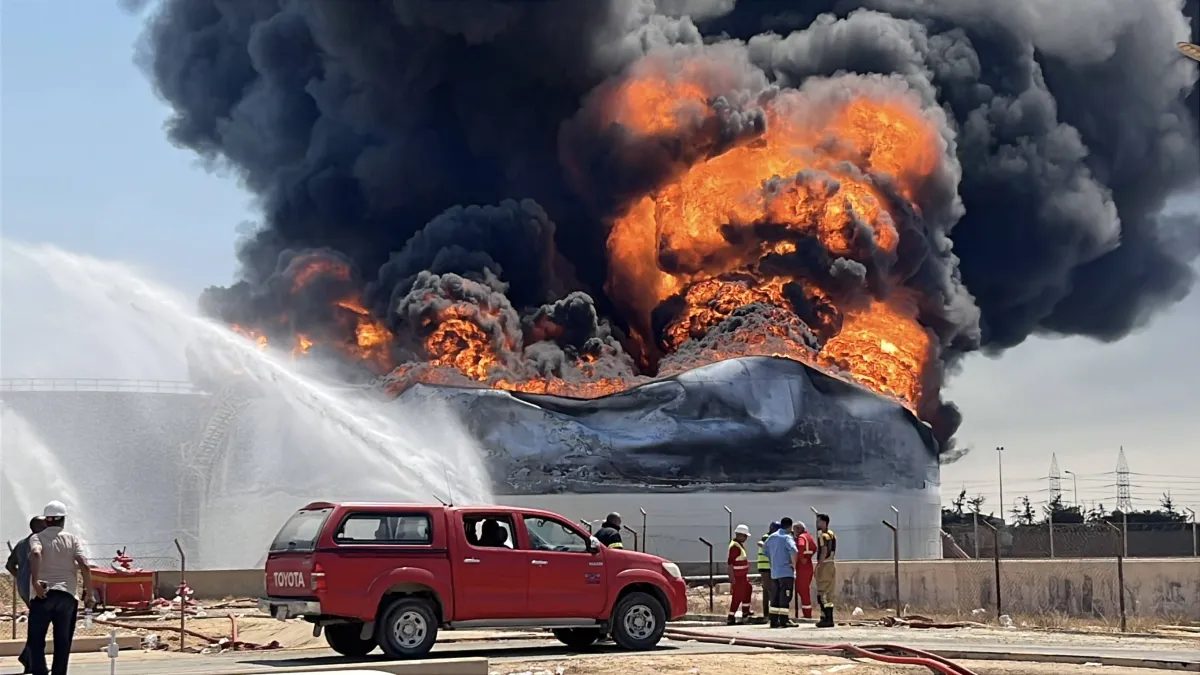
The Tripoli attempt extends a campaign that ran through August against the Al-Zawiya complex, about 40 kilometres west of the capital — at 120,000 barrels a day, Libya’s largest refinery still running. The sequence, as logged by the NOC and the refinery company: a drone crashed into an untreated naphtha storage tank on August 8, causing a leak staff contained; a water desalination unit was hit on August 9; a tank holding about 4.5 million litres of petrol was struck on August 10, caught fire and collapsed; and the oil blending and filling plant of the Al-Zawiya Oil Refining Company was hit in what the NOC called a new drone attack the same night, with further strikes on diesel tanks on August 11.
No group claimed any of the attacks. The NOC warned that if they continued it would declare force majeure — the legal step that suspends supply contracts — and shut the refinery entirely. Prime Minister Abdulhamid Dbeibah called the strikes an escalation and said drone attacks on oil facilities “will not go unanswered”, while his defence ministry promised decisive action, according to Libyan media reports. The government formed a committee to assess the damage.
The substation that burned out
The campaign was not only about oil. On August 12, the General Electricity Company of Libya — GECOL, the state power utility — said the 30/11 kV substation in southern Al-Zawiya had been attacked and burned out completely, knocking out power across southern districts of the city. An explosion at the same substation then cascaded through the grid, blacking out Tripoli, Zawiya, Sabratha, Sorman and Gharyan twice in one night.
General Electric withdrew its engineers from the adjacent 1,300-megawatt power plant, more than 700 megawatts of which was already offline, and said it would stay away until security improves. GECOL warned that continued attacks on the grid could cause partial or total blackouts. This week brought one piece of repair news: GECOL announced that Unit 3 of the Zawiya combined-cycle plant had been returned to service and reconnected to the grid.
The militia war underneath
The strikes sit on top of an armed conflict between factions aligned, loosely, with the Tripoli government itself. Clashes between the Anti-Security Threats Apparatus and the 103rd Battalion rocked Sorman and Zawiya in early August, killing at least four people, closing the coastal highway toward Tunisia and letting prisoners escape from Sorman’s central prison. The road through Sorman reopened after the 52nd Brigade deployed and the municipality declared life was returning to normal.
The UN Support Mission in Libya, UNSMIL, demanded an immediate end to the clashes in Zawiya and Sorman, warning that fighting had damaged the refinery and endangered civilians, and called for an independent and comprehensive investigation. Washington’s adviser Massad Boulos likewise called for comprehensive investigations into the Al-Zawiya violence and the Benghazi assassination of the eastern forces’ intelligence chief in the same week.
Whose drones?
Radio France Internationale reported, after analysing photographs and footage from the Al-Zawiya site, that the attack pattern pointed to Ukrainian-made first-person-view drones guided by fibre-optic cable — weapons that cannot be jammed by conventional means. The report noted that a crashed FPV drone near Tripoli’s airport on August 10 killed a seven-year-old girl, and said suspicion had fallen on armed groups loyal to the Tripoli government. No side has accepted responsibility, and the claims remain unverified.
What to watch: whether the NOC’s precautionary tank-emptying disrupts fuel supply in the capital; whether the damage-assessment committee publishes findings; and whether the promised decisive action against the drone operators ever materializes in a country where, since 2011, such investigations have rarely produced answers.
This report is based on statements by the National Oil Corporation, Brega and GECOL carried by the Libya Observer and Libya Herald; Reuters, Anadolu and Asharq Al-Awsat reporting on the August clashes; a Radio France Internationale investigation cited by the Libya Observer; and UNSMIL and US statements.
Frequently Asked Questions
What was attacked in Tripoli?
The Brega fuel depot on Airport Road, the capital’s main fuel storage site, was targeted by a suspected drone in the early hours of September 3, 2026. The National Oil Corporation said there was no significant damage but began emptying tanks as a precaution.
What happened at the Al-Zawiya refinery in August?
A series of drone strikes between August 8 and 11 hit an untreated naphtha tank, a desalination unit, a petrol tank holding 4.5 million litres that burned and collapsed, and the blending and filling plant. The NOC threatened to declare force majeure and shut the refinery if the attacks continued.
What are the NOC and GECOL?
The National Oil Corporation is Libya’s state oil company and owns the fuel distributor Brega. GECOL, the General Electricity Company of Libya, is the state power utility that runs the national grid.
Who is behind the drone attacks?
No group has claimed responsibility. Radio France Internationale reported indications that Ukrainian-made fibre-optic FPV drones were used and said suspicion had fallen on armed groups aligned with the Tripoli government; the claims are unverified.
Connected Coverage
For our first report on the August strikes, see drones hit Libya’s biggest working refinery as oil output nears a 13-year high. For the political framework this violence threatens, see the 4+4 electoral deal signed by Libya’s rival camps.
This article was produced by The Rio Times’ automated newsroom system. How we use AI · Report an error · Editorial responsibility: Matthias Camenzind, Editor-in-Chief