Key Facts
- Brazil’s CPI prints at midday, with the mid-month IPCA reading expected to show inflation still pressing against the ceiling of the central bank’s target range, keeping the Selic rate firmly at 14.25% for now.
- Asia traded without conviction overnight, with a lack of clear direction from Tokyo and Shanghai leaving European futures largely flat as traders wait for US manufacturing data.
- Durable goods orders in focus, as a rebound above 1.6% in the US headline figure would signal industrial strength, potentially firming the dollar against Latin American currencies.
- Mexico’s trade balance drops early, with a forecast surplus of $2.4bn providing one of the few clear macro signals in the region this morning before the main equity session begins.
- The real closed virtually flat on Friday, with the scanned data showing USD/BRL at 5.0873, a tiny +0.06% move that left the currency down 9% from its 52-week high.
Today’s Focus
Monday’s pre-open hinges on a packed data docket rather than any single overnight market swing. Brazil releases its mid-month IPCA inflation gauge around noon local time, with the market expecting the headline number to print at 0.4% month-on-month. That would keep the annual rate uncomfortably high, near 4.9%, reinforcing the view that the Banco Central do Brasil will keep the Selic rate at 14.25% for a while yet.
Before that, traders will chew on Mexico’s trade balance for June. A reading around the $2.4bn surplus estimate would suggest external accounts remain healthy, offering some support to the peso even if US trade rhetoric rattles sentiment later in the week. Meanwhile, Colombia and Chile face a quiet morning on the domestic indicator front, leaving their currencies sensitive to the external tape.
The US calendar provides the main external pulse. Durable goods orders for June are due early in the New York morning, and any upside surprise could lift the dollar by reinforcing the narrative of American economic resilience. Later in the day, a slew of regional Fed manufacturing surveys and a US 2-year note auction will shape bond markets, with spillover into carry-trade currencies like the Mexican peso and the Brazilian real.
Across the region, Friday’s close left a mixed picture. Brazil’s Ibovespa slipped again, underperforming a flat S&P 500, while the Merval in Buenos Aires edged lower by more than 1%. The Colombian peso was barely changed against the dollar, and traders will watch to see if that calm holds through a morning with several moving parts.
What matters today. Whether Brazil’s mid-month inflation print and Mexico’s trade figures give local markets enough domestic cushion to ignore a potentially firming dollar on the back of strong US durable goods orders.
| Instrument | Level | Session |
|---|---|---|
| USD/COP | 3,212.65 | -0.03% |
Latin American markets — Source: RT close, 2026-07-24. Figures rendered directly from the feed.
01 The overnight tape in one read
Overnight trade felt like a waiting room. Asian equity benchmarks, including Japan’s Nikkei 225 and the Shanghai Composite, lacked firm direction, with futures for the Euro Stoxx 50 and the FTSE 100 pointing to a broadly flat open for Europe. Without a fresh catalyst from across the Pacific, traders on the Latin American desk will have little to go on from the screen alone.
The commodity board is equally quiet. Brent and WTI crude prices are steady in early electronic trade, offering no jolt for oil-heavy bourses in Brazil, where Petrobras dominates turnover, or in Colombia, where Ecopetrol carries weight. Iron ore, crucial for Vale and the Ibovespa’s materials bloc, was not flashing any large moves in the early Asian window.
The US dollar is parked roughly where it ended Friday against major peers. US Treasury yields are similarly becalmed ahead of today’s durable goods orders and the 2-year note auction. This lack of energy leaves Latin American currencies opening where they left off, with the real, the Mexican peso and the Colombian peso awaiting the data triggers scheduled through the day.
The balance of evidence suggests a guarded open. Brazil’s slowing growth and persistent inflation create a tricky domestic backdrop, while the Merval’s Friday dip hints at pre-election repositioning in Argentina. Unless the US data severely disappoints, a slightly firmer dollar could prevail, squeezing regional carry trades. Watch the Mexico trade balance as the earliest intraday steer, then IPCA at noon Brasília time for the main direction on the real and the Ibovespa.
02 The board before the open
| Instrument | Level | Change | Read |
|---|---|---|---|
| USD/BRL | 5.0873 | +0.06% | Real steady, eyes on CPI |
| Merval | 3,283,854 | −1.07% | Buenos Aires slipped on Friday |
| COLCAP | 2,275 | −0.38% | Colombia drifted lower |
| USD/COP | 3,212.65 | −0.09% | Peso little changed |
Friday’s board provided a sober entry point. Brazil’s benchmark stock index, the Ibovespa, extended its losing streak to two straight sessions, falling 1.52% and leaving it more than 12% below its 52-week high. This underperformance was stark against a virtually flat S&P 500, which edged up just 0.05%.
Argentina’s main stock index, the Merval, shed over 1%, indicating some domestic repositioning likely tied to fiscal and electoral news flow rather than a global risk-off wave. In contrast, Mexico’s Mexbol index managed a small 0.21% gain, showing resilience near the end of last week. Colombia’s COLCAP weakened slightly, while the peso barely budged. Rio Times · Live Market Intelligence
Live Market IntelligenceLatin America — Cross-Market Board
Latin America — Cross-Market Board
Instrument Last Change YoY Prev. High Low Volume
IBOV
187,143.75
+0.43%
+21.85%
186,340.46
168,310
167,142
—
IPSA
10,859.41
-1.00%
—
10,969.49
11,210
10,984
1,513,213,483
IPC MEX
64,214.36
-1.38%
+12.17%
65,110.57
66,121
65,405
108,886,187
MERVAL
2,819,323
+0.00%
+30.51%
3,022,485
3,042,365
2,991,150
—
COLCAP
2,549.16
-0.38%
—
9.04
9.05
9.02
4,133
BVL PERÚ
60,410.88
-0.96%
—
—
—
—
—
USD/BRL
5.16
+0.01%
-5.13%
5.16
5.18
5.14
—
EUR/BRL
5.95
+1.01%
-5.83%
5.89
5.98
5.94
—
USD/MXN
17.06
-0.24%
-8.58%
17.10
17.08
17.01
—
USD/CLP
913.98
+0.04%
-5.67%
913.65
915.11
906.68
—
USD/COP
3,140
+0.03%
-22.04%
3,139
3,141
3,105
—
USD/PEN
3.36
-0.66%
-4.82%
3.38
3.38
3.35
—
USD/ARS
1,493
+0.10%
+12.96%
1,491
1,494
1,480
—
USD/UYU
40.27
+1.24%
+1.80%
39.77
40.27
40.23
—
USD/PYG
5,939
+1.68%
-19.54%
5,841
5,939
5,925
—
USD/BOB
11.64
-0.76%
+72.04%
11.73
11.72
11.64
—
USD/DOP
58.34
+1.25%
-3.44%
57.62
58.34
58.04
—
USD/CRC
445.92
+0.89%
-9.71%
441.97
448.50
445.92
—
03 What the data shows — gainers were led by education and telecoms
| Stock | Move | Turnover | Note |
|---|---|---|---|
| YDUQ3 | +3.0% | R$48m | Education firm led advancers |
| CVCB3 | +2.3% | R$25m | Tour operator bounced |
| VIVT3 | +2.2% | R$133m | Telecom heavyweight gained |
| ISAE4 | −7.2% | R$292m | Largest decliner on heavy volume |
| PETR4 | — | R$1230m | Petrobras dominated turnover again |
The standout gainers on Brazil’s B3 exchange were a mixed bag of consumer-driven and defensive names. Educação Yduqs, ticker YDUQ3, rose 3% on modest turnover of R$48m, while tour operator CVC Brasil, CVCB3, added 2.3%. Telecom firm Telefônica Brasil, trading as VIVT3, put on 2.2% with a hefty R$133m in volume, suggesting institutional buying.
The pain was concentrated in a handful of names where turnover spiked. ISA Energia, ISAE4, plunged 7.2% on R$292m in volume, making it the clear loser of the day. Petrobras preferred shares, PETR4, were not the largest mover but were easily the most active instrument on the exchange, shifting R$1.23bn, followed by the iron-ore giant Vale, VALE3, at R$650m. The heavy trading in commodity majors suggests foreign traders were actively repositioning.
04 Brazil and the currencies
The real is holding steady just above the 5.08 mark against the dollar, a level that has become the de facto equilibrium while the market waits for fresh inflation data. Today’s IPCA mid-month print, expected at 0.4%, will be the immediate test. If the number overshoots, the market will likely push back any expectations of a Selic cut, keeping the real supported by the wide interest-rate differential.
With the Selic at 14.25%, the carry trade remains firmly in the real’s favour—on paper. Investors can earn the high local rate while funding in yen or euros. But the slowing economy, flagged by the World Bank’s forecast of just 1.6% GDP growth in 2026, makes the yield look riskier. If the IPCA print suggests inflation is stickier than hoped, the central bank is cornered: cutting too early risks a weaker real, which would feed back into even higher consumer prices.
Across the rest of the region, currencies are hostage to the dollar’s broader tone. The Mexican peso will take early cues from the trade balance, while the Colombian peso, which barely moved on Friday, is adrift without a local anchor. Chile’s peso, for which the scan provided no fresh data, will likely track copper prices and flows ahead of tomorrow’s central bank rate decision.
05 The regional setup
| Index | Country | Change |
|---|---|---|
| Ibovespa | Brazil | −1.52% |
| Mexbol | Mexico | +0.21% |
| Merval | Argentina | −1.07% |
| COLCAP | Colombia | −0.38% |
The last session’s scoreboard showed a region tilted slightly downward, with only Mexico resisting the pull. The Ibovespa, Brazil’s main stock index, was the weakest link, falling hard enough to sit 12.4% below its 52-week high. That leaves the index in a technical correction from its peak, a fact not lost on foreign allocators trimming exposure.
Argentina’s Merval also disappointed, despite the country’s ongoing programme of economic stabilisation that has drawn headlines. The decline suggests profit-taking or rotation out of a market that has been a strong performer this year.
06 The technical picture
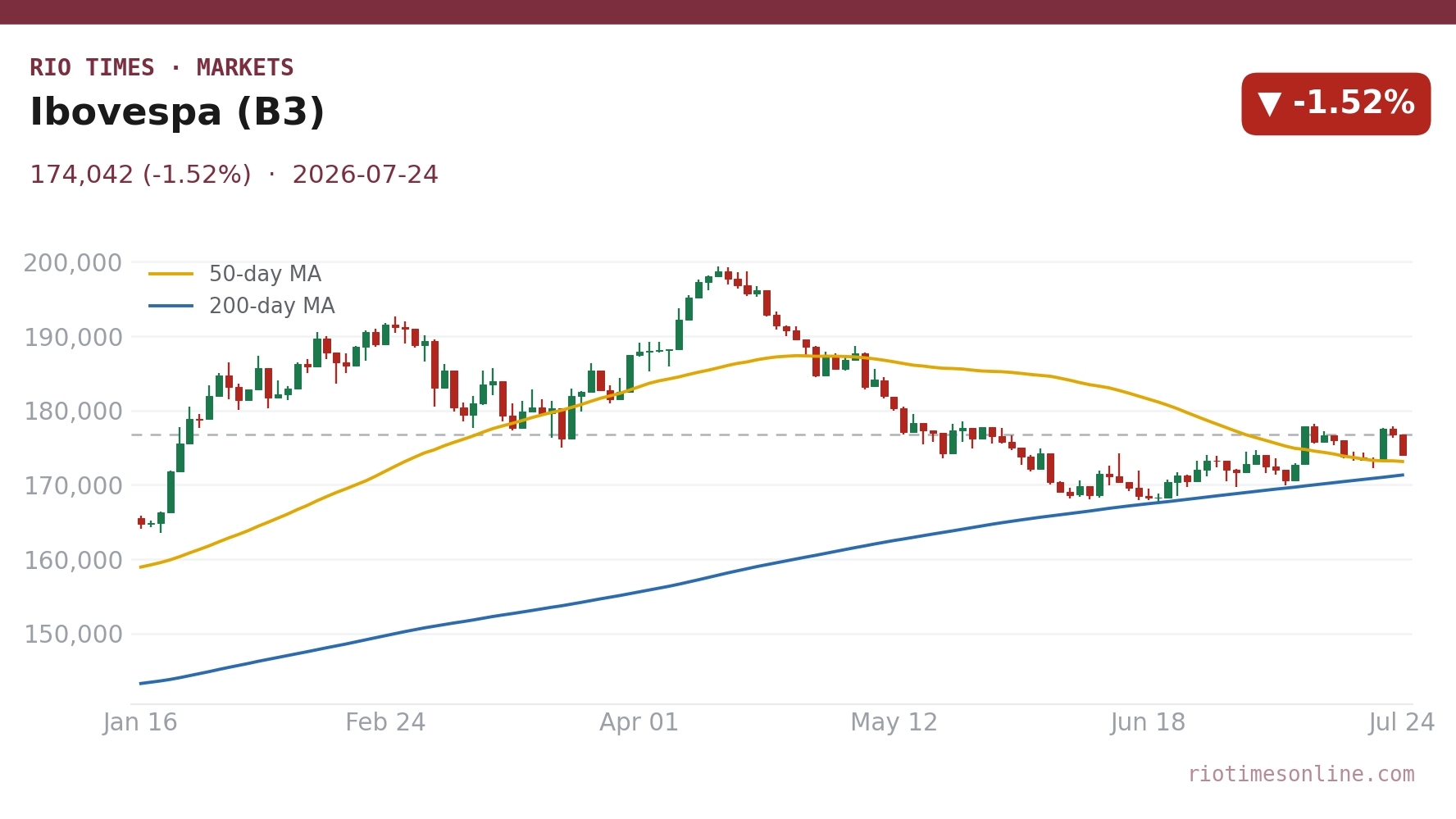
The Ibovespa is nursing two straight daily losses and has broken below several short-term moving averages. With a 52-week trading band running from 132,129 at the low to 198,657 at the high, the index at 174,042 sits in the middle of its annual range, but the momentum is pointing the wrong way. The next support level to watch is the previous swing low near the 170,000 mark.
The Merval, despite a single down day, remains within sight of its historic highs. Technically, a drop of just over 1% on a Friday is not alarming, but it bears watching if the selling continues into the new week as pre-election positioning ramps up.
Mexico’s Mexbol is a different story. Its 0.21% gain on Friday, though small, kept it in a relatively constructive consolidation pattern. The index is holding above the 66,000 level, and its proximity to the 71,601 52-week high suggests it remains the regional outperformer on a trend basis, albeit lacking the volume for a decisive breakout just yet.
07 What to watch
- Brazil IPCA CPI: The mid-month print lands at noon Brasília time. Anything above the 0.4% estimate argues the Selic stays at 14.25% for months, supporting the real but hurting growth stocks.
- Mexico trade balance: A surplus near $2.4bn would signal solid external demand and steady remittance flows, giving the peso a domestic anchor in a day dominated by US data.
- US durable goods orders: If the headline figure rebounds more than the forecast 1.6%, the dollar could jump. That would hit the entire regional FX complex, especially the Chilean and Colombian pesos.
- Dallas Fed manufacturing: A regional factory index that often gives an early scent of US industrial demand for Latin American raw materials. A weak reading would pressure commodity exporters.
Frequently Asked Questions
Why is the Selic rate so high?
Brazil’s central bank has kept its benchmark Selic rate at 14.25% to fight inflation that has been pressing against the upper bound of the 1.5% to 4.5% target range. High rates attract foreign capital, supporting the real, but they also slow the economy by making credit expensive.
What does the IPCA mid-month CPI tell us?
The IPCA is Brazil’s main inflation gauge, measuring consumer prices. The mid-month version, published today, gives an early, real-time picture of price pressures before the full-month data. It is one of the key numbers the Banco Central do Brasil watches.
How is the Mexican peso trading?
The scan did not provide a live quote for USD/MXN this morning, but Friday saw a broadly steady dollar against emerging-market currencies. Today’s direction will be shaped by the domestic trade balance and the US durable goods report.
Why did Brazil’s stock market fall on Friday?
The Ibovespa lost 1.52% while Wall Street was flat, driven largely by heavy selling in a handful of names such as ISA Energia, which dropped 7.2%. The decoupling suggests local, stock-specific concerns outweighed the stable external backdrop.
This article was produced by The Rio Times’ automated newsroom system. How we use AI · Report an error
LatAm Markets: Live Signals → — real-time movers, turnover leaders and FX across Latin America.
Read More from The Rio Times