Key Facts
- Chile’s central bank decides tonight, with economists in the Bloomberg survey nearly unanimous that the board holds the key rate at 4.5% amid sticky services inflation and a soft peso.
- Brazil’s mid-month IPCA-15 lands at noon São Paulo, seen easing to 0.19% monthly and 4.67% annually (from 0.41% and 4.8%), still well above the 3% target.
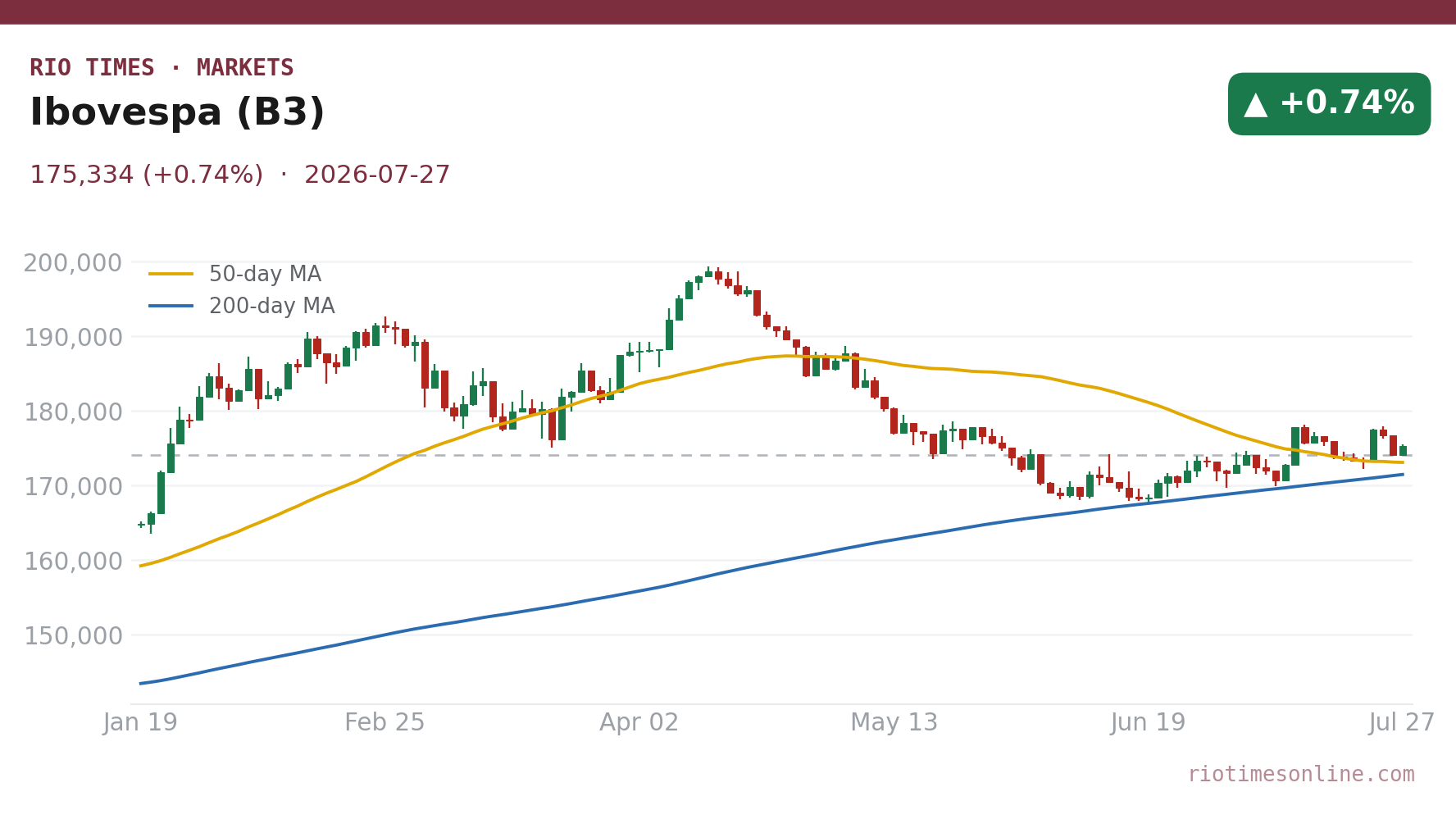
- Monday’s regional boards were constructive, led by Mexico’s IPC +1.20% to 67,183, with Brazil’s Ibovespa +0.74% to 175,334 and the Merval +0.65%.
- The real weakened 0.64% to 5.1168 per dollar and will move instantly on any surprise in the Brazilian inflation print.
- WTI crude slipped below US$72 on expectations of another US inventory build, with the Federal Reserve’s Wednesday decision the week’s main event.
Today’s Focus
The Latin American pre-open is shaped by a pair of local macro events that land before the big one — the US Federal Reserve’s Wednesday rate call. Chile’s central bank finishes its two-day meeting late tonight, and virtually every economist in the Bloomberg survey expects the board to leave the key rate unchanged at 4.5%. Sticky services inflation and a peso that has weakened on and off through July have tied the bank’s hands, even as growth cools. A surprise cut would be the shock of the month and would lift everything from Santiago retail stocks to the local bond market.
Before that, Brazil drops its mid-month IPCA-15 inflation print at noon São Paulo time. The consensus sees the monthly figure easing to 0.19% from 0.41% and the annual pace slipping to 4.67% from 4.8%. That is still well above the 3% target, but a softer print would give Copom room to extend the Selic cutting cycle it resumed in June. The real — which weakened 0.64% in Monday’s session to 5.1168 per dollar — will move instantly on any deviation from the estimate.
Monday’s equity session was quietly constructive. Mexico’s IPC rose 1.20% to 67,183, leading the five regional boards. Brazil’s Ibovespa added 0.74% to 175,334, with industrial stocks outperforming while oil producers slumped. The Merval in Buenos Aires picked up 0.65% in a low-volume session where attention stayed on the crawling-peg peso. Chile’s IPSA was nearly flat, up 0.12%, as traders held fire ahead of tonight’s rate decision. Colombia’s COLCAP edged up 0.37% with little drama.
Overnight, Asian equities were mixed. Tokyo and Sydney futures edged lower while Hong Kong found a small bid, but nothing on the tape looked like a macro conviction trade. European futures are pointing to a slightly softer open as bund yields tick higher after a disappointing German import-price print. The dollar index is essentially flat, and West Texas Intermediate crude slipped below $72 on expectations of another US inventory build. For Latin America, the morning is about two local numbers — the IPCA in Brazil and the rate call in Chile — with Wednesday’s Fed decision a low-hum background noise that could turn into a roar if Chair Powell surprises on the hawkish side.
What matters today. Local macro dominates the pre-open — Brazil’s IPCA-15 inflation print at noon and Chile’s rate decision tonight will set the regional mood before the Fed takes over on Wednesday.
| Instrument | Level | Session |
|---|---|---|
| Ibovespa (Brazil) | 175,334 | +0.74% |
| S&P 500 (US) | 7,413 | +0.02% |
| USD/BRL | 5.1168 | +0.64% |
| USD/MXN | 17.451 | -0.19% |
| USD/CLP | 939.85 | -0.95% |
| USD/COP | 3,217 | +0.00% |
| USD/ARS | 1,497 | +0.03% |
Latin American markets — Source: RT close, 2026-07-27. Figures rendered directly from the feed.
01 The overnight tape in one read
Asia handed Wall Street a muted handover. Tokyo shares traded either side of flat with the yen steady around 144 per dollar, while Hong Kong’s Hang Seng added a few tenths of a percent on light volumes. No major data crossed the wires during the Asian shift, and the mood was one of waiting — waiting for the Fed, waiting for US earnings, waiting for any reason to commit capital.
European futures slipped as German 10-year bund yields edged up a couple of basis points after import-price data came in below expectations. Germany’s import-price index rose 6.2% year-on-year, a touch softer than the 6.8% consensus, and the month-on-month reading dropped 0.8% — a sign that pipeline inflation is cooling faster than expected. The euro traded little changed against the dollar, keeping the shared currency inside the narrow band it has occupied all month.
US futures were effectively flat at the time of writing, with S&P 500 contracts down less than a tenth of a percent. The US Treasury will auction seven-year notes later today, and traders will scrutinise the bid-to-cover ratio for any sign that the recent yield drift higher is attracting real-money buyers. The Richmond Fed manufacturing index is the only data point of note on the US calendar before Wednesday’s Fed decision, where the consensus firmly expects the benchmark rate to stay at 3.75%.
Oil was the main mover in the overnight session. West Texas Intermediate slipped below $72 a barrel after the American Petroleum Institute was expected to report a crude stock build of around 1.5 million barrels later tonight. If the API data confirms a build, it would be the third consecutive weekly increase, putting downward pressure on Brent at a time when China demand concerns are already capping the upside.
The weight of evidence points to a morning session driven almost entirely by domestic data. Chile is a high-confidence hold at 4.5% — every economist in the survey says so — but the IPSA and the Chilean peso will move on the accompanying statement’s tone. If the central bank warns that inflation is re-accelerating, rate-cut hopes for the fourth quarter will evaporate and the peso could weaken toward 940 per dollar. Brazil’s IPCA-15 is the higher-volatility event. A print below the 0.19% consensus would reinforce the narrative that Copom can deliver another cut in August and likely push the Ibovespa’s industrial and consumer-discretionary names higher. A print above 0.25% would be an ugly surprise that snaps the real weaker and punishes rate-sensitive stocks. The variable to watch is the IPCA-15 services-core print — the number Copom has flagged as its main concern — because even a soft headline won’t rescue sentiment if the core proves sticky.
02 The board before the open
| Instrument | Level | Change | Read |
|---|---|---|---|
| Ibovespa | 175,334 | +0.74% | Gain led by industrials; Petrobras shares a drag |
| IPC (Mexico) | 67,183 | +1.20% | Strongest regional board; broad-based buying |
| IPSA (Chile) | 10,964 | +0.12% | Flat ahead of tonight’s rate decision |
| Merval (Argentina) | 3,305,316 | +0.65% | Low-volume drift higher; currency-crawling-peg trade |
| COLCAP (Colombia) | 2,283 | +0.37% | Quiet session with no local catalysts |
| S&P 500 | 7,413 | +0.02% | Barely moved; all eyes on Wednesday’s Fed call |
| USD/BRL | 5.1168 | +0.64% | Real softer ahead of IPCA-15 print |
| USD/MXN | 17.451 | −0.19% | Peso firmed; support from carry-trade flows |
| USD/CLP | 939.85 | −0.95% | Peso rallied into rate decision; best currency on the day |
Monday’s board shows a region that edged higher without fireworks, with every one of the five domestic equity indices posting a gain. Mexico’s IPC — the main stock benchmark in Mexico City — was the clear standout, climbing 1.20% in a session where the peso also firmed slightly against the dollar. The move did not come on any single news event, but traders noted renewed appetite for Mexican equities from foreign accounts after a month of cautious positioning.
Chile’s IPSA was the quietest board, up just 0.12%, and that makes sense — no one wanted to bet aggressively on Santiago equities with the central-bank rate decision landing tonight. The Chilean peso was, however, the best-performing currency on the regional table, strengthening nearly a full percent against the dollar to 939.85, which suggests some positioning for a hawkish hold or at least language that keeps the rate at 4.5% for longer than the market currently prices. Rio Times · Live Market Intelligence
Live Market IntelligenceLatin America — Cross-Market Board
Latin America — Cross-Market Board
Instrument Last Change YoY Prev. High Low Volume
IBOV
187,206.89
-0.56%
+21.85%
188,268.59
168,310
167,142
—
IPSA
11,220.60
-0.16%
—
11,238.58
11,210
10,984
1,513,213,483
IPC MEX
63,924.77
-0.28%
+12.17%
64,106.82
66,121
65,405
108,886,187
MERVAL
3,098,898
-1.87%
+30.51%
3,022,485
3,042,365
2,991,150
—
COLCAP
2,589.69
-1.41%
—
9.04
9.05
9.02
4,133
BVL PERÚ
59,373.28
-0.32%
—
—
—
—
—
USD/BRL
5.16
+0.01%
-5.13%
5.16
5.18
5.14
—
EUR/BRL
5.95
+1.01%
-5.83%
5.89
5.98
5.94
—
USD/MXN
17.06
-0.24%
-8.58%
17.10
17.08
17.01
—
USD/CLP
913.98
+0.04%
-5.67%
913.65
915.11
906.68
—
USD/COP
3,140
+0.03%
-22.04%
3,139
3,141
3,105
—
USD/PEN
3.36
-0.66%
-4.82%
3.38
3.38
3.35
—
USD/ARS
1,493
+0.10%
+12.96%
1,491
1,494
1,480
—
USD/UYU
40.27
+1.24%
+1.80%
39.77
40.27
40.23
—
USD/PYG
5,939
+1.68%
-19.54%
5,841
5,939
5,925
—
USD/BOB
11.64
-0.76%
+72.04%
11.73
11.72
11.64
—
USD/DOP
58.34
+1.25%
-3.44%
57.62
58.34
58.04
—
USD/CRC
445.92
+0.89%
-9.71%
441.97
448.50
445.92
—
03 What the data shows — industrials and Embraer led São Paulo while Petrobras slumped
| Stock | Move | Turnover | Note |
|---|---|---|---|
| MBRF3 | +7.1% | R$145m | Moura Dubeux-homebuilder; extended rally |
| TOTS3 | +7.0% | R$192m | Totvs-software; broke above recent trading range |
| CSNA3 | +6.5% | R$66m | Siderúrgica Nacional-steel; sector rotation play |
| EMBJ3 | +5.3% | R$514m | Embraer; strong foreign flow and defence-demand optimism |
| PETR4 | −2.8% | R$1,345m | Petrobras-pref; heaviest turnover on B3; oil-weight drag |
| PRIO3 | −5.3% | R$394m | Prio-oil junior; crude-price sensitivity |
The B3 scan tells a clear story of sector rotation. The six biggest gainers included a homebuilder, a software company, a steelmaker, and Embraer — the aircraft manufacturer whose shares jumped 5.3% on turnover of R$514 million. Embraer has now run well above its 52-week average and is drawing foreign institutional flow on a thesis that defence spending budgets in Europe and Asia will keep rising. Totvs, the enterprise-software firm, jumped 7% on R$192 million in turnover, breaking above a trading range that had held for weeks.
On the losing side, oil was the pain trade. Prio, the independent oil producer, dropped 5.3%, and both Petrobras share classes fell — the preferred shares lost 2.8% and the common shares 3.2%. Between them, Petrobras moved over R$1.6 billion in turnover, making the state-controlled oil giant the heaviest-traded story on the day. The slide mirrors the overnight drift lower in crude and suggests some positioning risk ahead of the API inventory data due tonight. Vale, the mining heavyweight, turned over R$825 million but did not make either the top-gainer or top-loser list, indicating a holding pattern before the next move in iron ore futures.
04 Brazil and the currencies
The real gave back some ground on Monday, weakening 0.64% to 5.1168 per dollar, but it remains well inside the 4.89-to-5.59 range that has contained it for months. The move was largely a positioning adjustment ahead of today’s IPCA-15 mid-month inflation reading, the data point that will set the tone for Copom’s August meeting. The Selic — the central bank’s benchmark rate — currently sits at 14.25% after the third straight 25-basis-point cut delivered in June, and the market is pricing a roughly 60% chance of another cut in August if inflation cooperates.
The mid-month CPI print is expected to show the headline slowing to 4.67% year-on-year from 4.8%, with the monthly rate dropping to 0.19% from 0.41%. Those are moves in the right direction, but Copom has been explicit that services-core inflation — a measure that strips out volatile items like food and energy — is the number that matters most. If that core print stays sticky, the central bank’s post-meeting minutes from June made clear that the committee would not hesitate to pause the cutting cycle, even with growth running below potential. The World Bank’s latest forecast puts Brazil’s GDP growth at just 1.6% for 2026, down from 3.4% in 2024, so the tension between a slowing economy and stubborn inflation is the central macro debate for anyone trading the real or the Ibovespa.
Across the rest of the region, currencies had a mixed but generally quiet session. The Mexican peso firmed 0.19% to 17.451 per dollar, continuing to attract carry-trade flows as Banxico — Mexico’s central bank — keeps rates elevated while the Fed’s cutting cycle remains on pause. The Chilean peso was the standout, rallying 0.95% to 939.85, a move that likely reflects local-positioning squaring ahead of tonight’s rate decision. The Colombian peso was unchanged at 3,217 per dollar, and the Argentine peso barely moved at 1,497 in the official market, with the parallel blue-chip swap rate continuing to tell a different story about real demand for Argentine-peso exposure.
05 The regional setup
| Index | Country | Change |
|---|---|---|
| IPC | Mexico | +1.20% |
| Ibovespa | Brazil | +0.74% |
| Merval | Argentina | +0.65% |
| COLCAP | Colombia | +0.37% |
| IPSA | Chile | +0.12% |
Mexico led the region on Monday with a session that felt more like a catch-up trade than a conviction rally. The IPC — the Mexican stock exchange’s main index — added 1.20%, and the gains were spread across sectors rather than concentrated in a single group. The bourse is now trading about 6% below its 52-week high of 71,601, and some fund managers have started arguing that Mexican equities are pricing in too much US-tariff risk given that the actual trade-policy noise from Washington has been quieter than feared.
Brazil’s Ibovespa is in a different spot. The index closed at 175,334, which is nearly 12% below its 52-week high of 198,657, making it the worst-performing regional board relative to its own recent peak. The gap reflects a cocktail of high domestic rates, fiscal-uncertainty ahead of the election cycle, and the drag from commodity-heavy names that dominate the index. Argentina’s Merval continues to trade more as a currency-proxy than a pure equity play — the 0.65% gain on Monday was less about corporate fundamentals and more about the crawling-peg devaluation schedule that keeps the official peso on a predictable path. Chile’s IPSA and Colombia’s COLCAP were both essentially marking time, with neither market offering a catalyst strong enough to draw fresh money before the week’s central-bank news flow.
06 The technical picture
The Ibovespa’s 0.74% gain on Monday keeps the index inside the consolidation band that has defined July, with 175,000 acting as a near-term magnet. The 52-week range is wide — 132,129 on the low end to 198,657 on the high — and the index is currently closer to the middle of that band than to either extreme. A break above 178,000 would open a path to the 180,000 round-number handle, but that likely requires a softer-than-expected IPCA-15 print and a dovish read on the Fed’s Wednesday statement. Support sits at 172,500, the intraday low from the previous week.
Mexico’s IPC is the technically cleaner chart. Monday’s move took it to 67,183, clearing the 67,000 level that had acted as resistance in the second half of July. The 52-week high of 71,601 is now the next obvious target, though volumes will need to pick up to confirm the breakout. Chile’s IPSA is pinned near 10,964 with support at 10,800 and resistance at 11,100 — a tight range that is unlikely to break before tonight’s rate decision gives the market a reason to move. The real at 5.1168 per dollar is mid-range, and the 5.05-to-5.18 band is the short-term zone to watch around the IPCA release.
07 What to watch
- Brazil IPCA-15 (noon São Paulo time): Every decimal matters. A print below 0.19% month-on-month would stoke August-cut hopes and lift rate-sensitive stocks like homebuilders and retailers. A print above 0.25% would be a gut-punch for the real and the Ibovespa.
- Chile rate decision (10pm São Paulo time): A hold at 4.5% is the base case, but the statement’s language on services inflation and the peso will dictate whether the IPSA rallies or retreats. A hawkish surprise — signalling no cuts in 2026 — would be genuinely market-moving.
- API US crude inventory (tonight): Another stock build would push WTI closer to $70 and weigh on Petrobras, Prio and the broader energy complex across the region. A surprise draw would offer relief.
- Fed pre-positioning flows: With Wednesday’s Fed decision now 24 hours away, any shift in fed-funds futures pricing — especially around the dot-plot expectations — will ripple through the dollar and hit the real, the peso and the sol in tandem.
Frequently Asked Questions
What is the IPCA-15 and why does it matter?
It is Brazil’s mid-month consumer-price index, an early read on inflation that the central bank watches closely. Because it comes out two weeks before the full-month IPCA, it is the first hard inflation data point that can shift Selic-rate expectations, and it moves the real and the Ibovespa instantly.
Why is Chile’s rate decision important for the whole region?
Chile is one of Latin America’s most liquid markets and a bellwether for how regional central banks balance growth and inflation. If the Chilean central bank signals it cannot cut rates because inflation is sticky, it raises the bar for rate cuts in Colombia and Peru as well.
How does the Fed affect Latin American markets?
The US federal funds rate sets the floor for global dollar liquidity. When the Fed is hawkish — keeping rates high — it strengthens the dollar, making Latin American currencies and equities less attractive to foreign investors. A dovish Fed does the opposite, releasing a wave of carry-trade flows into markets like Brazil and Mexico.
What do the BDRs and CEDEARs in the scan mean?
BDRs on B3 and CEDEARs in Buenos Aires are receipts that track foreign stocks — mostly US names like Apple or Tesla — and their moves are driven by the underlying US share price multiplied by the exchange rate. They are not domestic-company stories and should be read as currency-and-US-tape proxies.
This article was produced by The Rio Times’ automated newsroom system. How we use AI · Report an error
LatAm Markets: Live Signals → — real-time movers, turnover leaders and FX across Latin America.
Read More from The Rio Times