Grenada Carriacou Commissions Two 100,000-Gallon Tanks

CARIBBEAN · GRENADA
Key Facts
- —The country Grenada is a three-island state in the eastern Caribbean. Carriacou and Petite Martinique are its two smaller sister islands, north of the main island.
- —What happened The government said on 3 October 2026 that two new 100,000-imperial-gallon water tanks, at Mt Royal and Belair on Carriacou, had been commissioned under the G-CREWS climate project.
- —The numbers The Green Climate Fund has paid out US$40.04 million in grants to the project since 2020, its project page shows. Co-financing brings the total to about US$47.7 million.
- —What it means for you Carriacou should be better protected against dry taps in droughts and storms. Two clinics there also gained water cisterns, the ministry said.
- —Still open The ceremony date, the cost of the Carriacou works and the timeline for a further desalination plant were not given. The project’s listed end date, 25 November 2025, has passed.
Grenada has commissioned new water infrastructure on Carriacou, the larger of its two sister islands. The works were built under G-CREWS, a climate project paid for mainly by the Green Climate Fund (GCF).
The Ministry of Carriacou and Petite Martinique Affairs announced the commissioning on Saturday 3 October 2026, via NOW Grenada. Its centrepiece is two storage tanks of 100,000 imperial gallons each, at Mt Royal and Belair.
What was commissioned on Carriacou
The ceremony was held on the grounds of the Princess Royal Hospital in Belair, the ministry said. Each tank holds about 455,000 litres, stored for dry spells and storms.
Tevin Andrews, the minister for Carriacou and Petite Martinique affairs and local government, recalled the 2010 drought that hit the islands hard. He said the tanks leave the sister islands far better prepared for natural disasters.
Health Minister Phillip Telesford said new cisterns now serve the Windward Medical Station and the L’Esterre Medical Centre. They are meant to keep both clinics running safely all year.
Todd LaBarrie, acting manager of the state water utility Nawasa, said a further desalination plant is being set up on the island. Such a plant turns seawater into drinking water.
Project development specialist Natasha Joseph said 18 farmers on the two islands received irrigation kits, shade houses and water systems. That support came through the project’s Challenge Fund for Agriculture, run by the Grenada Development Bank.
Who pays for the project
G-CREWS stands for Climate-Resilient Water Sector in Grenada. Germany’s development agency GIZ runs it with Grenada’s government, the National Water and Sewerage Authority (Nawasa) and the Grenada Development Bank.
The GCF project page shows US$40.04 million in grants, fully paid out in four tranches between 2020 and 2024. Co-financing of US$7.68 million, including from Germany’s International Climate Initiative, brings the total to about US$47.7 million.
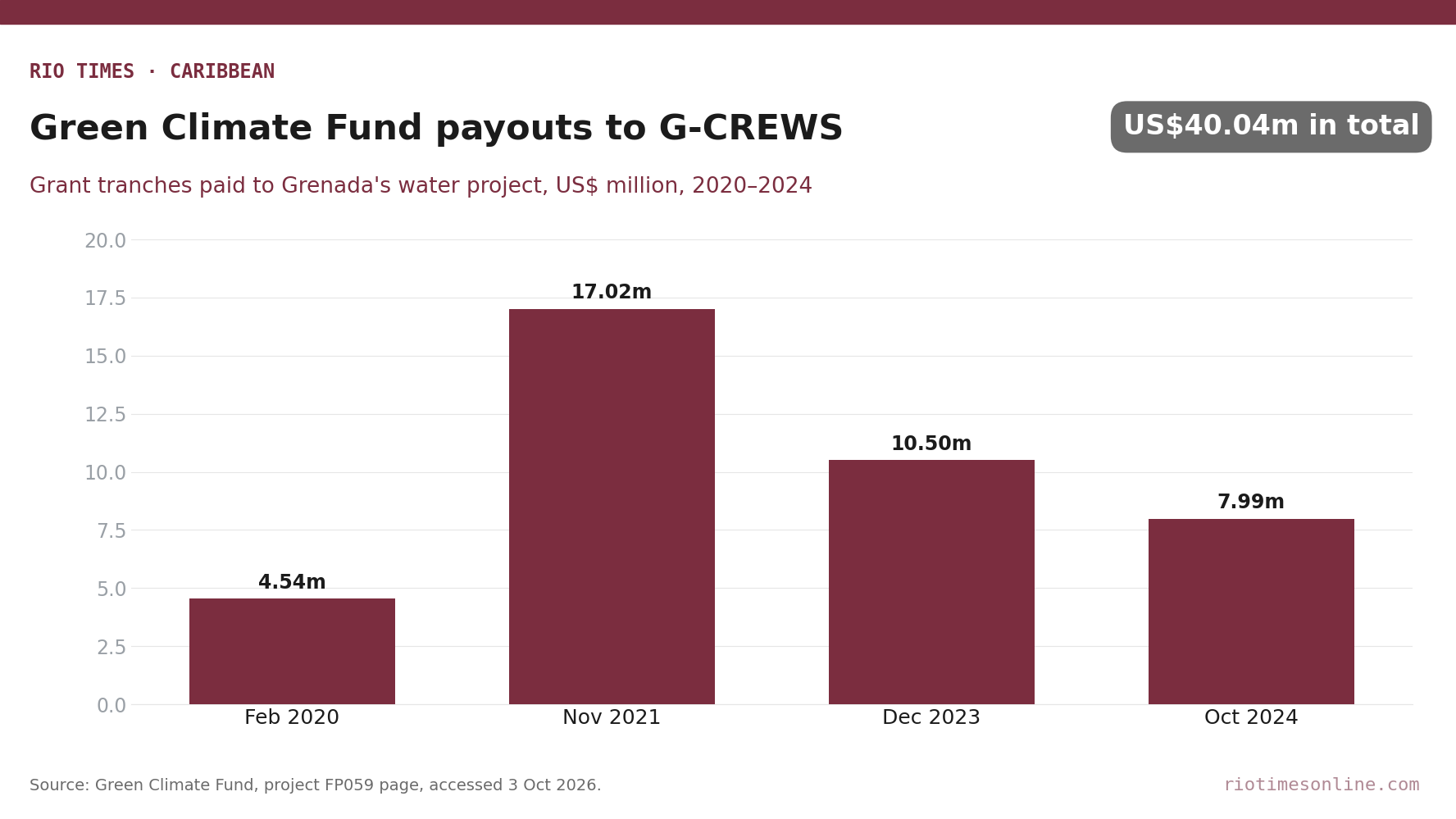
The GCF board approved the project on 1 March 2018, and implementation began in November 2019. The fund expects about 107,000 people to become more resilient to climate shocks as a result.
Why water infrastructure matters on small islands
Grenada relies heavily on surface water and rainwater catchment, the GCF notes. Rising temperatures, erratic rain and saltwater seeping into groundwater are making shortages worse.
Storage is the first line of defence when rain fails or a hurricane cuts supply. The wider project also funds new wells, rainwater harvesting, renewable-powered pumping and a climate-linked water tariff.
Progress, and what is behind schedule
The project’s 2025 annual report to the GCF, submitted in July 2026, records real gains. A new water resources law was gazetted in February 2025, and more than 50 local professionals were trained in climate-resilient plumbing.
The same report shows the heavy water infrastructure lagging. By the end of 2025, only two of eight planned hurricane-proof storage tanks had been commissioned.
The Seven Sisters transfer line, meant to serve 11,400 residents in south-eastern Grenada, was 62 percent complete at that point. The GCF page still lists 25 November 2025 as the implementation end date.
The commissioning lands as Grenada heads to a general election. The Supervisor of Elections said the election writ was received on 2 October.
What Is Not Yet Known
The ministry gave neither the ceremony date nor the cost of the Carriacou works, and its account is not independently confirmed. It is also unclear whether the two tanks count among the eight in the GCF plan.
No timeline or budget was given for the further desalination plant. The GCF has not published a revised end date for the project.
Election background is in Grenada Parliament to Dissolve, Election Date Due Sunday (2 October). Country context is in Grenada Explained 2026, the Spice Island at a Glance.
Sources: Ministry of Carriacou and Petite Martinique Affairs release, via NOW Grenada, 3 October 2026; Green Climate Fund, project FP059 (G-CREWS), accessed 3 October 2026; GIZ, 2025 Annual Performance Report for FP059, submitted 17 July 2026; Supervisor of Elections notice, via NOW Grenada, 3 October 2026.
Editorial responsibility: Matthias Camenzind, Editor-in-Chief · Editorial standards · Report an error
LatAm Markets: Live Signals → — real-time movers, turnover leaders and FX across Latin America.