Soybean Fund Falls 1.23% as Wheat Fund Drops 1.27% | Grains, Oct 26
Key Facts
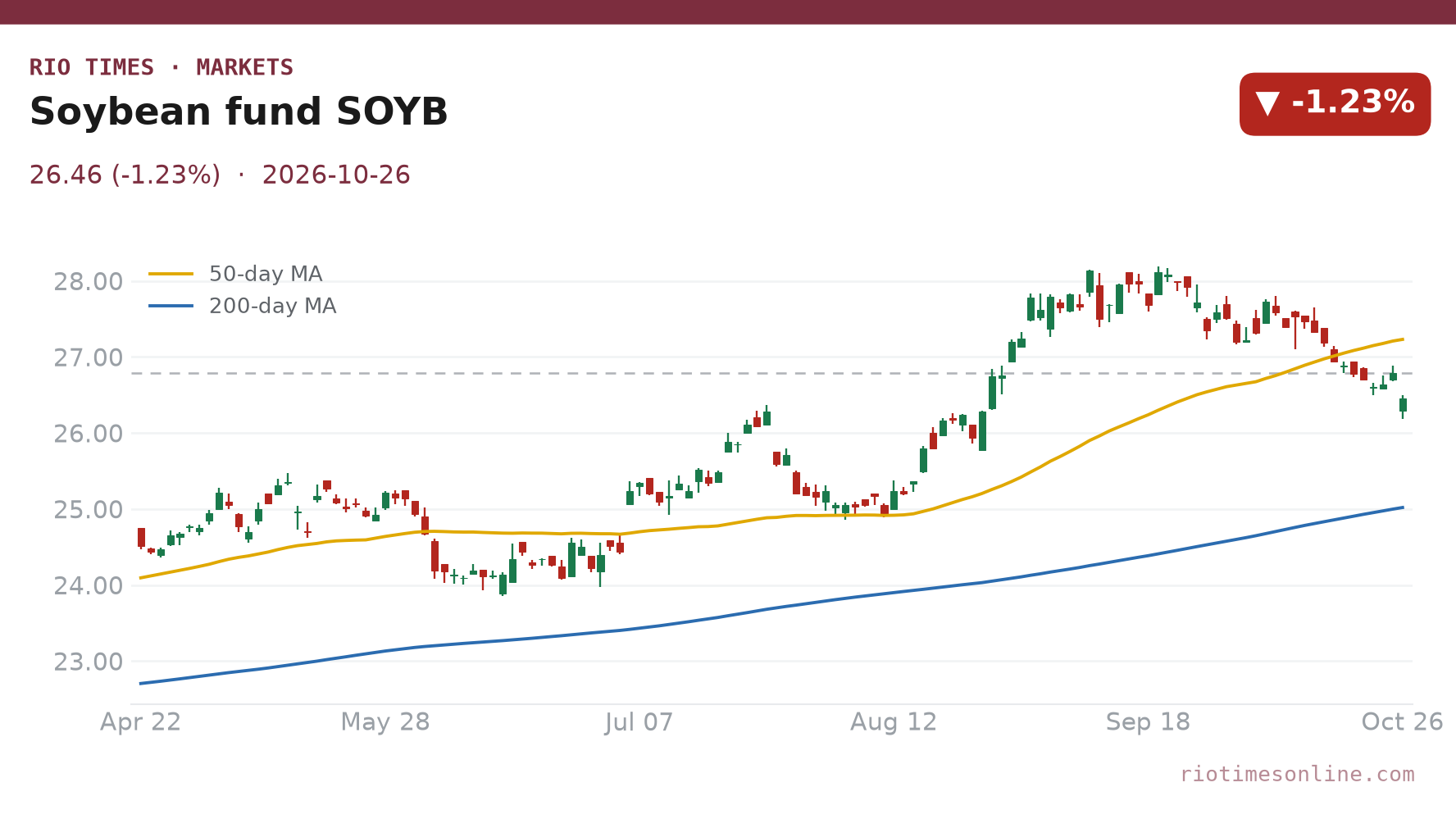
- SOYB, a soybean fund, fell 1.23% to US$26.46 on Monday, 26 October 2026.
- WEAT, a wheat fund, fell 1.27% to US$22.54, and CORN, a corn fund, fell 0.28% to US$17.63.
- DBA, a broad farm-goods fund, fell 0.97% to US$27.60.
- The dollar jumped 8.79% against Brazil’s real, which makes its exports cheaper abroad.
Today’s Focus
Grain funds fell on Monday as Brazil’s currency collapsed. SOYB, a fund that holds soybean futures, fell 1.23% to US$26.46, and WEAT, a wheat fund, fell 1.27% to US$22.54.
CORN, a corn fund, slipped 0.28% to US$17.63. DBA, a broad fund of farm commodities, lost 0.97% to US$27.60.
Brazil is the world’s largest soybean exporter, and a weaker real makes its crops cheaper in dollar terms.
What matters today. A sharply weaker real can lift Brazilian farmers’ margins and add export pressure on US grain prices, which is why US grain funds fell.
01 The session in one read
Grain proxies fell on Monday, 26 October 2026. Soybeans and wheat lost more than 1%, while corn was almost flat.
The US dollar jumped 8.79% against the Brazilian real to 5.4154, after President Lula’s re-election sent the Ibovespa down 13.88%.
We have no verified futures settlement for the session, so the board shows exchange-traded funds as proxies.
The evidence points to the real’s slide as a plausible driver of the grain-fund declines, because it makes Brazilian soybeans cheaper for buyers. We have no direct statement from traders, so this is an inference. The variable to watch is whether the real stabilises, which would remove the pressure.
02 The board
The grain board was lower. SOYB’s 1.23% fall to US$26.46 and WEAT’s 1.27% fall to US$22.54 were the largest.
CORN’s 0.28% dip to US$17.63 was small, and the broad DBA fund fell 0.97%.
| Asset | Level | Change |
|---|---|---|
| Soybeans (SOYB) | US$26.46 | -1.23% |
| Corn (CORN) | US$17.63 | -0.28% |
| Wheat (WEAT) | US$22.54 | -1.27% |
| Farm goods (DBA) | US$27.60 | -0.97% |
Source: RT close, 2026-10-26. Where a commodity has no spot feed, an exchange-traded tracker or leading producer is shown as a labelled proxy.
Live Market IntelligenceThe live market board
Rio Times · Live Market Intelligence
Latin America — Cross-Market Board
| Instrument | Last | Change | YoY | Prev. | High | Low | Volume |
|---|---|---|---|---|---|---|---|
| IBOV | 176,608.23 | -13.88% | +21.85% | 205,082.56 | 168,310 | 167,142 | — |
| IPSA | 10,575.59 | -1.59% | — | 10,746.36 | 11,210 | 10,984 | 1,513,213,483 |
| IPC MEX | 69,647.80 | -0.33% | +12.17% | 69,879.62 | 66,121 | 65,405 | 108,886,187 |
| MERVAL | 3,017,221 | — | +30.51% | 3,022,485 | 3,042,365 | 2,991,150 | — |
| COLCAP | 2,505.04 | -1.38% | — | 9.04 | 9.05 | 9.02 | 4,133 |
| BVL PERÚ | 57,093.72 | +0.04% | — | — | — | — | — |
| USD/BRL | 5.16 | +0.01% | -5.13% | 5.16 | 5.18 | 5.14 | — |
| EUR/BRL | 5.95 | +1.01% | -5.83% | 5.89 | 5.98 | 5.94 | — |
| USD/MXN | 17.06 | -0.24% | -8.58% | 17.10 | 17.08 | 17.01 | — |
| USD/CLP | 913.98 | +0.04% | -5.67% | 913.65 | 915.11 | 906.68 | — |
| USD/COP | 3,140 | +0.03% | -22.04% | 3,139 | 3,141 | 3,105 | — |
| USD/PEN | 3.36 | -0.66% | -4.82% | 3.38 | 3.38 | 3.35 | — |
| USD/ARS | 1,493 | +0.10% | +12.96% | 1,491 | 1,494 | 1,480 | — |
| USD/UYU | 40.27 | +1.24% | +1.80% | 39.77 | 40.27 | 40.23 | — |
| USD/PYG | 5,939 | +1.68% | -19.54% | 5,841 | 5,939 | 5,925 | — |
| USD/BOB | 11.64 | -0.76% | +72.04% | 11.73 | 11.72 | 11.64 | — |
| USD/DOP | 58.34 | +1.25% | -3.44% | 57.62 | 58.34 | 58.04 | — |
| USD/CRC | 445.92 | +0.89% | -9.71% | 441.97 | 448.50 | 445.92 | — |
03 What moved it
The sharpest development was the Brazilian currency. When the real falls, Brazilian farmers earn more reais per dollar of exports, which can encourage selling.
That competes with US exporters for buyers such as China, and pressures dollar prices. The move is an inference, not a confirmed cause.
US markets were steady, with the S&P 500 up 0.70% and the US dollar index, a gauge of the dollar against major currencies, up 0.22%. A firmer dollar also makes US grain dearer abroad.
04 The Latin American read
Brazil is the world’s largest soybean exporter, so its currency and politics matter to global grain prices.
Argentina is a major soy and corn exporter too. Its peso hit a record low of ARS1,541 per dollar, and its Merval fell 3.0%.
For farmers in both countries, a weaker currency raises local-currency income but also raises the cost of imported inputs.
05 The names to watch
SOYB at US$26.46 is the main proxy for soybean futures. WEAT at US$22.54 tracks wheat and CORN at US$17.63 tracks corn.
DBA at US$27.60 gives a broader read across farm commodities.
06 The outlook
Grain prices will follow weather, harvest progress and currencies in coming weeks. For now the Brazilian real is the variable that changed.
The Federal Reserve meets this week, and a firmer dollar would add pressure on US grains.
07 What to watch
- Brazilian real: Stabilisation would ease pressure on grain prices.
- Federal Reserve meeting: Rate guidance could move the dollar and grains.
- SOYB: Whether it holds above US$26.19, Monday’s low.
- Argentine peso: Its record low could prompt more export selling.
Frequently Asked Questions
Why did soybean funds fall?
A sharply weaker Brazilian real makes Brazil’s crops cheaper in dollars, which can pressure prices. This is our reading, not a confirmed cause.
What are SOYB, CORN and WEAT?
They are exchange-traded funds that hold soybean, corn and wheat futures contracts.
Why does Brazil’s currency matter for grains?
Brazil is the largest soybean exporter, so its exports compete with US crops when the real is weak.
Does this wrap state a futures settlement?
No. A verified futures settlement was not available for the session, so fund prices are shown.
Market data: RT
This article was produced by The Rio Times’ automated newsroom system. How we use AI · Report an error · Editorial responsibility: Matthias Camenzind, Editor-in-Chief
LatAm Markets: Live Signals → — real-time movers, turnover leaders and FX across Latin America.